
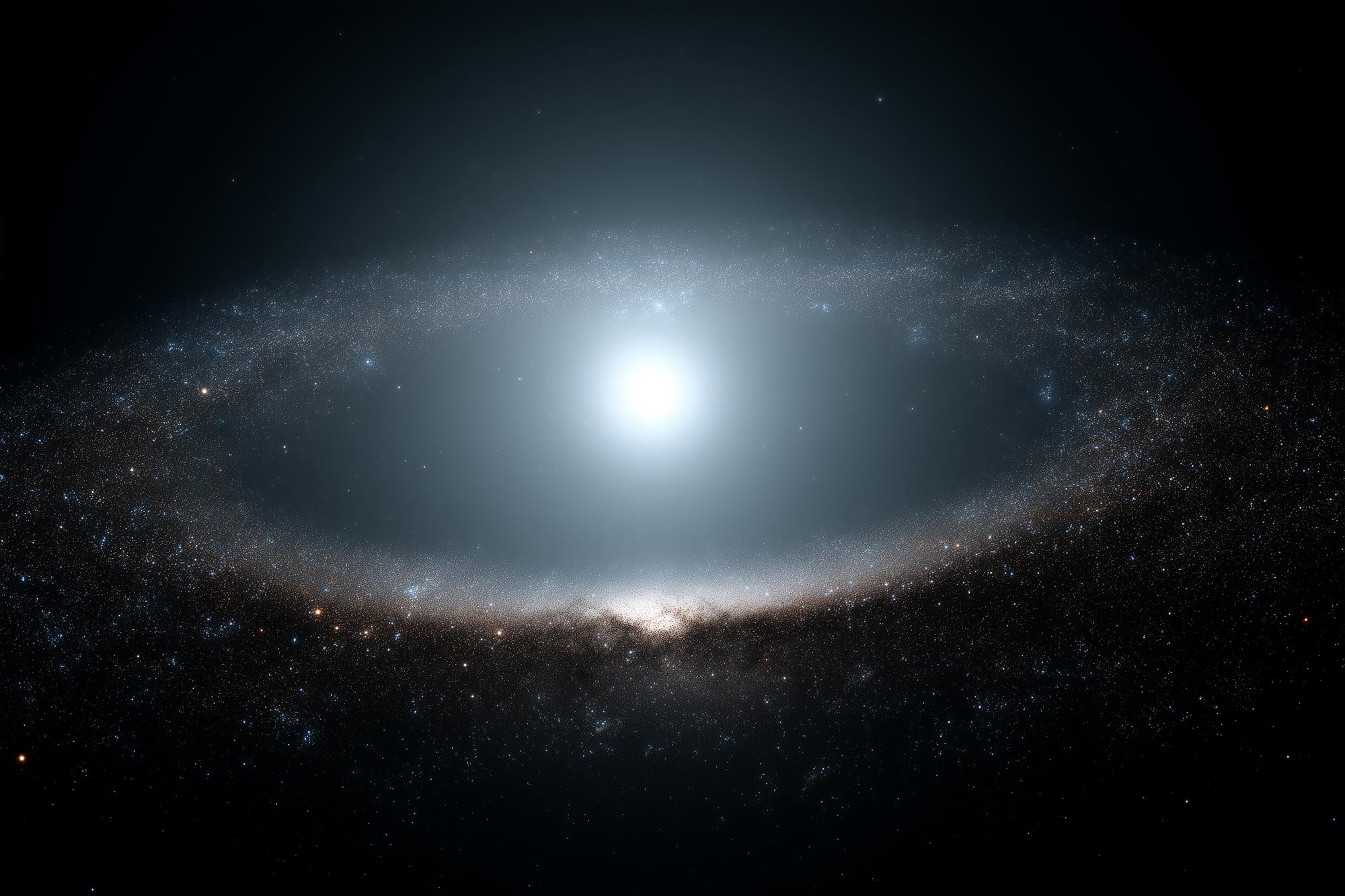
Astronomers using the James Webb Space Telescope may have found the universe’s first “dark stars.”
Within the first few hundred million years after the Big Bang, the universe’s earliest stars took shape from pristine clouds of hydrogen and helium. New observations from the James Webb Space Telescope (JWST) indicate that some of these primordial objects may have differed markedly from the regular (nuclear fusion-powered) stars that astronomers have observed and catalogued for millennia.
A recent study led by Cosmin Ilie of Colgate University, in collaboration with Shafaat Mahmud (Colgate ’26), Jillian Paulin (Colgate ’23) at UPenn, and Katherine Freese at The University of Texas at Austin, reports four extremely distant objects whose observed spectra and morphology are each consistent with supermassive dark stars.
“Supermassive dark stars are extremely bright, giant, yet puffy clouds made primarily out of hydrogen and helium, which are supported against gravitational collapse by the minute amounts of self-annihilating dark matter inside them,” Ilie said.
According to the researchers, supermassive dark stars and the black holes they leave behind could help resolve two active questions in astronomy: 1) why JWST is finding extremely bright yet compact galaxies at great distances that appear more common than expected, and 2) how the supermassive black holes powering the most distant quasars first formed.
From Theory to Observation
Freese developed the original theory behind dark stars with Doug Spolyar and Paolo Gondolo. Theypublished their first peer-reviewed paper on this theory in the journal Physical Review Letters/em> in 2008. In that paper, they envisioned how such dark stars might have led to supermassive black holes in the early universe. In a 2010 Astrophysical Journal publication, Freese, Ilie, Spolyar, and collaborators identified two mechanisms via which dark stars can grow to become supermassive, and predicted that they could seed the supermassive black holes powering many of the most distant quasars in the Universe.
Although dark matter makes up about 25% of the universe, its nature has eluded scientists. It is now widely believed that dark matter consists of a new type of elementary particle, yet to be observed or detected. While the hunt to detect such particles has been on for a few decades, no conclusive evidence has been found yet. Among the leading candidates for dark matter are Weakly Interacting Massive Particles. When they collide, these particles would theoretically annihilate themselves, depositing heat into collapsing clouds of hydrogen and converting them into brightly shining dark stars.
The conditions for the formation of dark stars were just right a few hundred million years after the Big Bang, and at the center of dark matter halos. This is when, and where the first stars in the universe are expected to have formed.
“For the first time, we have identified spectroscopic supermassive dark star candidates in JWST, including the earliest objects at redshift 14, only 300 Myr after the Big Bang,” said Freese, the Jeff and Gail Kodosky Endowed Chair in Physics and director of the Weinberg Institute and Texas Center for Cosmology and Astroparticle Physics at UT Austin. “Weighing a million times as much as the Sun, such early dark stars are important not only in teaching us about dark matter but also as precursors to the early supermassive black holes seen in JWST that are otherwise so difficult to explain.”
Discovering the Candidates
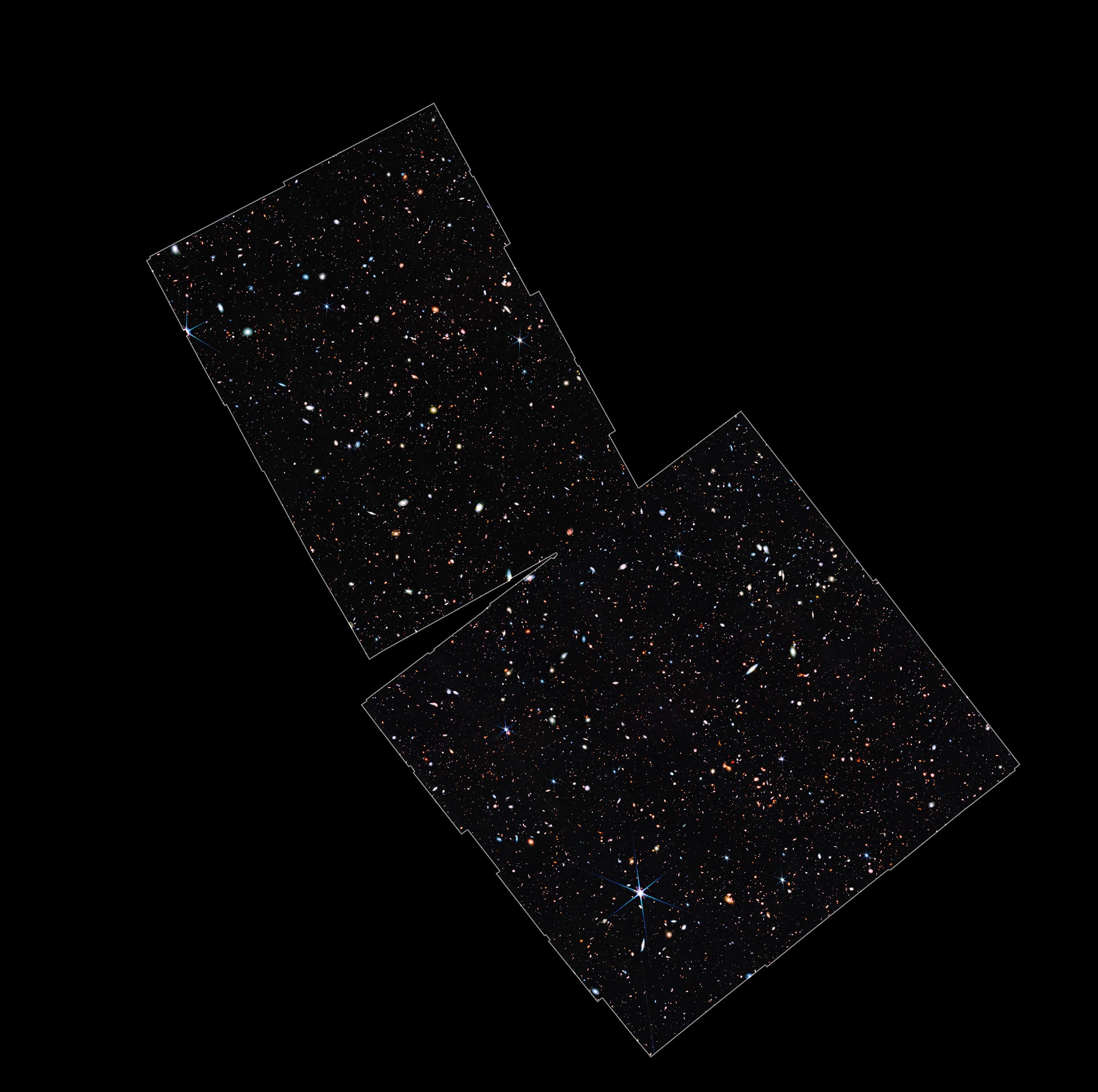
In a 2023 PNAS study by Ilie, Paulin, and Freese, the first supermassive dark star candidates (JADES-GS-z13-0, JADES-GS-z12-0, and JADES-GS-z11-0) were identified using photometric data from JWST’s NIRCam instrument. Since then, spectra from JWST’s NIRSpec instrument became available for those, and a few other extremely distant objects.
The team, which now also includes Shafaat Mahmud analyzed the spectra and morphology of four of the most distant objects ever observed (including two candidates from the 2023 study): JADES-GS-z14-0, JADES-GS-z14-1, JADES-GS-13-0, and JADES-GS-z11-0, and found that each of them is consistent with a supermassive dark star interpretation.
JADES-GS-z14-1 is not resolved, meaning it is consistent with a point source, such as a very distant supermassive star would be. The other three are extremely compact, and can be modeled by supermassive dark stars powering a nebula (i.e. ionized H and He gas surrounding the star). Each of the four objects analyzed in this study is also consistent with a galaxy interpretation, as shown in the literature. Dark stars have a smoking gun signature, an absorption feature at 1640 Angstrom, due to the large amounts of singly ionized helium in their atmospheres. And in fact, one of the four objects analyzed shows signs of this feature.
A Possible Breakthrough
“One of the most exciting moments during this research was when we found the 1640 Angstrom absorption dip in the spectrum of JADES-GS-z14-0. While the signal-to-noise ratio of this feature is relatively low (S/N~2), it is for the first time we found a potential smoking gun signature of a dark star. Which, in itself, is remarkable,” Ilie said.
Astronomers using the Atacama Large Millimeter/submillimeter Array (ALMA) measured the spectrum of the same object, revealing the presence of oxygen, via a nebular emission line. Researchers said that if both spectral features are confirmed, the object cannot be an isolated dark star, but rather may be a dark star embedded in a metal rich environment. This could be the outcome of a merger, where a dark matter halo hosting a dark star merges with a galaxy. Alternatively, dark stars and regular stars could have formed in the same host halo, as the researchers now realized it is possible.
The identification of supermassive dark stars would open up the possibility of learning about the dark matter particle based on the observed properties of those objects, and would establish a new field of astronomy: the study of dark matter-powered stars. This published PNAS research is a key step in this direction.
Reference: “Spectroscopic Supermassive Dark Star candidates” by Cosmin Ilie, Sayed Shafaat Mahmud, Jillian Paulin and Katherine Freese, 30 September 2025, Proceedings of the National Academy of Sciences.
DOI: 10.1073/pnas.2513193122
This research was made possible by generous funding from the following agencies: Colgate University Research Council, The Picker Interdisciplinary Sciences Institute, the U.S. Department of Energy’s Office of High Energy Physics program, Swedish Research Council, LSST Discovery Alliance, the Brinson Foundation, the WoodNext Foundation, and the Research Corporation for Science Advancement Foundation.
Never miss a breakthrough: Join the SciTechDaily newsletter.
Follow us on Google and Google News.
5 Comments
A simpler and more logical explanation is that the scientists still don’t know of, and factor-in, the true nature of externally induced radiant pulsing coherent angular attractive lines of gravity force varying in strength with the inverse-square law of attraction, and the less obvious effect that has on light. In my still formally unpublished model of gravity, individual photons accelerate (blueshift) on expanding lines of gravity force when emitted by a star and decelerate (redshift) on contracting lines when arriving to earth. Gravity ‘lensing’ is consistent with gravity lines of force affecting individual photons in deep space, as was/is the scattered dot pattern in Thomas Young’s double slit experiments. If I’m wrong, then where is the dark matter that causes the aluminum disks to rotate independently of the manually rotated aluminum arm in my most recent online video demonstrations (https://odysee.com/@charlesgshaver:d/5Gravity:c)?
The authors have had the same ‘dark star’ model since 2007, with increasing evidence against the model, particularly WIMPs as the DM core. Recently they’ve adopted self-interacting DM as an alternative, since SIDM provides a wider leverage to match observations (not necessarily a positive). The absorption signature measured that is predicted by the model has very low significance. No positive detection yet of DM core-powered dark stars…
The auto habit (that can be unlearned) – is constructing an idea and then becoming so tunnel-visioned that anything experiment provides is mentally morphed into a proof.
I agree. Every time there is a new observation that requires further analysis, people jump in with “it must be dark matter.” When the observations don’t match with prevailing hypotheses about dark matter, we come up with different types of dark matter. This is, as you aptly put it, tunnel vision.
Why do t people realize that light is going at light speed. I thought we all agreed anything traveling at light speed gets this time warp affect? Wouldn’t light also get affected by such a thing? Wouldn’t it them make since that such galaxies as we see aren’t really at such distances? And how would that work anyway something about the way we are thinking about how we are looking at such distances does t really mean such time. Cuz the stars are moving and the light is moving and the way we think about it just something doesn’t seem right