
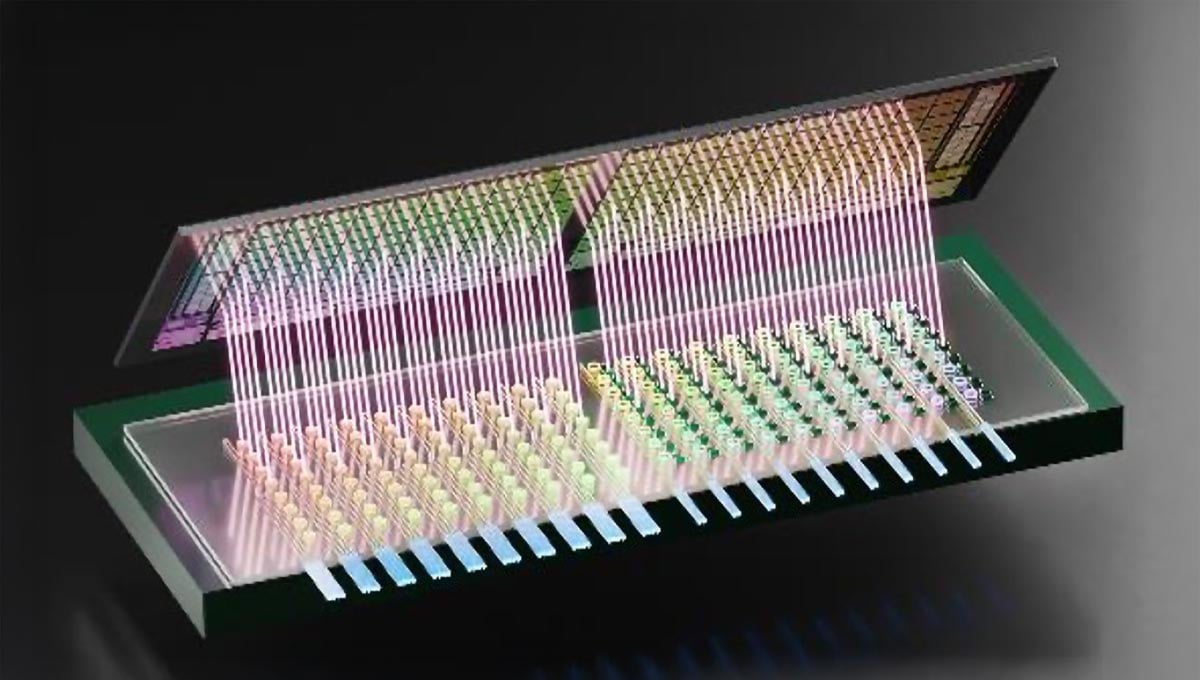
Columbia engineers have created a powerful 3D photonic-electronic chip that could overcome one of AI’s biggest hardware challenges: energy-hungry data transfer.
Their design combines light-based data movement with CMOS electronics to achieve unmatched efficiency and bandwidth. This breakthrough could reshape AI hardware, enabling smarter systems that move data faster while using far less energy—key for future technologies like autonomous vehicles, massive AI models, and beyond.
Breaking AI’s Energy Barrier
Artificial intelligence (AI) holds the potential to drive major technological breakthroughs, but its progress has been slowed by energy inefficiencies and data transfer bottlenecks. Now, researchers at Columbia Engineering have developed a promising solution: a 3D photonic-electronic platform that dramatically improves both energy efficiency and bandwidth density. These are key steps toward building faster, more capable AI hardware.
The work, published in Nature Photonics and led by Keren Bergman, Charles Batchelor Professor of Electrical Engineering, introduces a novel approach that combines photonics with advanced complementary metal-oxide-semiconductor (CMOS) electronics. This integration enables high-speed, energy-efficient data communication and directly tackles one of AI’s biggest hardware limitations: moving large amounts of data quickly without draining power.
Crushing the Data Transfer Limit
“In this work, we present a technology capable of transferring vast volumes of data with unprecedentedly low energy consumption,” said Bergman. “This innovation breaks through the long-standing energy barrier that has limited data movement in traditional computer and AI systems.”

The Columbia Engineering team collaborated with Alyosha Christopher Molnar, Ilda and Charles Lee Professor of Engineering at Cornell University, to develop a 3D-integrated photonic-electronic chip that boasts a high density of 80 photonic transmitters and receivers within a compact chip footprint. This platform delivers high bandwidth (800 Gb/s) with exceptional energy efficiency, consuming just 120 femtojoules per bit. With a bandwidth density of 5.3 Tb/s/mm², this innovation far exceeds existing benchmarks.
Designed for low cost, the chip integrates photonic devices with CMOS electronic circuits and leverages components manufactured in commercial foundries, setting the stage for widespread industry adoption.
Reshaping AI Infrastructure at the Core
The team’s research redefines how data is transmitted between compute nodes, addressing the long-standing bottlenecks in energy efficiency and scalability. By 3D integrating photonic and electronic chips, this technology achieves unmatched energy savings and high bandwidth density, breaking free from traditional data locality constraints. This innovative platform enables AI systems to efficiently transfer vast volumes of data, supporting distributed architectures that were previously impractical due to energy and latency limitations.
Beyond AI: A New Era for Computing
The resulting advancements are poised to unlock unprecedented levels of performance, making this technology a cornerstone of future computing systems across applications, from large-scale AI models to real-time data processing in autonomous systems. Beyond AI, this approach holds transformative potential for high-performance computing, telecommunications, and disaggregated memory systems, signaling a new era of energy-efficient, high-speed computing infrastructure.
Reference: “Three-dimensional photonic integration for ultra-low-energy, high-bandwidth interchip data links” by Stuart Daudlin, Anthony Rizzo, Sunwoo Lee, Devesh Khilwani, Christine Ou, Songli Wang, Asher Novick, Vignesh Gopal, Michael Cullen, Robert Parsons, Kaylx Jang, Alyosha Molnar and Keren Bergman, 21 March 2025, Nature Photonics.
DOI: 10.1038/s41566-025-01633-0
The collaborative research included contributions from Cornell University’s Molnar lab, the Air Force Research Laboratory, and Dartmouth College. The project received funding from the Defense Advanced Research Projects Agency (DARPA) and the Advanced Research Projects Agency-Energy (ARPA-E), underscoring its critical role in advancing national technological capabilities.
Never miss a breakthrough: Join the SciTechDaily newsletter.
Follow us on Google and Google News.
1 Comment
If this news is true, shouldn’t it be a good news for all computing, and not just AI? Like, I could use some of that at home.
Every narrative in IT seems to be shaped around AI, but AI is not be all end all.