

Fossil tracks from Australia reveal reptiles appeared 40 million years earlier than thought.
The origin of reptiles on Earth may be up to 40 million years earlier than previously believed, based on new evidence from a significant fossil site in Australia.
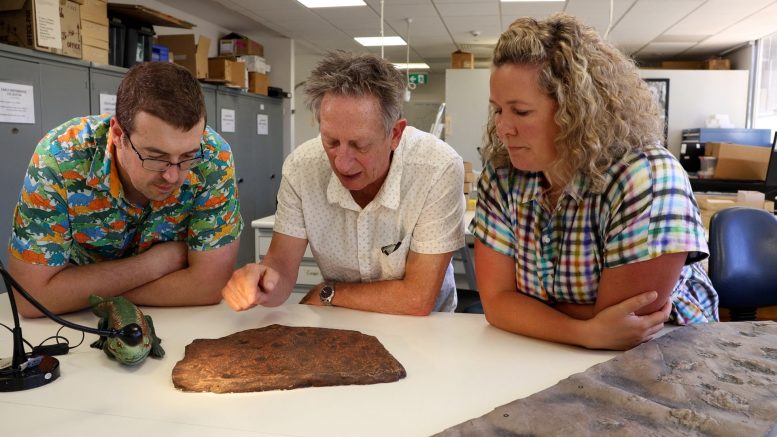
Flinders University Professor John Long and his team have identified fossilized tracks made by an amniote with clawed feet, most likely a reptile, dating back to the Carboniferous period, around 350 million years ago.
“Once we identified this, we realized this is the oldest evidence in the world of reptile-like animals walking around on land – and it pushes their evolution back by 35-to-40 million years older than the previous records in the Northern Hemisphere,” says Professor Long, Strategic Professor in Paleontology at Flinders.

Evidence from Gondwana shifts global timeline
Published in the journal Nature, the discovery suggests that these animals originated on the ancient southern supercontinent Gondwana, with Australia at its center.
The fossil tracks, found in the Mansfield district of northern Victoria, Australia, were likely made by a small, stumpy animal that Professor Long describes as resembling a Goanna.
“The implications of this discovery for the early evolution of tetrapods are profound,” says Professor Long.
“All stem-tetrapod and stem-amniote lineages must have originated during the Devonian period – but tetrapod evolution proceeded much faster, and the Devonian tetrapod record is much less complete than we have believed.”
New data challenge accepted fossil record
Fossil records of crown-group amniotes – the group that includes mammals, birds, and reptiles – begin in the Late Carboniferous period (about 318 million years old), while previously the earliest body fossils of crown-group tetrapods were from about 334 million years ago, and the oldest trackways were about 353 million years old.
This suggests the modern tetrapod group originated in the early Carboniferous period, with the modern amniote group appearing in the early part of the Late Carboniferous period.
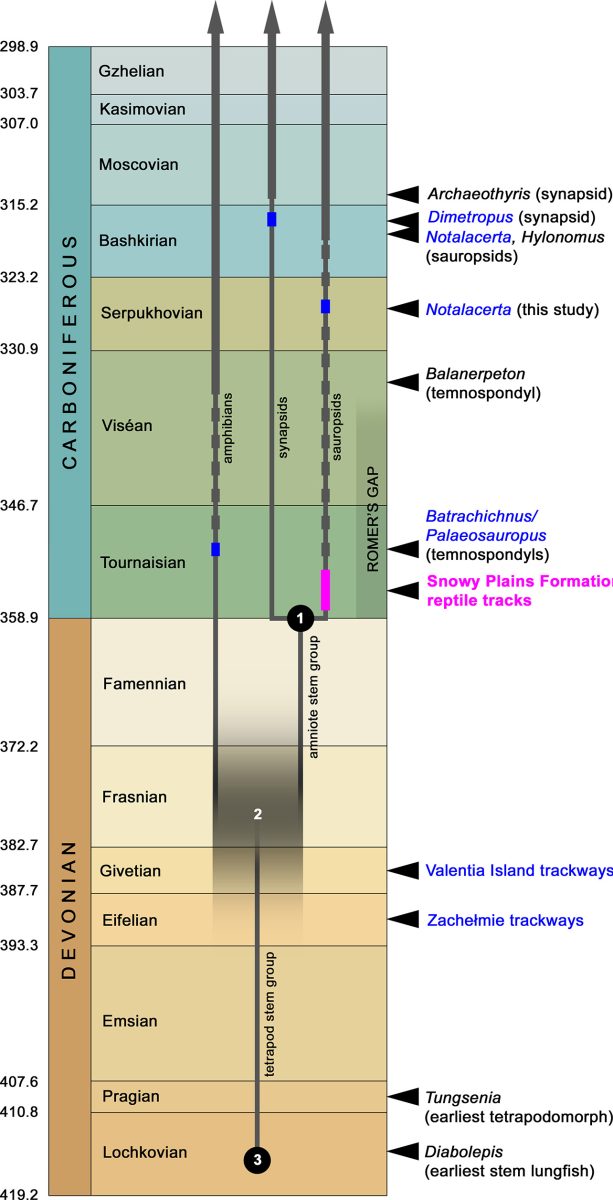
“We now present new trackway data from Australia that falsify this widely accepted timeline,” says Professor Long, who worked with Australian and international experts on the major Nature journal paper.
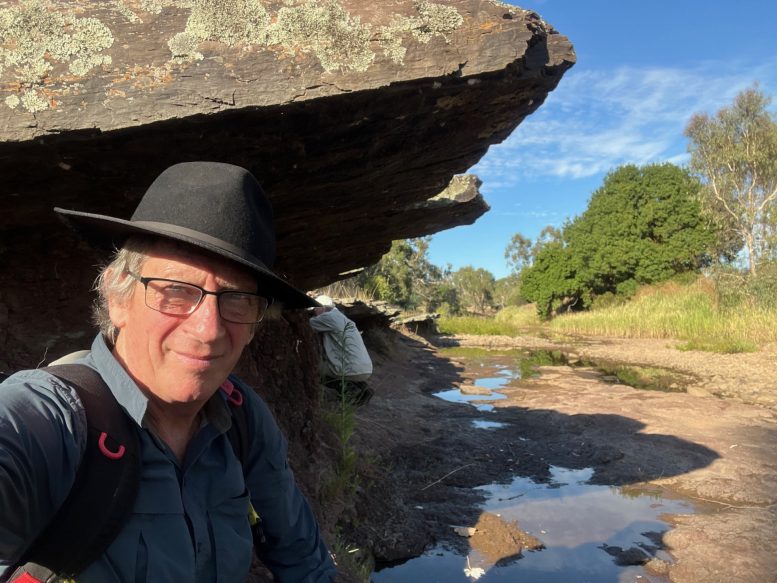
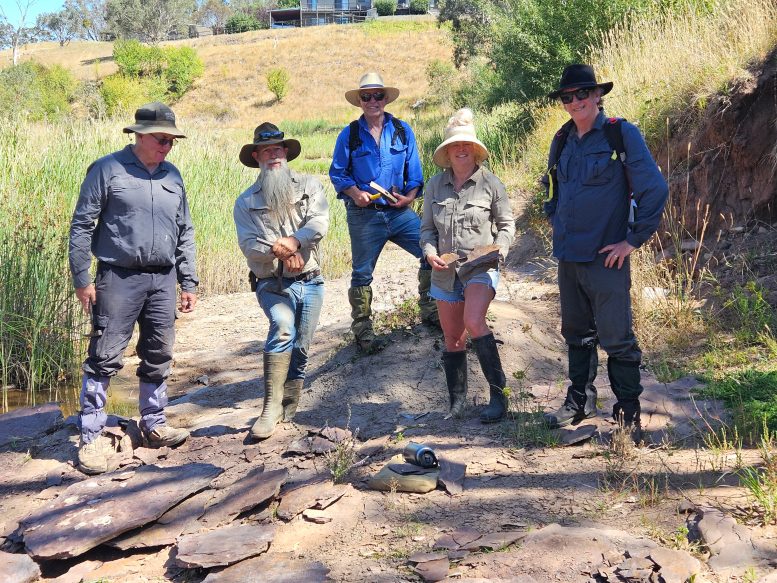
“My involvement with this amazing fossil find goes back some 45 years, when I did my PhD thesis on the fossils of the Mansfield district, but it was only recently after organizing paleontology field trips to this area with Flinders University students that we got locals fired up to join in the hunt for fossils.
“Two of these locals – Craig Eury and John Eason (coauthors on the paper) – found this slab covered in trackways and, at first, we thought they were early amphibian trackways, but one in the middle has a hooked claw coming off the digits, like a reptile – an amniote, in fact.
“It was amazing how crystal clear the trackways are on the rock slab. It immediately excited us, and we sensed we were onto something big – even though we had no idea just how big it is.”
A team effort leads to breakthrough discovery
The Flinders paleontology team working on this project included Dr. Alice Clement, who scanned the fossil footprints to create digital models that were then analyzed in detail, working closely with a team from Uppsala University led by Professor Per Erik Ahlberg, a member of the Royal Swedish Academy of Sciences.
“We study rocks and fossils of the Carboniferous and Devonian age with specific interest to observe the very important fish-tetrapod transition,” says Dr. Clement.
“We’re trying to tease apart the details of how the bodies and lifestyles of these animals changed, as they moved from being fish that lived in water, to becoming tetrapods that moved about on land.”
Another coauthor, Dr. Aaron Camens, who studies animal trackways from around Australia, produced heatmaps that explain details of the fossil footprints much more clearly.
“A skeleton can tell us only so much about what an animal could do, but a trackway actually records its behavior and tells us how this animal was moving,” says Dr. Camens.
Mansfield’s long search finally pays off
Because Professor Long had been studying ancient fish fossils of this area since 1980, he had a clear idea of the age of rock deposits in the Mansfield district, from the Carboniferous period, which started about 359 million years ago.
“The Mansfield area has produced many famous fossils, beginning with spectacular fossil fishes found 120 years ago, and ancient sharks. But the holy grail that we were always looking for was evidence of land animals, or tetrapods, like early amphibians. Many had searched for such trackways, but never found them – until this slab arrived in our laboratory to be studied.
“This new fossilized trackway that we examined came from the early Carboniferous period, and it was significant for us to accurately identify its age – so we did this by comparing the different fish faunas that appear in these rocks with the same species and similar forms that occur in well-dated rocks from around the world, and that gave us a time constraint of about 10 million years.”
La Trobe University’s Dr. Jillian Garvey, who liaised with the Taungurung Land and Waters Council for the study, has researched in the Mansfield basin since the early 2000s.
“This discovery rewrites this part of evolutionary history,” Dr. Garvey says. “It indicates there is so much that has happened in Australia and Gondwana that we are still yet to uncover.”
Reference: “Earliest amniote tracks recalibrate the timeline of tetrapod evolution” by John A. Long, Grzegorz Niedźwiedzki, Jillian Garvey, Alice M. Clement, Aaron B. Camens, Craig A. Eury, John Eason and Per E. Ahlberg, 14 May 2025, Nature.
DOI: 10.1038/s41586-025-08884-5
Funding: Australian Research Council
Never miss a breakthrough: Join the SciTechDaily newsletter.
Follow us on Google and Google News.
1 Comment
Ozarks Primori Repo skull has been found in West Fork Ar. USA. 320 MY Belived to be a Carboniferous Pennsylvanian age tetrapod diadectes. I have the largest collection of Carboniferous fossils in Arkansas .This area is Pitkin formation and outcrops of brachipods and asterosomas,lepododendron etc. are found locally.