

Footprints from Australia show reptiles may have evolved 35 million years earlier than thought, changing the timeline of tetrapod evolution.
A remarkable discovery in Australia is reshaping what we know about the origins of reptiles. Scientists have uncovered fossilized footprints with long toes and sharp claws preserved in a 355-million-year-old rock slab. These tracks are the oldest evidence of reptiles ever found, pushing their origin back by a staggering 35 million years.
This game-changing find challenges long-held views about when and how backboned animals, known as tetrapods, first made their move onto land. The research, led by a team at Uppsala University in Sweden, has been published in the journal Nature.
Not only does this discovery upend the evolutionary timeline, but it also opens up new questions about how early reptiles lived and evolved. These ancient footprints offer a rare glimpse into a distant past when life was just beginning to take hold on land.
“I’m stunned,” says Per Ahlberg of Uppsala University, who coordinated the study. “A single track-bearing slab, which one person can lift, calls into question everything we thought we knew about when modern tetrapods evolved.”

The origin story of tetrapods begins with fish leaving the water and ends with their descendants adapting to life on land, eventually giving rise to modern amphibians and amniotes—the group that includes reptiles, birds, and mammals. Until now, the timeline appeared straightforward: the first tetrapods emerged during the Devonian period, and the earliest members of modern groups followed in the Carboniferous.
The oldest known amniote fossils date to about 320 million years ago, leading researchers to believe that the split between amphibians and amniotes—known as the tetrapod crown-group node—occurred in the early Carboniferous, around 355 million years ago. The Devonian was thought to be dominated by more primitive, fish-like tetrapods and transitional species like Tiktaalik.
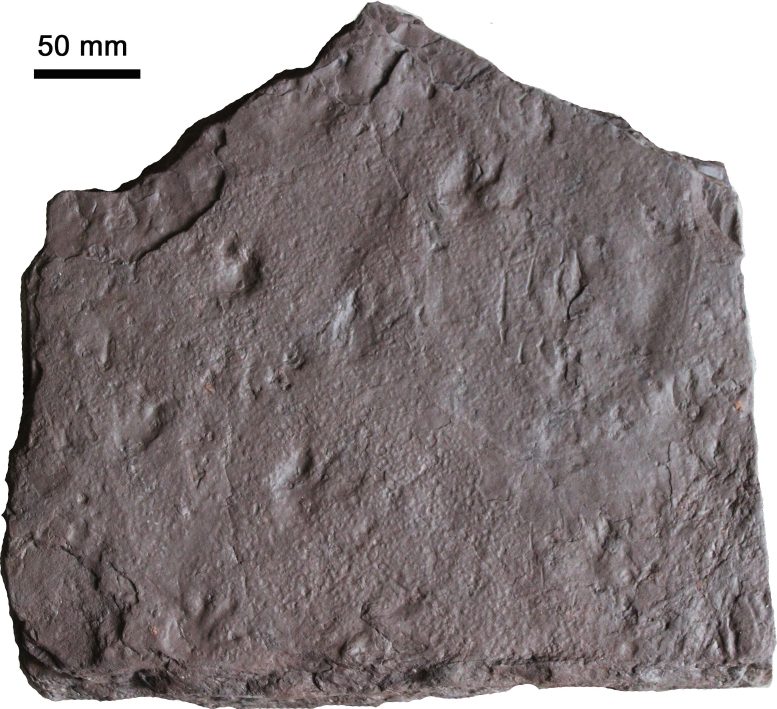
The earliest clawed footprints ever found
A sandstone slab from the earliest Carboniferous period in Australia, dating to around 355 million years ago, now challenges this view. Discovered by two amateur palaeontologists who co-authored the study, the slab contains well-preserved footprints with long toes and clearly defined claw marks at the tips. These represent the oldest known clawed footprints ever found.

“When I saw this specimen for the first time, I was very surprised, after just a few seconds I noticed that there were clearly preserved claw marks,” says Grzegorz Niedźwiedzki of Uppsala University, co-author of the study.
“Claws are present in all early amniotes, but almost never in other groups of tetrapods,” adds Per Ahlberg; “The combination of the claw scratches and the shape of the feet suggests that the track maker was a primitive reptile.”
New trackways push reptile origins back
If this interpretation is correct, it pushes the origin of reptiles, and thus amniotes as a whole, back by 35 million years to the earliest Carboniferous. Further support comes from new fossil reptile footprints from Poland, also presented in the study; not as old as those from Australia, but also substantially older than previous records. This recalibration of the origin of reptiles impacts the whole timeline of tetrapod evolution. The tetrapod crown-group node must be older than the earliest amniotes, because it is a deeper branching point in the tree, but how old exactly? The authors address this problem by combining data from fossils and modern DNA.

“It’s all about the relative length of different branches in the tree,” explains Per Ahlberg, “In a family tree based on DNA data from living animals, branches will have different lengths reflecting the number of genetic changes along each branch segment. This does not depend on fossils, so it’s really helpful for studying phases of evolution with a poor fossil record.”

Revising what we thought about early tetrapods
Their analysis, overlaying branch lengths from DNA analyses onto the known fossil dates, indicates that the tetrapod crown group node lies far back in the Devonian, roughly contemporary with Tiktaalik. This means that a diversity of advanced tetrapods existed at a time when, it has been thought, only transitional ‘fishapods’ were dragging themselves around muddy shorelines and starting in a small way to explore the land. But perhaps that should not surprise us.
“The Australian footprint slab is about 50 cm across”, says Per Ahlberg, “and at present it represents the entire fossil record of tetrapods from the earliest Carboniferous of Gondwana – a gigantic supercontinent comprising Africa, South America, Antarctica, Australia, and India. Who knows what else lived there?”
“The most interesting discoveries are yet to come and that there is still much to be found in the field. These footprints from Australia are just one example of this,” says Grzegorz Niedźwiedzki.
Reference: “Earliest amniote tracks recalibrate the timeline of tetrapod evolution” by John A. Long, Grzegorz Niedźwiedzki, Jillian Garvey, Alice M. Clement, Aaron B. Camens, Craig A. Eury, John Eason and Per E. Ahlberg, 14 May 2025, Nature.
DOI: 10.1038/s41586-025-08884-5
Funding: European Research Council, Australian Research Council
Never miss a breakthrough: Join the SciTechDaily newsletter.
Follow us on Google and Google News.
1 Comment
Link here naming amateur discoverers, with location –
https://www.abc.net.au/news/science/2025-05-15/fossil-footprints-early-animal-ancestors-discovered-victoria/105275336