
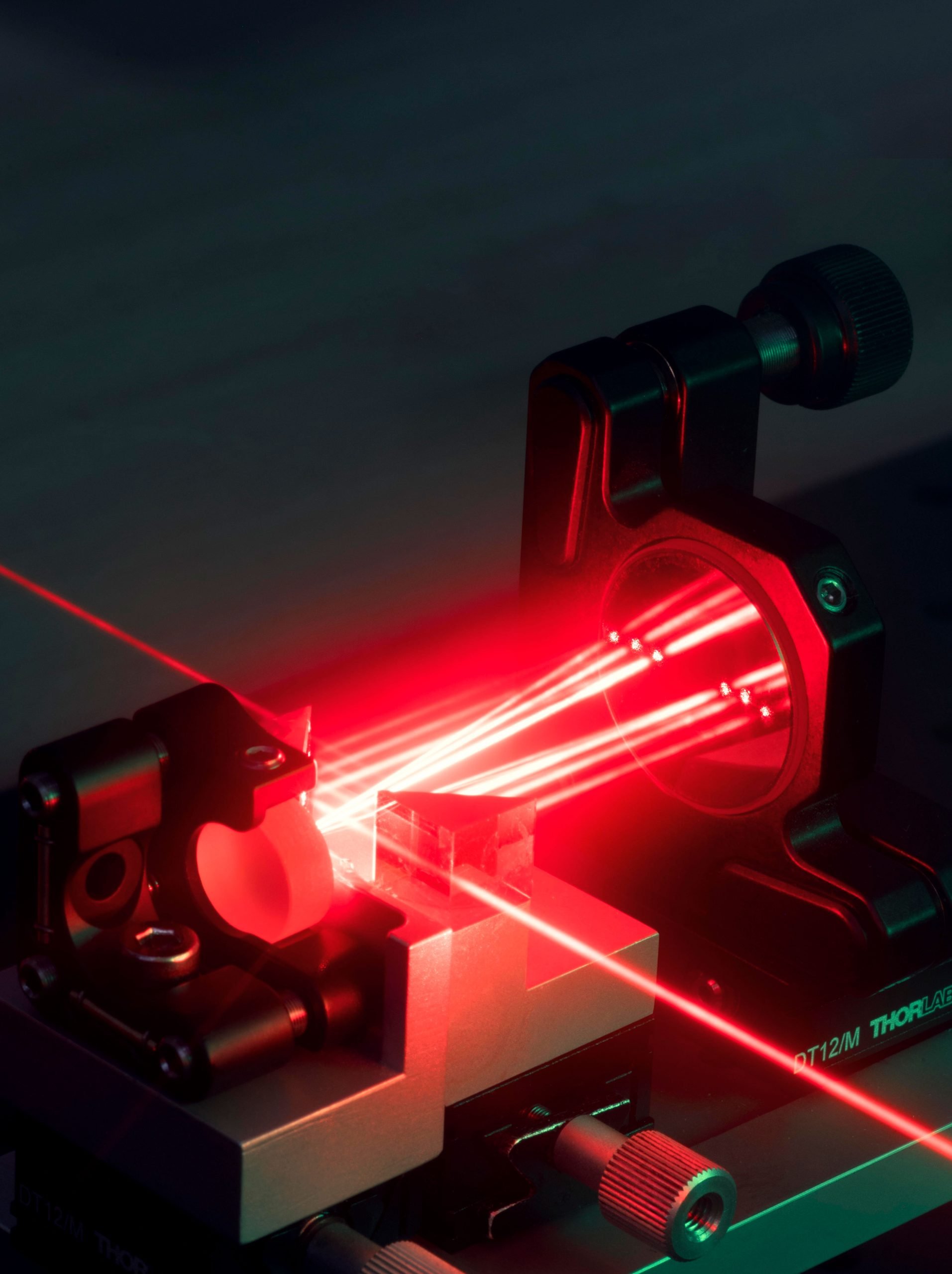
Researchers have developed an innovative and versatile system designed for a new generation of short-pulse lasers.
Lasers that produce extremely short bursts of light are known for their remarkable precision, making them indispensable tools in manufacturing, medical technology, and scientific research. However, creating short-pulse lasers that are both powerful and efficient typically requires large, complex, and costly setups.
A research team at the University of Stuttgart, working in collaboration with Stuttgart Instruments GmbH, has now overcome this challenge. Their newly developed laser system is more than twice as efficient as existing designs, small enough to fit in the palm of a hand, and adaptable for a variety of uses. Details of their innovation have been published in the journal Nature.
Eighty percent efficiency is possible
“With our new system, we can achieve levels of efficiency that were previously almost unattainable,” says Prof. Harald Giessen, Head of the 4th Physics Institute at the University of Stuttgart.
In their experiments, the researchers showed that it is fundamentally possible to reach an 80% efficiency rate with a short-pulse laser. In practical terms, this means that 80% of the energy supplied to the system can be effectively utilized.
“For comparison: current technologies achieve only about 35%—which means they lose much of their efficiency and are correspondingly expensive,” explains Giessen.
A lot of energy in an extremely short time
Short-pulse lasers emit bursts of light lasting only nano-, pico-, or femtoseconds (i.e., a few billionths to quadrillionths of a second). This capability enables them to deliver immense energy to a very small area in an incredibly brief period.
The process involves two lasers working in tandem: a pump laser and the short-pulse laser. The pump laser channels light energy into a special crystal that forms the core of the system. This crystal transfers energy from the pump laser to an ultrashort signal pulse, converting the incoming light particles into infrared light.
The result is a tool that can perform experiments, measurements, and production tasks not possible with visible light. In manufacturing, these lasers are used for ultra-precise and delicate material processing. In medicine, they enable advanced imaging techniques, while in quantum research, they allow scientists to conduct exceptionally precise measurements at the molecular scale.
Synchronize laser amplification and bandwidth
“Designing short-pulse lasers efficiently remains an unsolved challenge,” explains Dr. Tobias Steinle, lead author of the study. “In order to generate short pulses, we need to amplify the incoming light beam and cover a wide range of wavelengths.” Until now, it has not been possible to combine both properties simultaneously in a small and compact optical system.”
Laser amplifiers with a wide bandwidth require special crystals that are particularly short and thin. Efficient amplifiers, on the other hand, require especially long crystals. Connecting several short crystals in series is one possible way to combine both. It is already being pursued in research. The key is to ensure that the pulses from the pump laser and the signal laser remain synchronized.
New multipass concept
Researchers have now solved this problem with a new multipass procedure. Instead of using a single long crystal or many short crystals, they use a single short crystal and repeatedly run the light pulses through this crystal in their optical parametric amplifier.
Between two passes through the crystal, the separated pulses are precisely realigned so that they remain synchronized. The system can generate pulses shorter than 50 femtoseconds, occupies only a few square centimeters, and consists of just five components.
Highly versatile
“Our multipass system demonstrates that extremely high efficiencies need not to come at the expense of bandwidth,” explains Steinle. “It can replace large and expensive laser systems with high power losses, which were previously required to amplify ultrashort pulses.”
The new system is highly versatile and can be adapted to other wavelength ranges beyond infrared light as well as to different crystal systems and pulse durations. With this concept, the researchers aim to build small, lightweight, compact, portable, and tunable lasers capable of precisely adjusting wavelengths. They see potential areas of application in medicine, analytics, gas sensor technology, and environmental research.
Reference: “Dispersion-engineered multipass optical parametric amplification” by Jan H. Nägele, Tobias Steinle, Johann Thannheimer, Philipp Flad and Harald Giessen, 5 November 2025, Nature.
DOI: 10.1038/s41586-025-09665-w
The study was supported by the Federal Ministry of Research, Technology and Space (BMFTR) as part of the KMU-Innovativ funding line, the Federal Ministry for Economic Affairs and Energy (BMWE), the Baden-Wuerttemberg Ministry of Science, Research and the Arts, the German Research Foundation (DFG), the Carl Zeiss Foundation, the Baden-Wuerttemberg Foundation, the Center for Integrated Quantum Science and Technology (IQST), and the Innovation Campus Mobility of the Future (ICM). It was carried out by the 4th Physics Institute of the University of Stuttgart in cooperation with Stuttgart Instruments GmbH as part of the MIRESWEEP project (a novel, cost-effective tunable mid-infrared laser source for analytical applications).
Never miss a breakthrough: Join the SciTechDaily newsletter.
Follow us on Google and Google News.
7 Comments
Star Trek hand held lasers are soon to become available for Space Force usage. THE future is here NOW.
Alternate usage would be space based lasers for the Golden Dome antiballistic missle defense. The current size laser is the size of an athletic gym.
Details of their innovation have been published in the journal Nature. Innovation is certainly valuable, but the journal Nature do not necessarily represent science.
When we pursue the ultimate truth of all things, the space in which our bodies and all things exist may itself be the final and deepest puzzle we need to explore. This is not only the pursuit of physics, but also the most magnificent exploration of the origin of the universe by human reason.
Based on the Topological Vortex Theory (TVT), space is an uniformly incompressible physical entity. Space-time vortices are the products of topological phase transitions of the tipping points in space, are the point defects in spacetime. Point defects do not only impact the thermodynamic properties, but are also central to kinetic processes. They create all things and shape the world through spin and self-organization.
In today’s physics, some so-called peer-reviewed journals—including Physical Review Letters, Nature, Science, and others—stubbornly insist on and promote the following:
1. Even though θ and τ particles exhibit differences in experiments, physics can claim they are the same particle. This is science.
2. Even though topological vortices and antivortices have identical structures and opposite rotational directions, physics can define their structures and directions as entirely different. This is science.
3. Even though two sets of cobalt-60 rotate in opposite directions and experiments reveal asymmetry, physics can still define them as mirror images of each other. This is science.
4. Even though vortex structures are ubiquitous—from cosmic accretion disks to particle spins—physics must insist that vortex structures do not exist and require verification. Only the particles that like God, Demonic, or Angelic are the most fundamental structures of the universe. This is science.
5. Even though everything occupies space and maintains its existence in time, physics must still debate and insist on whether space exists and whether time is a figment of the human mind. This is science.
6. Even though space, with its non-stick, incompressible, and isotropic characteristics, provides a solid foundation for the development of physics, physics must still insist that the ideal fluid properties of space do not exist. This is science.
and go on.
Is this the counterintuitive science they widely promote? Compromising with pseudo academic publications and peer review by pseudo scholars is an insult to science and public intelligence. Some so-called scholars no longer understand what shame is. The study of Topological Vortex Theory (TVT) reminds us that the most profound problems in physics often lie at the intersection of different theories. By exploring these border regions, we can not only resolve contradictions in existing theories but also discover new physical phenomena and application possibilities.
Under the topological vortex architecture, it is highly challenging for even two hydrogen atoms or two quarks to be perfectly symmetrical, let alone counter-rotating two sets of cobalt-60. Contemporary physics and so-called peer-reviewed publications (including Physical Review Letters, Science, Nature, etc.) stubbornly believe that two sets of counter rotating cobalt-60 are two mirror images of each other, constructing a more shocking pseudoscientific theoretical framework in the history of science than the “geocentric model”. This pseudo scientific framework and system have seriously hindered scientific progress and social development.
For nearly a century, physics has been manipulated by this pseudo scientific theoretical system and the interest groups behind it, wasting a lot of manpower, funds, and time. A large amount of pseudo scientific research has been conducted, and countless pseudo scientific papers have been published, causing serious negative impacts on scientific and social progress, as well as humanistic development.
Complexity does not necessarily mean that there is no logical and architectural framework to follow. Mathematics is the language and tool that reveals the motion of spacetime, rather than the motion itself. Although the physical form of spacetime vortices is extremely simple, their interaction patterns are highly complex, and we must develop more and richer mathematical languages to describe and understand them.
The development of the Topological Vortex Theory (TVT) reflects a progression from concrete physical phenomena to abstract mathematical modeling and, ultimately, to interdisciplinary unification.
——Excerpted from https://t.pineal.cn/blogs/4569/An-Overview-of-the-Development-of-Topological-Vortex-Theory-TVT.
Very good reply, however, it is a non-sequitur reply to this article. Your replies are consistently about the same theories. This indicates you are either a frustrated author unable to convince others of your theory, or an AI in search of promoting it. I posit that this forum is an inappropriate place for such a search.
Thank you for browsing.
Exposing rampant pseudoscience requires more people and media participation. Although lifting the fig leaf may make some people feel disgusted, it is still necessary for scientific and social progress, as well as humanistic development. The purpose is also to make the public fully aware of the dirtiness and ugliness behind the grandiose appearance of certain so-called peer-reviewed publications.
Publishing articles in so-called prestigious journals has become a deeply ingrained habit among some people in the academic community. Some so-called prestigious journals are neither scientific nor honest, their interests are solidified, and they have long fallen into a fig leaf for certain individuals and groups. However, not all the public are fools, it’s just that those who love to run naked never know what shame is. Please ask every person who truly loves science to seriously consider, and answer these questions publicly based on your understanding:
1. Even though θ and τ particles exhibit differences in experiments, physics can claim they are the same particle. Is this science? Why?
2. Even though topological vortices and antivortices have identical structures and opposite rotational directions, physics can define their structures and directions as entirely different. Is this science? Why?
3. Even though two sets of cobalt-60 rotate in opposite directions and experiments reveal asymmetry, physics can still define them as mirror images of each other. Is this science? Why?
4. Even though vortex structures are ubiquitous—from cosmic accretion disks to particle spins—physics must insist that vortex structures do not exist and require verification. Only the particles that like God, Demonic, or Angelic are the most fundamental structures of the universe. Is this science? Why?
5. Even though everything occupies space and maintains its existence in time, physics must still debate and insist on whether space exists and whether time is a figment of the human mind. Is this science? Why?
6. Even though space, with its non-stick, incompressible, and isotropic characteristics, provides a solid foundation for the development of physics, physics must still insist that the ideal fluid properties of space do not exist. Is this science? Why?
If the above-mentioned issue requires so-called peer review, it is undoubtedly an insult to peer review.
Incommensurability is a core concept introduced by American philosophers of science Thomas Kuhn and Paul Feyerabend to describe the incomparability between successive paradigms during scientific revolutions. This theory emphasizes the fundamental differences between paradigms in their linguistic systems, taxonomic categories, and value judgments, which prevent them from being directly compared or translated through a common standard. In his work The Structure of Scientific Revolutions, Kuhn used this concept alongside “paradigm” to construct a discontinuous model of scientific development.