
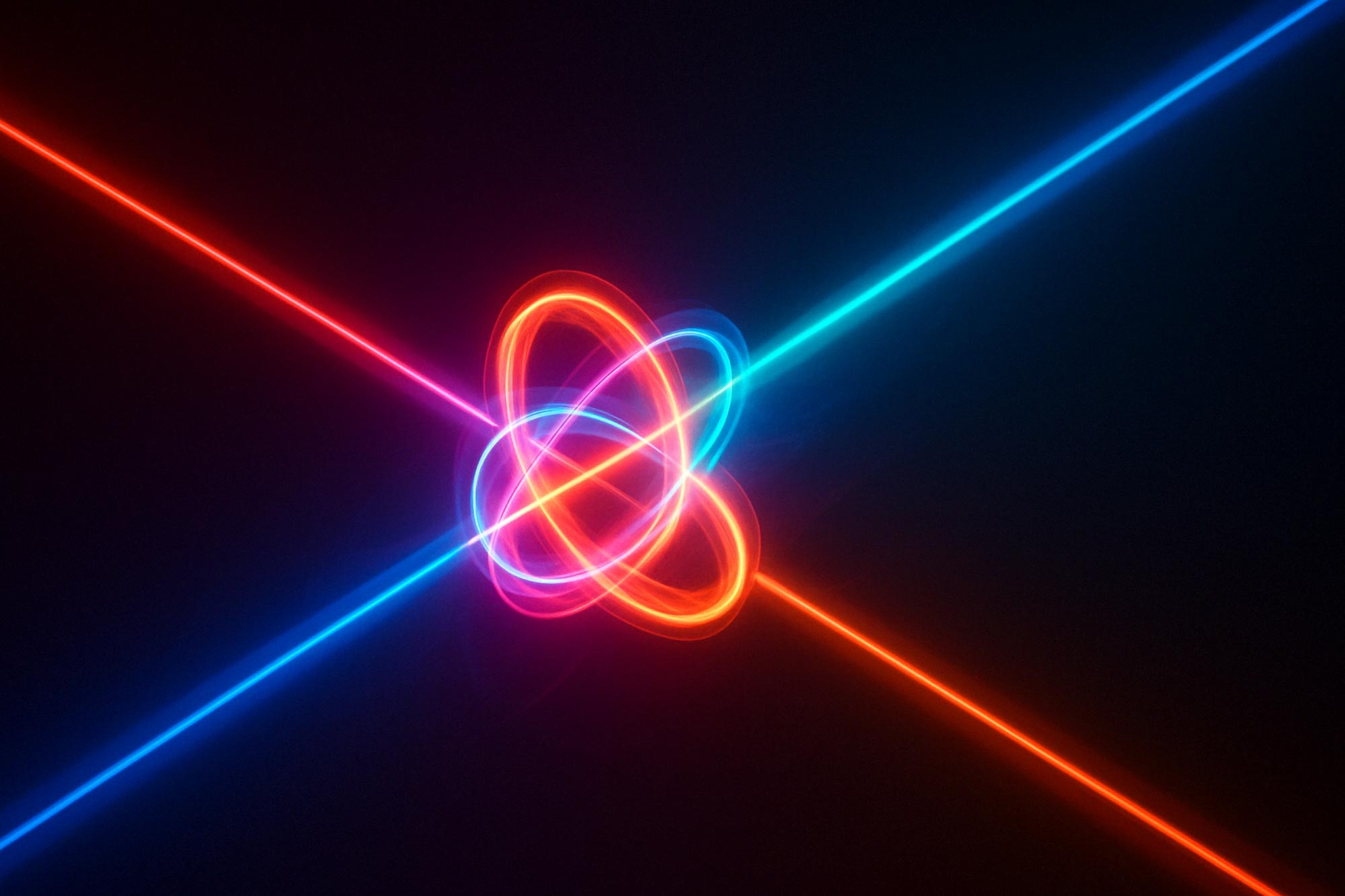
Light can tie knots—literally. Engineers at Duke University have managed to manipulate laser beams to form intricate 3D patterns called optical knots, using custom-designed optics.
These twisted beams could one day carry information or measure air turbulence, but researchers discovered that real-world conditions like turbulent air can distort them more than expected. To combat this, they modified the knot’s shape to make it more resilient, opening new paths for using light in surprising ways.
Light Beams Can Tie Knots Too
Knots are typically formed by twisting long, flexible materials—like shoelaces or cords—which makes the idea of tying a knot in a beam of light sound impossible.
But researchers have found a way to do exactly that.
Picture tossing several stones into a pond at once. The ripples spread out and eventually collide, creating a complex interference pattern. Now imagine you could precisely control the speed and shape of each ripple. With careful coordination, you could produce intricate 3D patterns right where the waves intersect.
Scientists are applying this same principle to light. By overlapping multiple laser beams—each carefully tuned and shaped—and guiding them through a series of lenses, they can generate interference patterns that create a stable 3D structure known as an optical knot. These patterns resemble delicate webs or smoke rings suspended in space.
Holographic Strip Splits Light to Weave Knots
In recent work published in Nature Communications and Photonics Research, engineers at Duke University have taken this concept further. They developed a holographic element that splits a single laser beam into five custom-shaped beams, which then form a tightly controlled optical knot. This technique could one day be used to encode information or to measure turbulence in air—opening up new possibilities for communication and environmental sensing.
“Before we can actually use optical knots for any kind of application, we have to really study them and understand how they behave.”
Natalia Litchinitser Professor of Electrical and Computer Engineering
Are Optical Knots as Stable as We Thought?
The team was able to show that information embedded into these optical knots can survive the constituent lasers traveling through turbulent air—but not as easily as scientists originally believed.
“People thought that because these shapes are mathematically stable objects, they should be able to be transmitted through complex environments without any complications,” said Natalia Litchinitser, professor of electrical and computer engineering at Duke. “As it turns out, they’re not guaranteed to be stable, but we can make them more stable.”
Testing in a Tabletop Turbulence Chamber
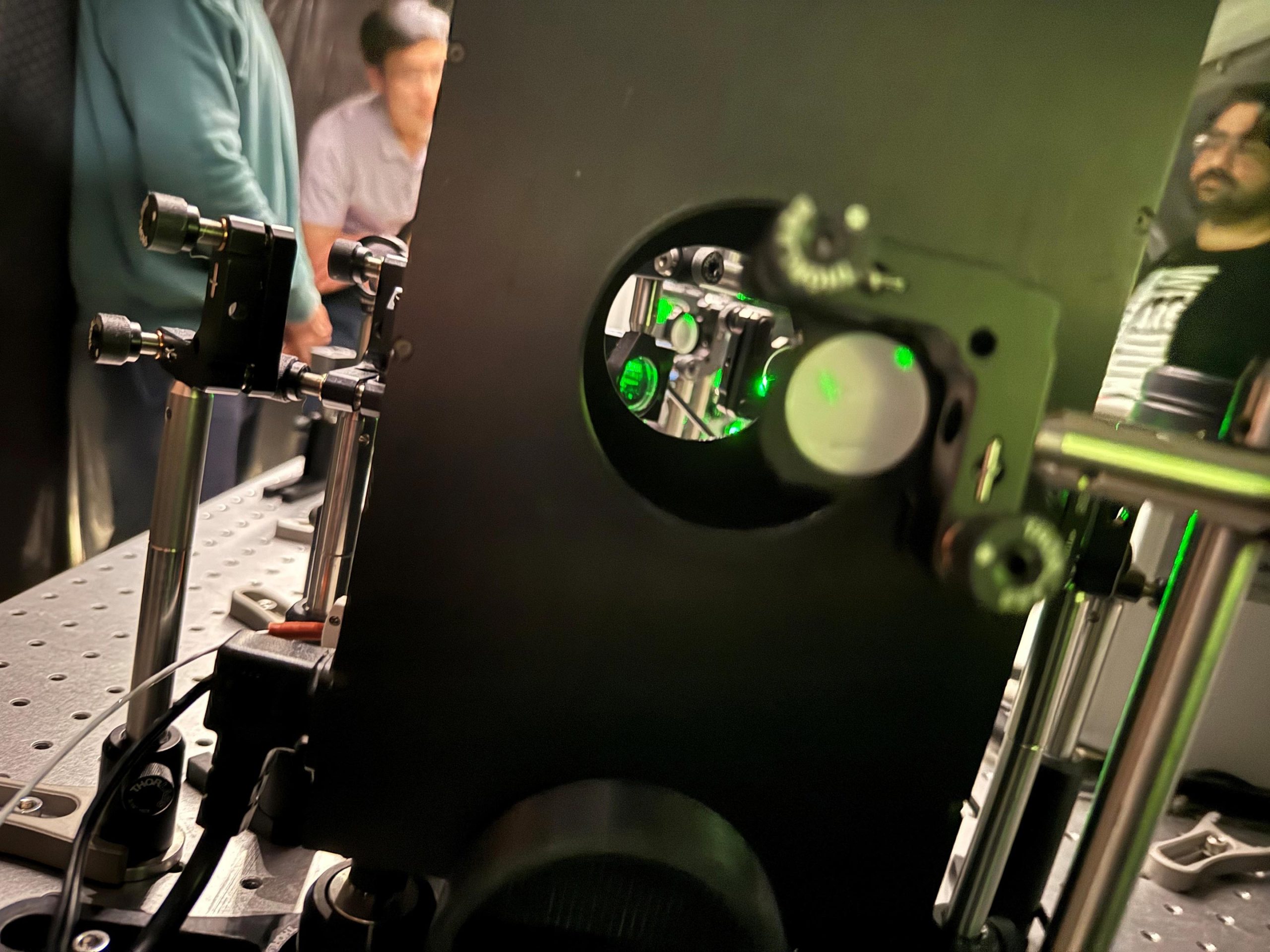
To produce this result, the researchers had to essentially use a small convection oven. While it is possible to simulate a laser traveling through turbulence with the use of fiber optic devices, the team wanted to replicate the real thing over a long distance. But while their collaborators in South Africa have a set up spanning two separate buildings, the Duke team was relegated to a single dining-room-sized table.
“We used a small toaster-oven-sized device with a hot plate in the bottom and fans to create air turbulence,” explained Danilo Gomes Pires, a postdoctoral scientist working in Litchinitser’s lab. “Then we shrunk the light beam and bounced it off several mirrors to mimic it traveling almost 1,000 feet.”
The optical knot experimental setup, where a laser is manipulated and passed through lenses to form the desired result. Credit: Ken Kingery, Duke University
Knot Breakdown: What Happens in Turbulent Air
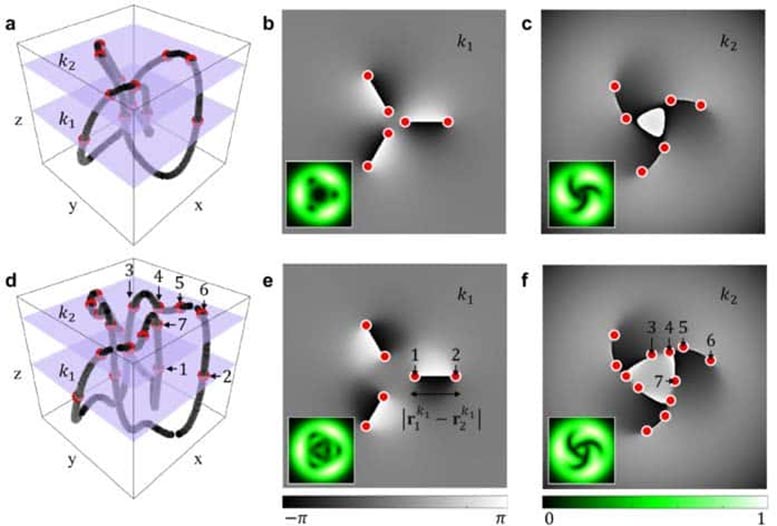
If the laser beams were unperturbed by their journey, the resulting knot should have looked like one continuous, flowing string with three loops. But instead, the researchers found that, as the turbulence got more intense, the knot was more likely to devolve into two interconnected rings or even a single ring, losing any of the information it contained.
But they also discovered that this degradation was not inevitable, and that they could make the knot stable for longer. By adding more squiggles to its otherwise smooth features—like building a complicated twisting and turning waterslide instead of a simple winding ride—they created more reference points to measure within a given plane.
Big Potential for Tiny Knots
While tying optical knots is still a technology in its infancy—they were only discovered about two decades ago—it has several potential applications. Information could be encoded into their shapes and transmitted over long distances. Measuring how much the knot is disrupted by its travels could also lead to ways to measure the amount of turbulence it passed through. Researchers also believe that the intricacies of the resulting knots could be used to trap and manipulate tiny particles in 3D space.
“Before we can actually use optical knots for any kind of application, we have to really study them and understand how they behave,” Litchinitser said. “Ours is the first demonstration of propagating through real turbulence, so from here we can take the next step and scale it up to continue exploring how these work in free space.”
References:
“Stability of optical knots in atmospheric turbulence” by D. G. Pires, D. Tsvetkov, H. Barati Sedeh, N. Chandra and N. M. Litchinitser, 27 March 2025, Nature Communications.
DOI: 10.1038/s41467-025-57827-1
“Sculpting isolated optical vortex knots on demand” by Danilo G. Pires, Dmitrii Tsvetkov, Natalia M. Litchinitser and Hooman Barati Sedeh, 31 January 2025, Photonics Research.
DOI: 10.1364/PRJ.533264
This work was supported by the Office of Naval Research (N00014-20-2558) and the Army Research Office (W911NF2310057).
Never miss a breakthrough: Join the SciTechDaily newsletter.
Follow us on Google and Google News.
5 Comments
Note 2504210458_Source1. Analyzing【
1.
Scientists are developing an optical knot, which is a 3D pattern for laser beams. The knot can transmit data or detect turbulence. However, the knot was found to be more vulnerable than expected, requiring creative improvements to increase its stability.
Light can literally tie a knot. Engineers at Duke University succeeded in manipulating a laser beam to form a sophisticated 3D pattern called optical knots. This is using a custom-designed optical device.
The twisted beam will one day be able to transmit information or measure air turbulence. However, the researchers found that in real environments such as turbulence, the beam can be distorted more severely than expected. To address this, the researchers improved the resilience by changing the shape of the knot, opening new avenues for the use of light in surprising ways.
1-1.
A beam of light can tie a knot
Knots are typically made by twisting long, flexible materials, such as shoelaces or strings, but the idea of tying a knot to a beam of light seems impossible. But researchers have found a way to do exactly that.
Imagine throwing several rocks at the same time into a pond. The ripples spread and eventually collide to create complex interference patterns. Now let’s imagine that the speed and shape of each ripple can be precisely adjusted. With careful adjustment, sophisticated three-dimensional patterns can be created at the intersection of waves.
_[3,3-1] The optical knot is an imaging of a kind of laser beam show. Or it is a flight of a small fly. These are the concept of qpeoms’ mixer, and the coordinate axis of the laser is diagonal zz’ in qpeoms theory. And according to the freer vix(*) domain, the coordinate side can be the concept of set. Uh-huh. Anyway, the laser show will allow us to capture and manipulate small particles in space.
The concepts of pumping, density inversion, and condensation emerge to form a laser beam. Pumping produces nk2 by 1. To make light, it is the nk2 end, but there are many atoms. This is the density inversion for energy level 1. The generation of many excited elements in a ground mcell of 1 is in an unstable qcell state, and when they achieve the nk state by lowering the energy level to banc, they become metastable. The energy level decreases in the high state, and the light is theoretically reduced in the induced emission (laser beam) of 10 billion msbase4.qpeoms in the excited state of msbase as the wavelength and phase directions reduce.>>>Seeing the ground state msbase4.qpeoms in the excited state of msbase1.>>>>Seeing the energy level oms4 in the form of a sequential density reversal leading to the energy level oms1-1 or msbase3 viewbase3. The energy level drops to E1>E2(E2>E1) and light is infinitely full in space-time by qms.nqvix.qcell. Uh-huh. Of course, sometimes the naturally induced emission of supernova light also appears in this process. Uh-huh.
View 1.
sample 1.vix.a’6//vixx.a(b1,g3,k3,o5,n6)
b0acfd|0000e0
000ac0|f00bde
0c0fab|000e0d
e00d0c|0b0fa0
f000e0|b0dac0
d0f000|cae0b0
0b000f|0ead0c
0deb00|ac000f
ced0ba|00f000
a0b00e|0dc0f0
0ace00|df000b
0f00d0|e0bc0a
View 1-1.
01000000
00000001
00010000
00000100
View base3.
040902
030507
080106
≈≈≈≈========
Source 1.
https://scitechdaily.com/how-scientists-are-tying-light-in-midair-to-send-messages-through-chaos/
1-2.
Scientists are applying this principle to light as well. When multiple laser beams, each precisely tuned and shaped, are superimposed and passed through a series of lenses, an interference pattern can be created that forms a stable three-dimensional structure called an optical knot. This pattern is similar to a delicate spider’s web or smoke rings floating in space.
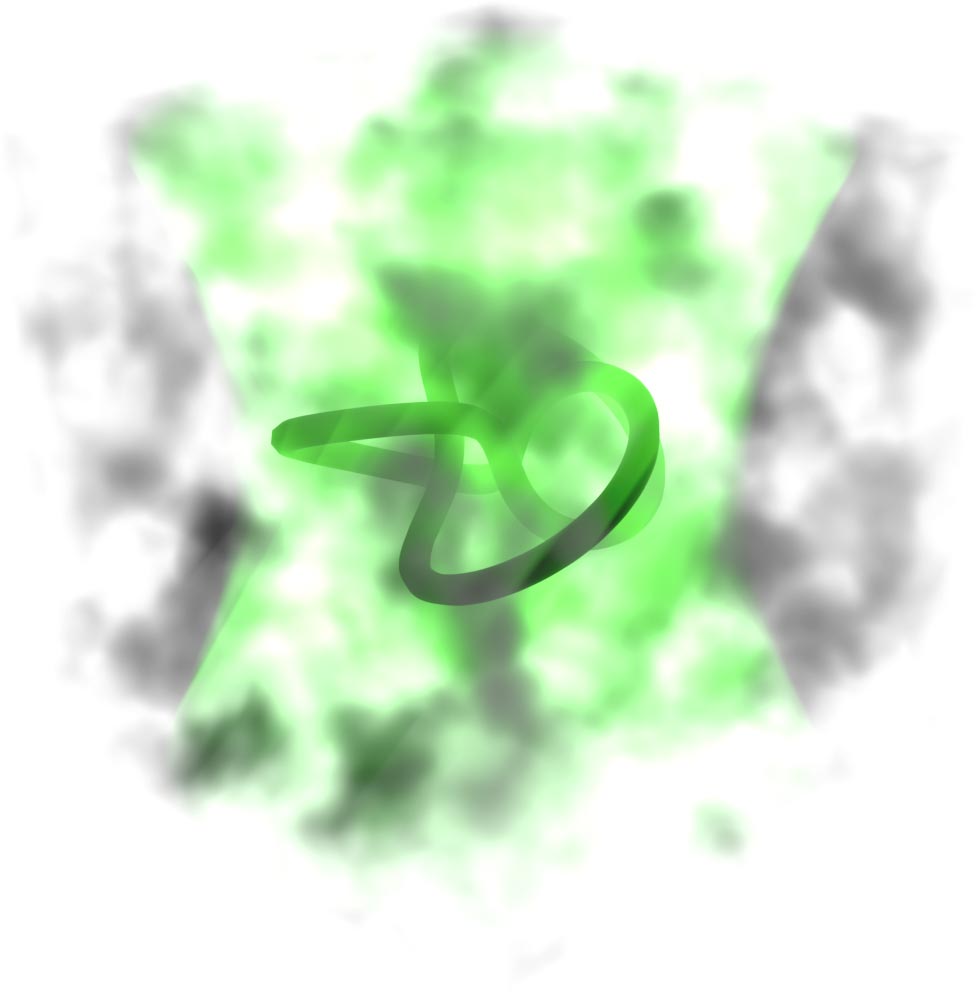
Computational representation of optical knots. The green region is the region through which laser light passes. The dark region inside is the region through which light interferes itself to form twisted and dark optical knots. A holographic strip divides light and weaves the knots.
1-3.
The concept was further advanced in a recently published study by Duke Tim. They developed a holographic element that divides a single laser beam into five custom beams to form tightly controlled optical knots. The technology could one day be used to encode information or measure turbulence in the air, opening new possibilities in communication and environmental sensing.
Indeed, before applying optical knots to any kind of application, we must study the optical knots closely and understand how they work.
2.
Is the optical knot as stable as we thought it would be?
The team showed that the information contained in these optical knots could withstand the compositional lasers passing through turbulence, but it wasn’t as easy as scientists originally thought.
People thought that since this form was a mathematically stable object, it could be transmitted without any problems even in a complex environment. In practice, stability is not guaranteed, but it can be made more stable.
A black rectangular box that created turbulence to allow laser light to pass through. The device allowed researchers to demonstrate stability as optical knots pass through turbulence.
2-1.
Testing in Tabletop Turbulence Chamber
In order to achieve this result, the researchers actually had to use a small convection oven. An optical fiber device can be used to simulate a laser passing through turbulence, but the research team wanted to reproduce the actual laser over a long distance.
The researcher used a small toaster oven-sized device with a hot plate on the bottom and used a fan to create air turbulence.
Are Optical Knots as Stable as We Thought?
The team was able to show that information embedded into these optical knots can survive the constituent lasers traveling through turbulent air—but not as easily as scientists originally believed.
VERY GOOD.
According to the topological vortex theory (TVT), luminescence and heat generation are two different mechanisms. They act on different senses of humans, producing different interactions. Just as the sun brings heat to the Earth, it is not the sun directly transferring heat to the Earth, but rather the interaction between the vortices associated with the sun and the vortices of Earth’s objects. Temperature changes are closely related to the acceleration or deceleration rotation of vortices. In a sense, the deviation between the sun’s axis of rotation and the Earth’s axis of rotation may have a much greater impact on Earth’s climate change than the distance between the sun and the Earth, which is known as the ‘devilish long-range effect’.
The Earth’s equatorial plane and the Sun’s equatorial plane are relatively less affected by the deviation of their rotation axes, which may be one of the reasons why Earth’s species are more abundant near the equator than at the Earth’s poles.
That could be due to the weather at the poles and equatorial regions, perhaps?
Thank you for browsing and following.
The spin of topological vortices can be divided into uniform, accelerating, and decelerating rotations. Different vortices and their fractal structures may form extremely complex spatiotemporal structures through superposition, entanglement, and locking. When vortices are superimposed on the same plane, the superposition of co rotating vortices may accelerate rotation to form warm spacetime, while the superposition of counter rotating vortices may annihilate or decelerate rotation to form cold spacetime. Therefore, there is an opportunity to form more diverse vortex structures in warm spacetime.