
Close Menu
    Facebook X (Twitter) Instagram
    SciTechDaily
    • Biology
    • Chemistry
    • Earth
    • Health
    • Physics
    • Science
    • Space
    • Technology
    Facebook X (Twitter) Pinterest YouTube RSS
    SciTechDaily
    Home»Health»How Stress and the Circadian Clock Affect Sleep
    Health

    How Stress and the Circadian Clock Affect Sleep

    By Nagoya UniversityApril 15, 2021No Comments3 Mins Read
    Facebook Twitter Pinterest Telegram LinkedIn WhatsApp Email Reddit
    Share
    Facebook Twitter LinkedIn Pinterest Telegram Email Reddit
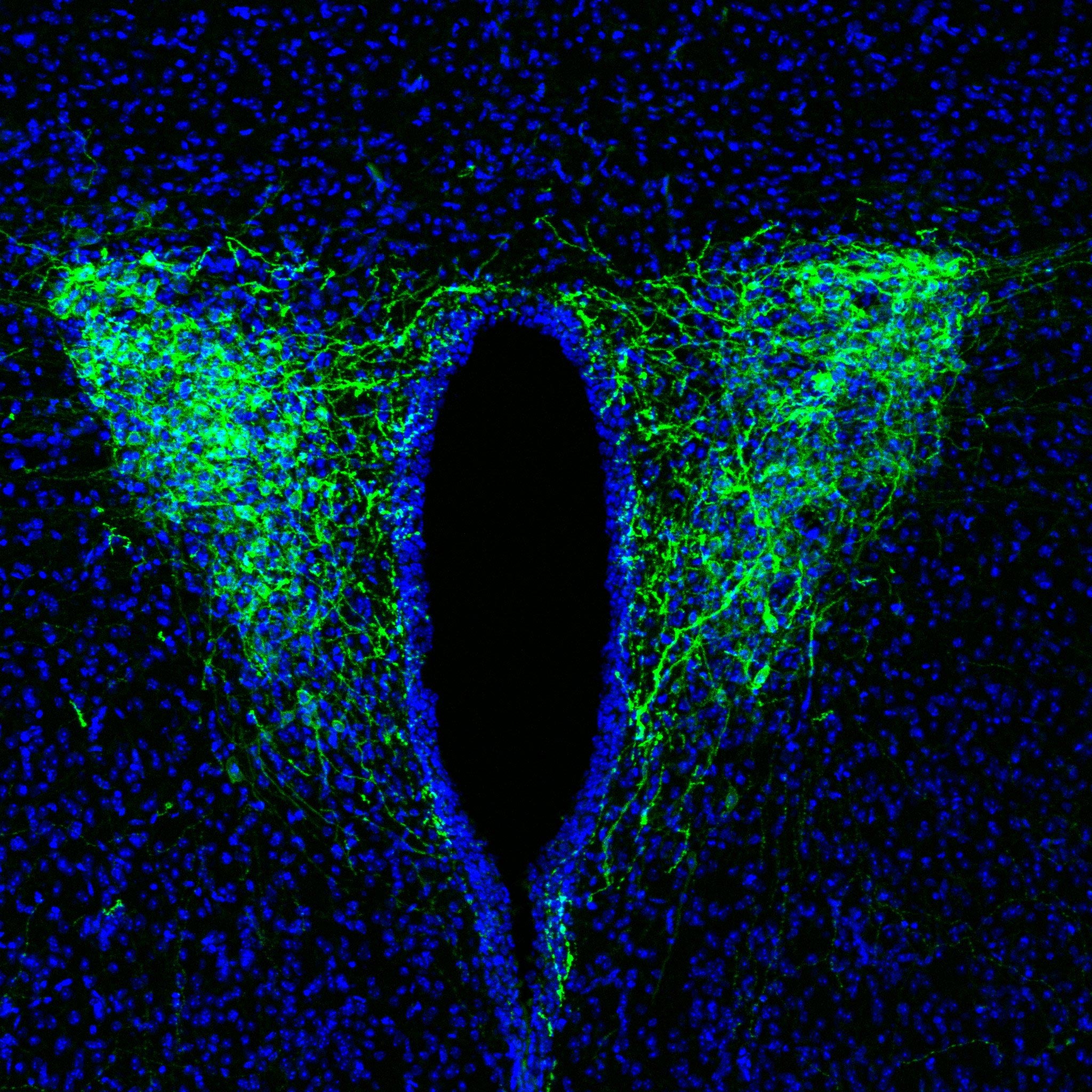
    CRF Neurons
    The optogenetic tool “Channelrhodopsin2” expresses CRF neurons in the paraventricular nucleus of the hypothalamus in mice. These neurons were found to be part of the neural pathway that is crucial for the circadian regulation of sleep and wakefulness. Overactivity of CRF neurons due to stress or disturbed circadian rhythm is likely to cause insomnia and other sleep disorders in humans. Credit: Daisuke Ono

    The findings could lead to the development of new therapies for sleep disorders caused by stress or a disturbed circadian rhythm.

    A Nagoya University-led research team in Japan has found a new neural pathway that links the circadian clock, stress, and wakefulness in mammals. The team identified a neuron, called the corticotropin-releasing factor (CRF) neuron, that becomes excessively active when the mammal is under stress, which could trigger insomnia and other sleep disorders. Their findings were recently published in the journal Science Advances.

    Living organisms exhibit a 24-hour oscillation called the circadian rhythm. In mammals, the central circadian clock, located in the brain’s suprachiasmatic nucleus (SCN) neurons, regulates the sleep-wake cycle. However, in the event of life-threatening situations, the circadian rhythm signal is shut off to keep the animal awake so that it can escape from danger even when it would normally be time to sleep. Although the temporary shutoff of the sleep-wake cycle is necessary for survival, excessive or prolonged stress caused by such dangers can trigger insomnia and other sleep disorders.

    “It is well-known that the circadian clock and stress have an effect on sleep, but it was unclear which neural pathway is crucial for the circadian regulation of sleep and wakefulness,” says Dr. Daisuke Ono of the Research Institute of Environmental Medicine at Nagoya University. To determine the pathway, a Nagoya University research team led by Prof. Akihiro Yamanaka and Dr. Ono, in collaboration with Takashi Sugiyama at Olympus Corporation in Japan, conducted a study using mice.

    The researchers focused on CRF neurons — which are known to play a role in stress response — that are located in the paraventricular nucleus of the hypothalamus. They investigated how sleep and wakefulness in mice would be affected when the CRF neurons were activated. The results showed that the activated CRF neurons kept the animals awake and made them move around vigorously, indicating that their wakefulness was promoted. The researchers also observed that CRF neurons remained active when the mice were awake, and that when the neurons’ activity was suppressed, the animals’ wakefulness and locomotor activities were reduced.

    Further investigations also showed that inhibitory neurons in the SCN, called GABAergic neurons, play a significant role in regulating the activity of CRF neurons, and that the activation of CRF neurons stimulates orexin neurons in the lateral hypothalamus, which results in the promotion of wakefulness.

    A Neural Circuit for Sleep-Wake Regulation Uncovered

    The team thus concluded that GABAergic neurons in the SCN control the activity of CRF neurons, which ultimately regulates the sleep-wake cycle. “We identified this neural pathway in mice, which are nocturnal animals. Further studies are required to elucidate how the nocturnal and diurnal difference is regulated in the brain,” says Dr. Ono.

    “In today’s society, sleep disorders are a serious problem. We hope our finding will contribute to the development of new therapies for insomnia and other sleep disorders caused by stress or a disturbed circadian rhythm.”

    Reference: “The mammalian circadian pacemaker regulates wakefulness via CRF neurons in the paraventricular nucleus of the hypothalamus” by Daisuke Ono, Yasutaka Mukai, Chi Jung Hung, Srikanta Chowdhury, Takashi Sugiyama and Akihiro Yamanaka, 6 November 2020, Science Advances.
    DOI: 10.1126/sciadv.abd0384

    Never miss a breakthrough: Join the SciTechDaily newsletter.
    Follow us on Google and Google News.

    Cell Biology Circadian Rhythm Nagoya University Neuroscience Physiology Sleep Science Stress
    Share. Facebook Twitter Pinterest LinkedIn Email Reddit

    Related Articles

    Circadian Rhythms Control Immune Cells That Clear Away Alzheimer’s Disease Protein

    Unexpected Benefits to Starting the Day Off With Chocolate

    Researchers Identify People That Are Missing a Critical Cell Process – Unique Insight Into Human Physiology

    Defying Your Natural Body Clock Linked to Depression and Lower Wellbeing

    Antidepressant Power of Lactate Revealed in New Research

    Scientists Discover How Behavioral Rhythms Are Fine-Tuned In the Brain

    Deep Sleep Takes Out the Trash: Waste Clearance Is Crucial for Brain Health

    Irregular Sleep Schedules Can Worsen Mood and Increase Risk of Depression

    New Research Shows the Moon Influences Our Sleep

    Leave A Reply Cancel Reply

    • Facebook
    • Twitter
    • Pinterest
    • YouTube

    Don't Miss a Discovery

    Subscribe for the Latest in Science & Tech!

    Trending News

    The Universe Is Expanding Too Fast and Scientists Can’t Explain Why

    “Like Liquid Metal”: Scientists Create Strange Shape-Shifting Material

    Early Warning Signals of Esophageal Cancer May Be Hiding in Plain Sight

    Common Blood Pressure Drug Shows Surprising Power Against Deadly Antibiotic-Resistant Superbug

    Scientists Uncover Dangerous Connection Between Serotonin and Heart Valve Disease

    Scientists Discover a “Protector” Protein That Could Help Reverse Hair Loss

    Bone-Strengthening Discovery Could Reverse Osteoporosis

    Scientists Uncover Hidden Trigger Behind Stem Cell Aging

    Follow SciTechDaily
    • Facebook
    • Twitter
    • YouTube
    • Pinterest
    • Newsletter
    • RSS
    SciTech News
    • Biology News
    • Chemistry News
    • Earth News
    • Health News
    • Physics News
    • Science News
    • Space News
    • Technology News
    Recent Posts
    • A Common Diabetes Drug May Hold the Key to Stopping HIV From Coming Back
    • Ancient “Syphilis-Like” Disease in Vietnam Challenges Key Scientific Assumptions
    • Drinking Alcohol To Cope in Your 20s Could Damage Your Brain for Life
    • Scientists Crack Alfalfa’s Chromosome Mystery After Decades of Debate
    • Ancient Ant-Plant Alliance Collapses As Predatory Wasps Move In
    Copyright © 1998 - 2026 SciTechDaily. All Rights Reserved.
    • Science News
    • About
    • Contact
    • Editorial Board
    • Privacy Policy
    • Terms of Use

    Type above and press Enter to search. Press Esc to cancel.