

High-speed X-ray imaging has revealed that cavitation significantly improves the efficiency of fuel jets in engines by enhancing fuel atomization. This discovery offers potential for designing more efficient engines, optimizing fuel usage as we shift towards alternative energies.
Cavitation is the formation of vapor bubbles within a liquid subjected to rapid acceleration, and it can potentially damage equipment like ship propellers. Its impact on microscopic devices remains largely unknown. In this study, scientists captured high-speed images of microscale cavitating fuel jets, revealing the motion of liquid jets at sonic speeds from high-pressure fuel injectors typical in vehicle engines.
Analysis indicated that previously invisible flow dynamics are influenced by cavitation across a range of pressures and temperatures, significantly boosting the energy conversion efficiency of the fuel injection process.
X-Ray Imaging Unlocks Secrets of Fuel Injection Efficiency
Using X-ray imaging, researchers explored cavitation’s role in enhancing fuel injection performance. Findings suggest that these vapor bubbles can be utilized to increase energy conversion efficiency, particularly when fuel is injected directly into engine cylinders—a method known to enhance combustion efficiency.
These insights are poised to guide the development of more efficient combustion engines, thereby improving the use of petroleum fuels as we transition to alternative energy sources.
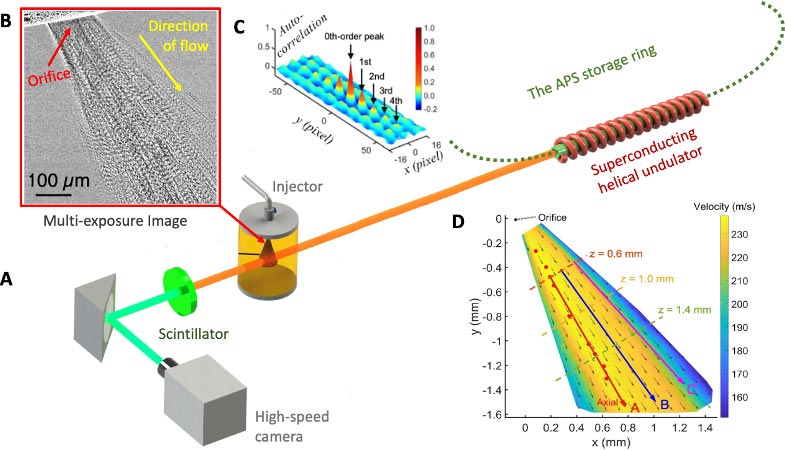
Advanced Photon Source Enhances Fluid Dynamics Research
Liquid fuel spray dynamics are hard to study because the flow is highly transient and optically opaque. The ultra-intense X-ray beams delivered by the unique superconducting helical undulator (SCHU) provide an ideal tool to visualize fast liquid-fuel dynamics. The SCHU is located at the Advanced Photon Source, a Department of Energy (DOE) Office of Science user facility operated by Argonne National Laboratory.
The research team demonstrated that the SCHU source enabled high-speed imaging at 65,000 frames per second with exposure time as short as 100 billionths of a second, with 1-micrometer spatial resolution. The unprecedented spatiotemporal resolution is made possible by the unique radiation properties of the SCHU device.
Breakthroughs in Fluid Dynamics Through High-Speed Imaging
Facilitated by highly quantitative analysis, the images reveal detailed fluid dynamics that are not only sensitive to hydrodynamic parameters such as injection pressure, surprisingly, but also their interplay with the fluid temperature, an important but often overlooked thermodynamic parameter.
For the first time, the scientists found that the flow dynamics related to the fluid velocity can be perfectly scaled by a single dimensionless parameter, cavitation number, in the extended pressure and temperature range. The researchers found that cavitation at high pressure and temperature promotes the liquid jet to reach 90% of the ideal values, significantly improving energy conversion during the atomization process in modern engines.
Reference: “Enhanced energy conversion efficiency promoted by cavitation in gasoline direct injection” by Qing Zhang, Ya Gao, Miaoqi Chu, Pice Chen, Qingteng Zhang and Jin Wang, 21 November 2022, Energy.
DOI: 10.1016/j.energy.2022.126117
The research was partially supported by the DOE Office of Science, Office of Basic Energy Sciences, Scientific User Facilities Division and Argonne National Laboratory. The research used resources at the Advanced Photon Source, a DOE Office of Science user facility operated by Argonne National Laboratory.
Never miss a breakthrough: Join the SciTechDaily newsletter.
Follow us on Google and Google News.
2 Comments
Fluid temperature is an important thermodynamic. Scientific research guided by correct theories can help people avoid detours, failures, and exaggeration. The physical phenomena observed by researchers in experiments are always appearances, never the natural essence of things. The natural essence of things needs to be extracted and sublimated based on mathematical theories via appearances , rather than being imagined arbitrarily.
Everytime scientific revolution, the scientific research space brought by the new paradigm expands exponentially. Physics should not ignore the analyzable physical properties of topological vortices.
(1) Traditional physics: based on mathematical formalism, experimental verification and arbitrary imagination.
(2) Topological Vortex Theory (TVT): Although also based on mathematics (such as topology), it focuses more on non intuitive geometry and topological structures, challenging traditional physical intuition.
Topological Vortex Theory (TVT) points out the limitations of the Standard Model in describing the large-scale structure of the universe, proposes the need to consider non-standard model components such as dark matter and dark energy, and suggests that topological vortex fields may be key to understanding these phenomena. Topological vortex theory (TVT) heralds innovative technologies such as topological electronics, topological smart batteries, topological quantum computing, etc., which may bring low-energy electronic components, almost inexhaustible currents, and revolutionary computing platforms, etc.
Topology tells us that topological vortices and antivortices can form new spacetime structures via the synchronous effect of superposition, deflection, or twisting of them. Mathematics does not tell us that there must be God particles, ghost particles, fermions, or bosons present. When physics and mathematics diverge, arbitrary imagination will make physics no different from theology. Topological vortex research reflections on the philosophy and methodology of science help us understand the nature essence of science and the limitations of scientific methods. This not only has guiding significance for scientific research itself, but also has important implications for science education and popularization.
All things follow certain laws, which can be revealed through observation and research ( such as topological structures ). Today, so-called official (such as PRL, Nature, Science, PNAS, etc.) in physics stubbornly believes that two sets of cobalt-60 rotating in opposite directions can become two sets of objects that mirror each other, is a typical case that pseudoscience is rampant and domineering.
Please witness the exemplary collaboration between theoretical physicists and experimentalists (https://scitechdaily.com/microscope-spacecrafts-most-precise-test-of-key-component-of-the-theory-of-general-relativity/#comment-854286). Let us continue to witness via facts the dirtiest and ugliest era in the history of sciences and humanities in human society. The laws of nature will not change due to misleading of certain so-called academic publications or endorsements from certain so-called scientific awards.
As some comments have stated ( https://scitechdaily.com/super-photons-unveiled-sculpting-light-into-unbreakable-communication-networks/#comment-861546 ): Fortunately, we have enough pieces to put the puzzle together properly, and there are folks who have chosen to forego today’s societal structures in order to do exactly that.
Additionally, some comments have stated ( https://scitechdaily.com/science-made-simple-what-is-nuclear-fission/#comment-862083 ): You have been spewing this type of nonsensical word salad for several years now. Outrage doesn’t equal competence. If anything, your inability to convince anyone is a sign of your incompetence. Ask the commenter:Today, so-called official (such as PRL, Nature, Science, PNAS, etc.) in physics stubbornly believes that two sets of cobalt-60 rotating in opposite directions can become two sets of objects that mirror each other, and it even won awards. These so-called academic publications blatantly talk nonsense, which is a public humiliation of the normal intellectual level of the public. Do you think this is human misfortune or personal misfortune?
Isn’t this the evil consequence of the Physics Review family misleading science? Academic circle is not Entertainment industry. Have some people really never know what shame is?
It is normal to make mistakes in scientific research, but what is abnormal is to stubbornly adhere to erroneous positions and not repent.