
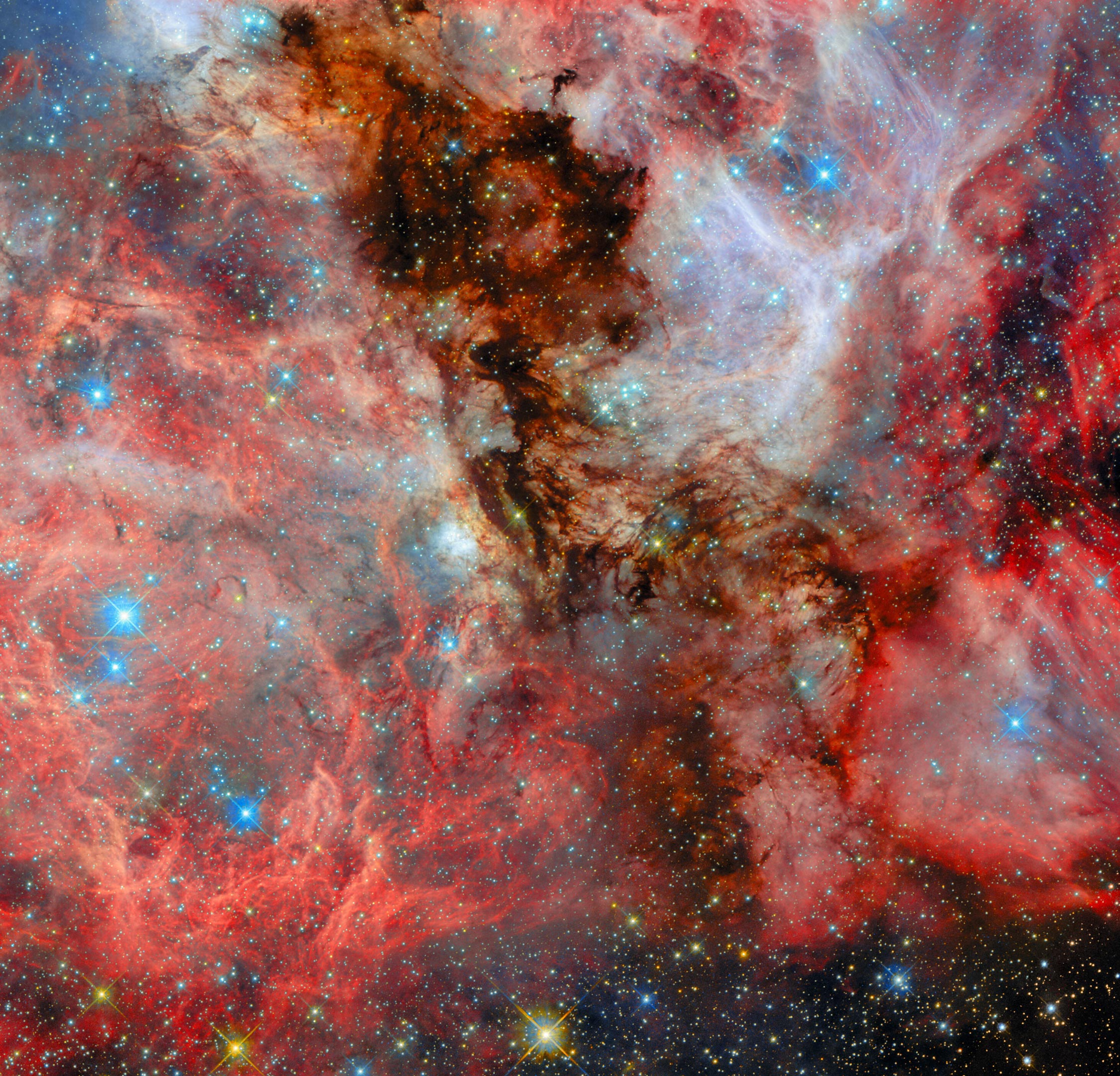
Hubble captures a dazzling stellar nursery where newborn stars light up and carve their way through glowing clouds in a nearby galaxy.
This striking image from the Hubble Space Telescope offers a fresh perspective on a faraway region where stars are actively forming. The view was captured alongside a recently released image and focuses on a nearby section of the N159 star-forming complex in the Large Magellanic Cloud, located about 160,000 light-years from Earth.
Glowing Gas and Emerging Stars
The scene is filled with dense clouds of cold hydrogen gas that twist and overlap to create ridges, hollow pockets, and glowing strands. Hidden within these thick clouds, newly born stars are beginning to shine. Their intense energy excites the surrounding hydrogen, causing it to glow with rich red colors that trace the structure of the gas.
How Young Stars Shape Their Surroundings
The brightest areas highlight clusters of hot, massive young stars. These stars release powerful radiation and stellar winds that push outward, reshaping the nearby gas. As a result, rounded bubbles and hollowed-out regions form, offering clear evidence of stellar feedback at work. In the foreground, darker clouds stand out as they are illuminated from behind by emerging stars. Together, these features reveal an ongoing exchange between star formation and the raw material that fuels it, showing how stars both arise from and transform their environment.
The Vast Scale of the N159 Region
N159 ranks among the most massive star-forming clouds in the Large Magellanic Cloud, a dwarf galaxy that is the largest of the small galaxies orbiting the Milky Way. While the image captures only a fraction of this region, the full star-forming complex spans more than 150 light-years, underscoring the immense scale of stellar creation taking place within this neighboring galaxy.
Never miss a breakthrough: Join the SciTechDaily newsletter.
Follow us on Google and Google News.
1 Comment
Memo 2602090309_Source 1. Reinterpretation []
Source 1.
https://scitechdaily.com/hubble-captures-a-wild-stellar-nursery-glowing-with-newborn-stars/
1.
The Hubble Space Telescope has captured a mysterious star nursery glowing with newborn stars.
_Glowing clouds and hollow bubbles reveal an intense star-forming region in the Large Magellanic Cloud, 160,000 light-years from Earth.
_Hubble has captured a dazzling star formation scene in a nearby galaxy, where newborn stars blaze through a glowing nebula.
1-1.
_This stunning image from the Hubble Space Telescope offers a new perspective on a distant, active star-forming region.
This image, taken alongside recently released images, focuses on the nearby N159 star-forming complex, located in the Large Magellanic Cloud, about 160,000 light-years from Earth.
1-2. Glowing Gas and Emerging Stars
The scene is filled with dense clouds of cool hydrogen gas. These clouds intertwine to form ridges, depressions, and glowing filaments.
Newly formed stars begin to glow within these thick clouds. The stars’ intense energy excites the surrounding hydrogen, causing it to glow a rich red color along the gas’s structure.
1-3.
How Do Young Stars Change Their Environment?
The bright region of the field reveals a cluster of hot, massive young stars. These stars emit powerful radiation and stellar winds, pushing away the surrounding gas and transforming its shape. The resulting bubbles and depressions clearly demonstrate stellar feedback.
ㅡa2.【nk stars, example1. The place where the universe’s first stars were born from the void of empty space is symbolically the N672 nebula grid field. Uh-huh. 0247.0304.
ㅡSource 1. appears to be a realistic observation, but it doesn’t explain the deeper meaning behind it like I do. Magicsum theory can clearly explain the birth of stars. 0307.
exemple1.
01000000>vixer.a3.black_hole
00000100>
00000001<vixxa.a6.neutron_star
00010000<
ㅡThe N672 nebula grid field, the universe's first stars, created stars with temperatures of example1. msbase.nk.
example1. 01100716
15080902
14051203
04110613
ㅡThe stars Vixer and Vixxa. They are similar to a leader and a subordinate, but their distinction is determined by different conditions. vixer.xyz is satisfied and vixxa.xy is satisfied. A leader is a powerful figure who emerges from among his subordinates and rules the land with numerous subjects and ministers like a king. Oh. 0258.0302.
】
_In the foreground, dark nebulae stand out, illuminated by the light of newly emerging stars. These features reveal the ongoing interaction between star formation and the matter that provides its energy, and reveal how stars are born and how they change their surroundings.
ㅡa1.【msbase.galaxy.nk represents the location of the stars.
ㅡThey appear to be densely packed and ordered by size, but these assumptions are expressed as a grid. In reality, the Grid Nebula exists, and the NKs are located in the depressions, symbolically highlighting the vast, dark grid line N672. Oh, my. 2602090240.
】
2. The Vast Scale of the N159 Region
_N159 is one of the largest star-forming nebulae in the Large Magellanic Cloud, the largest dwarf galaxy orbiting our own Milky Way.
_While this image captures only a tiny portion of the region, the entire star-forming complex spans over 150 light-years, revealing the immense scale of star formation occurring in our neighboring galaxy.