
Close Menu
    Facebook X (Twitter) Instagram
    SciTechDaily
    • Biology
    • Chemistry
    • Earth
    • Health
    • Physics
    • Science
    • Space
    • Technology
    Facebook X (Twitter) Pinterest YouTube RSS
    SciTechDaily
    Home»Space»Hubble Catches Baby Stars Blowing Giant Bubbles in Space
    Space

    Hubble Catches Baby Stars Blowing Giant Bubbles in Space

    By ESA/HubbleJanuary 1, 2026No Comments3 Mins Read
    Facebook Twitter Pinterest Telegram LinkedIn WhatsApp Email Reddit
    Share
    Facebook Twitter LinkedIn Pinterest Telegram Email Reddit
    Hydrogen Gas Cloud N159
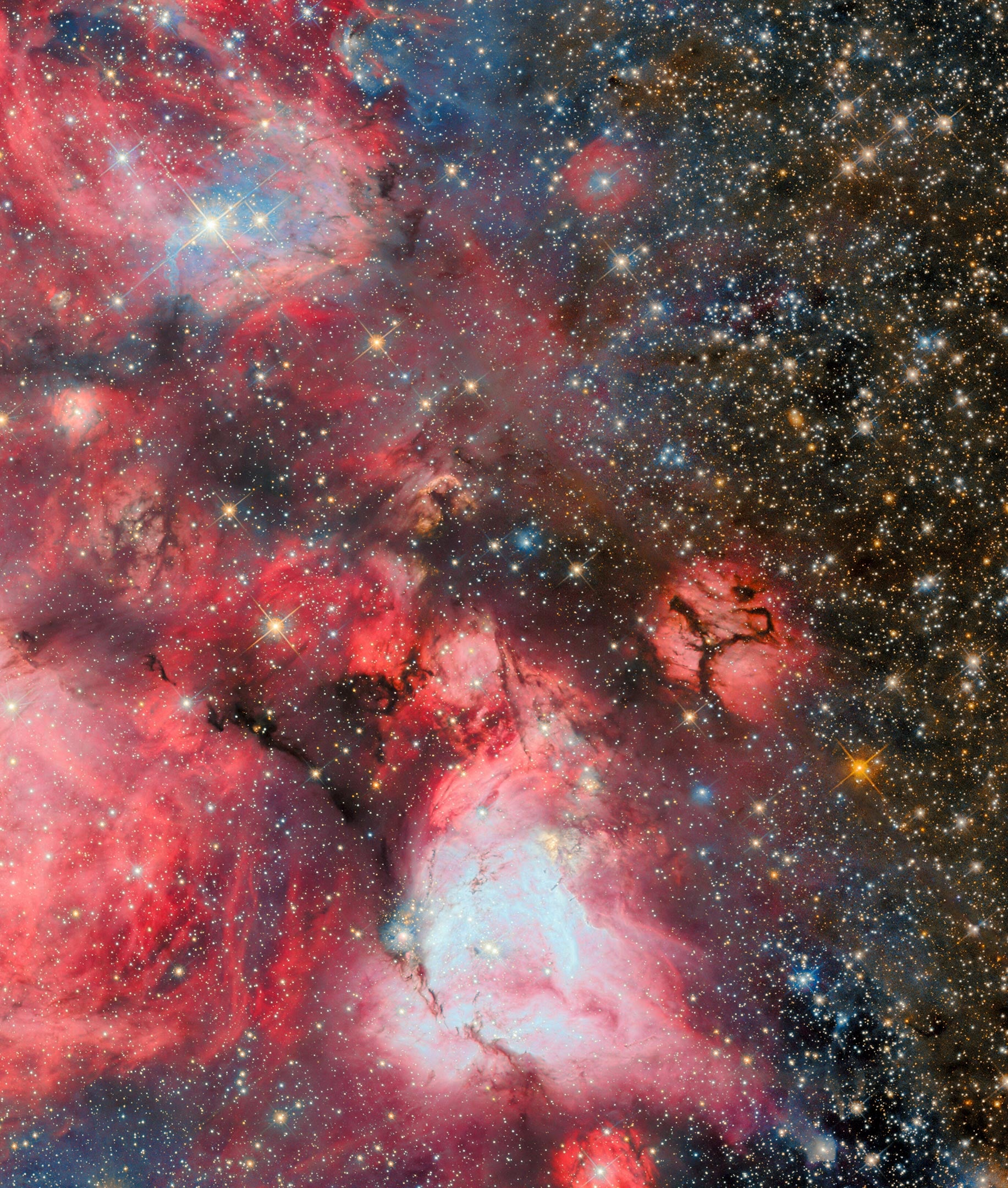
    This Hubble image showcases N159, a massive star-forming cloud where newborn stars blaze to life inside icy hydrogen gas. Their powerful radiation lights the cloud in red and sculpts giant bubbles that reveal the violent side of stellar birth. Credit: ESA/Hubble & NASA, R. Indebetouw

    A new Hubble Picture of the Week highlights an enormous region of space where stars are actively being born. The image centers on N159, a massive cloud made mostly of cold hydrogen gas. Hydrogen is the most common element in the universe and the primary building block of stars. This cloud lies about 160,000 light-years from Earth in the constellation Dorado, far beyond our own galaxy.

    N159 resides within the Large Magellanic Cloud, a dwarf galaxy that is the largest of the smaller galaxies orbiting the Milky Way. Because it is relatively close in cosmic terms, astronomers can study star formation there in remarkable detail. N159 stands out as one of the most massive and active regions of star birth within this neighboring galaxy.

    The Enormous Scale of the N159 Cloud

    The Hubble image captures only a fraction of the full N159 complex. When viewed in its entirety, this sprawling structure extends across more than 150 light-years of space. A single light year represents the distance light travels in one year, so the full cloud is nearly 10 million times farther across than the distance between Earth and the Sun. Sizes like this help explain why such regions can produce large numbers of stars over millions of years.

    How Stars Form Inside Cold Gas Clouds

    Deep inside N159, temperatures drop far below freezing, and gravity steadily pulls the gas inward. As the cloud collapses under its own weight, dense pockets form and eventually ignite nuclear reactions, marking the birth of new stars. These newborn stars begin to shine while still embedded in the gas and dust that created them.

    The hottest and most massive young stars emit intense energy that causes nearby hydrogen gas to glow red. This color comes from hydrogen atoms that have been energized by starlight. The Hubble Space Telescope is especially good at detecting this specific glow, allowing astronomers to trace where star formation is most active.

    Stellar Feedback and Expanding Gas Bubbles

    Not all young stars remain hidden within thick clouds. Some appear wrapped in reddish gas, while others sit at the center of large hollow regions that look like bubbles carved into the cloud. These structures form through a process known as stellar feedback.

    As young stars grow brighter, they release powerful radiation and fast-moving streams of charged particles called stellar winds. Together, these forces heat and push away surrounding gas, clearing cavities and reshaping the cloud itself. Over time, this feedback can slow down or even stop new star formation nearby while triggering it in other areas.

    A New View Using Expanded Wavelengths

    Hubble previously released an image of the entire N159 region in 2016. The newer version adds observations taken at an additional wavelength of light. This enhancement allows astronomers to better highlight the hot gas surrounding newborn stars, offering a clearer picture of how young stars interact with their environment and transform their cosmic birthplace.

    Never miss a breakthrough: Join the SciTechDaily newsletter.
    Follow us on Google and Google News.

    Astronomy European Space Agency Hubble Space Telescope
    Share. Facebook Twitter Pinterest LinkedIn Email Reddit

    Related Articles

    A Diamond Necklace of Cosmic Proportions

    Hubble Snaps a Stunning Close-Up of a Magnificent Spiral Galaxy

    Extraordinary Hubble Image: Light Bends From the Beyond

    Hubble Space Telescope Sees Volcanic Activity Reforming the Atmosphere on a Rocky Exoplanet

    Hubble Spies a Luminous Heart With Dark Tendrils

    Spectacular Return to the Veil Nebula

    Hubble Spots a Peculiar Sight: Unusual Spiral Galaxy With a Heavy Arm

    A Flash of Life: Hubble Spies an Unusual Planetary Nebula

    Through the Cosmic Clouds: Hubble Spots a Beautiful Stellar Nursery

    Leave A Reply Cancel Reply

    • Facebook
    • Twitter
    • Pinterest
    • YouTube

    Don't Miss a Discovery

    Subscribe for the Latest in Science & Tech!

    Trending News

    Scientists May Have Found the Key to Jupiter and Saturn’s Moon Mystery

    Scientists Uncover Brain Changes That Link Pain to Depression

    Saunas May Do More Than Raise Body Temperature – They Activate Your Immune System

    Exercise in a Pill? Metformin Shows Surprising Effects in Cancer Patients

    Hidden Oceans of Magma Could Be Protecting Alien Life

    New Study Challenges Alzheimer’s Theories: It’s Not Just About Plaques

    Artificial Sweeteners May Harm Future Generations, Study Suggests

    Splashdown! NASA Artemis II Returns From Record-Breaking Moon Mission

    Follow SciTechDaily
    • Facebook
    • Twitter
    • YouTube
    • Pinterest
    • Newsletter
    • RSS
    SciTech News
    • Biology News
    • Chemistry News
    • Earth News
    • Health News
    • Physics News
    • Science News
    • Space News
    • Technology News
    Recent Posts
    • Scientists Make Breakthrough on 40-Year-Old 2D Physics Puzzle
    • As Cities Invade the Amazon, Yellow Fever Makes a Dangerous Comeback
    • “Asian Flush” May Be a Hidden Trigger for Deadly Heart Damage
    • AI Could Detect Early Signs of Alzheimer’s in Under a Minute – Far Before Traditional Tests
    • What if Dark Matter Has Two Forms? Bold New Hypothesis Could Explain a Cosmic Mystery
    Copyright © 1998 - 2026 SciTechDaily. All Rights Reserved.
    • Science News
    • About
    • Contact
    • Editorial Board
    • Privacy Policy
    • Terms of Use

    Type above and press Enter to search. Press Esc to cancel.