

From breathtaking snapshots of distant galaxies to game-changing discoveries about the universe’s expansion, the Hubble Space Telescope has dazzled humanity for 35 years.
Launched in 1990 aboard the space shuttle Discovery, Hubble overcame early flaws to become one of NASA’s greatest triumphs. Its vivid images and countless scientific breakthroughs have reshaped our understanding of the cosmos, inspiring new generations of telescopes and astronomers. Now, with its successor — the Habitable Worlds Observatory — on the horizon, Hubble’s pioneering spirit continues to lead the way into the unknown.
Hubble’s 35-Year Milestone: Celebrating Cosmic Discoveries
To celebrate the Hubble Space Telescope’s 35 years in Earth orbit, NASA released a collection of striking new images captured by Hubble — spanning from the planet Mars to distant star-forming regions and even a nearby galaxy.
Since its launch in 1990, Hubble has become a household name and remains the most recognized and scientifically productive telescope in history. It stands as a symbol of American innovation, relentless scientific curiosity, and the enduring spirit of exploration.
Hubble’s Impact: A Window to the Universe
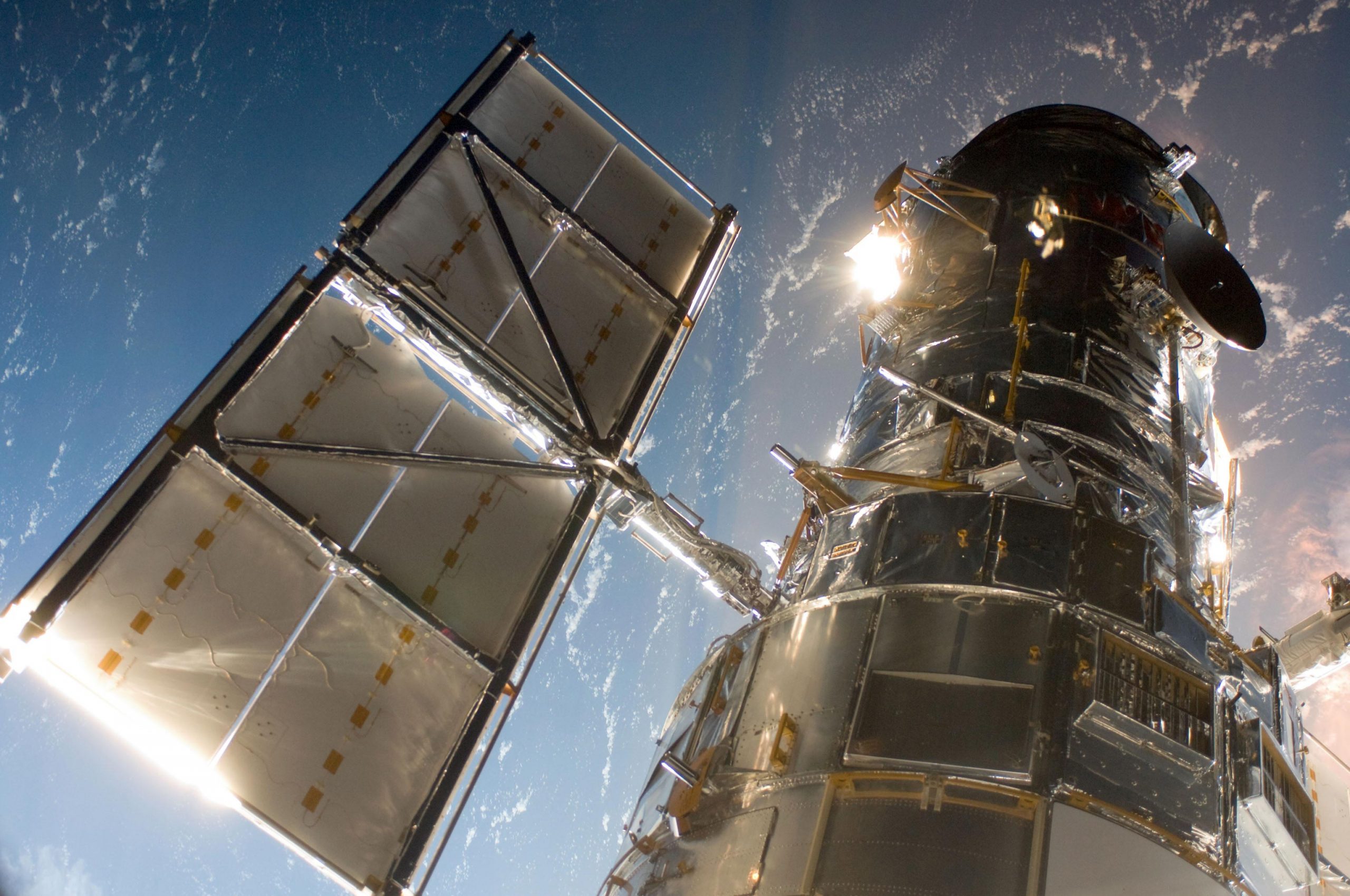
“Hubble opened a new window to the universe when it launched 35 years ago. Its stunning imagery inspired people across the globe, and the data behind those images revealed surprises about everything from early galaxies to planets in our own solar system,” said Shawn Domagal-Goldman, acting director of the Astrophysics Division at NASA Headquarters in Washington. “The fact that it is still operating today is a testament to the value of our flagship observatories, and provides critical lessons for the Habitable Worlds Observatory, which we plan to be serviceable in the spirit of Hubble.”
Orbiting above Earth’s hazy atmosphere, Hubble delivers crisp, detailed views of the universe that have transformed how the public sees space. Its breathtaking images have made astronomy more engaging and accessible for people of all ages, presenting the cosmos as both awe-inspiring and, at times, profoundly mysterious and dramatic.
The Launch of a Game-Changing Telescope
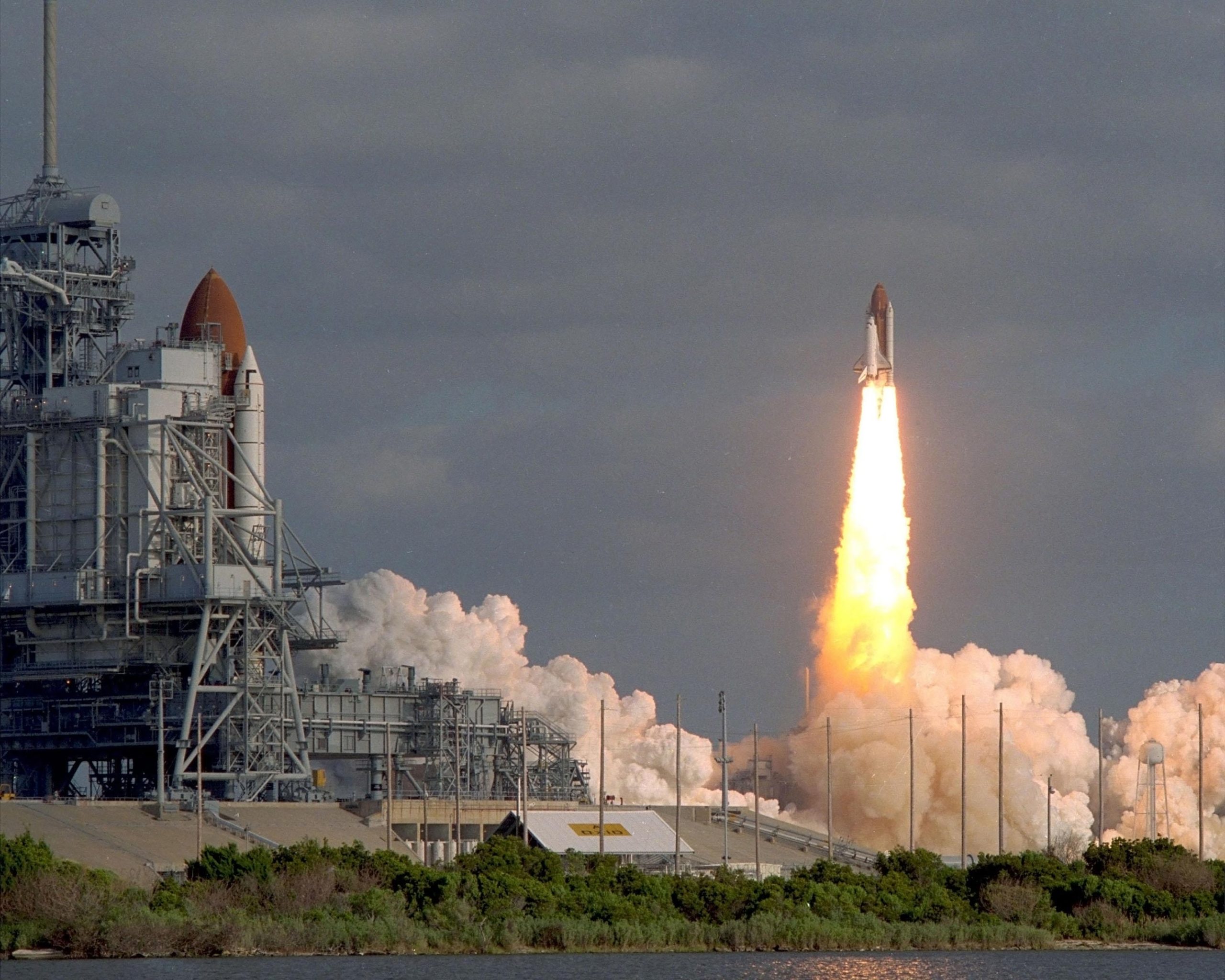
The 24,000-pound observatory was tucked away inside the space shuttle Discovery’s cargo bay and lofted into low Earth orbit on April 24, 1990. As the shuttle Discovery thundered skyward, the NASA commentator described Hubble as a “new window on the universe.” The telescope turned out to be exactly as promised, and more.
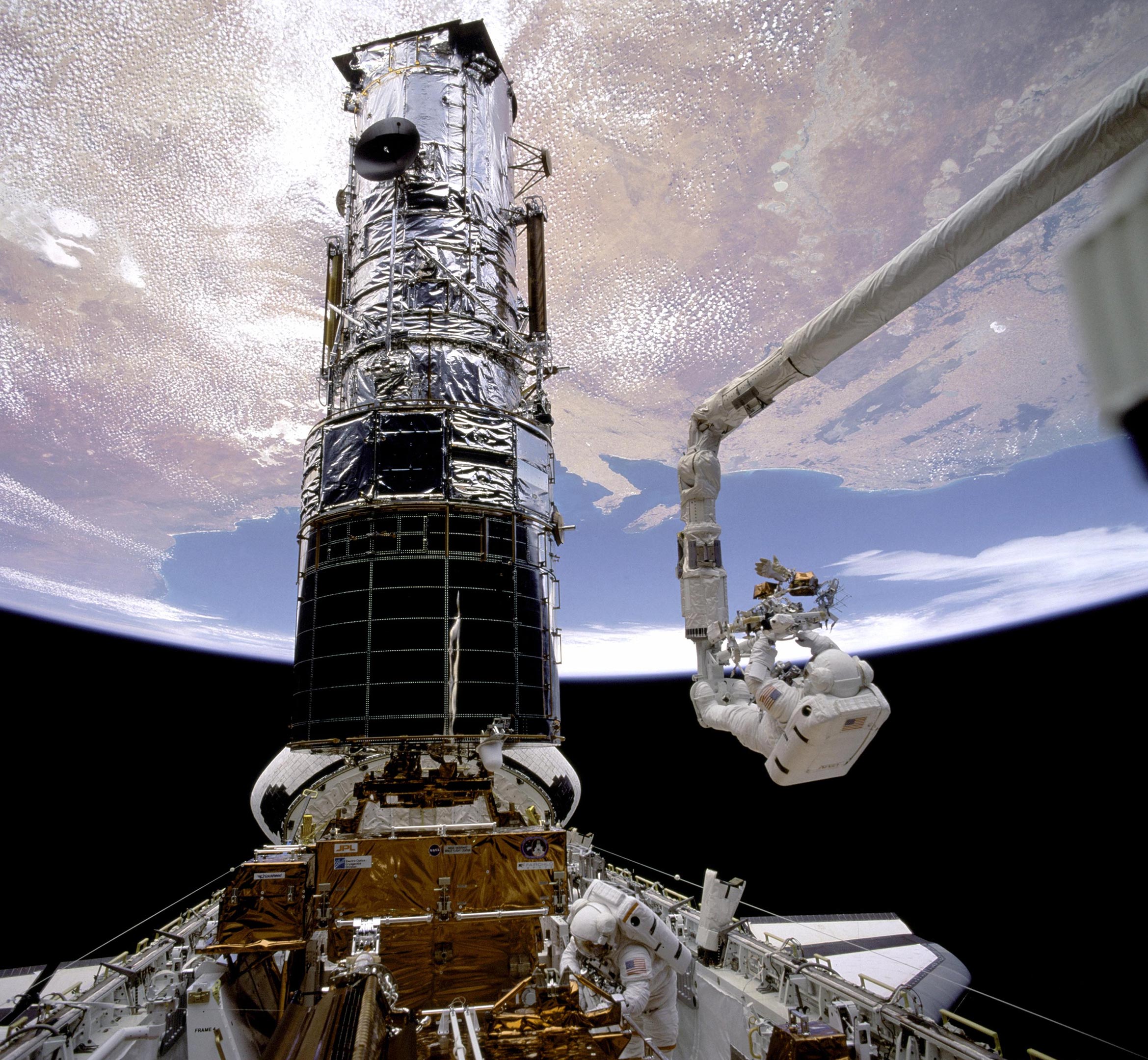
More scientific papers than ever are based on Hubble data, thanks to the dedication, perseverance, and skills of engineers, scientists, and mission operators. Astronauts chased and rendezvoused with Hubble on five servicing missions in which they upgraded Hubble’s cameras, computers, and other support systems. The servicing missions took place from 1993 to 2009.
A Rocky Start: Correcting Hubble’s Vision
The telescope’s mission got off to a shaky start in 1990 when an unexpected flaw was found in the observatory’s nearly eight-foot diameter primary mirror. Astronauts gallantly came to the rescue on the first shuttle servicing mission in December 1993 to improve Hubble’s sharpness with corrective optics.
To date, Hubble has made nearly 1.7 million observations, looking at approximately 55,000 astronomical targets. Hubble discoveries have resulted in over 22,000 papers and over 1.3 million citations as of February 2025. All the data collected by Hubble is archived and currently adds up to over 400 terabytes, representing the biggest dataset for a NASA astrophysics mission besides the James Webb Space Telescope.
Capturing Change Across the Universe
Hubble’s long operational life has allowed astronomers to return to the same cosmic scenes multiple times to observe changes that happened during more than three decades: seasonal variability on the planets in our solar system, black hole jets travelling at nearly the speed of light, stellar convulsions, asteroid collisions, expanding supernova bubbles, and much more.
Before 1990, powerful optical telescopes on Earth could see only halfway across the cosmos. Estimates for the age of the universe disagreed by a big margin. Supermassive black holes were only suspected to be the powerhouses behind a rare zoo of energetic phenomena. Not a single planet had been seen around another star.
Revolutionary Breakthroughs: From Dark Energy to Exoplanets
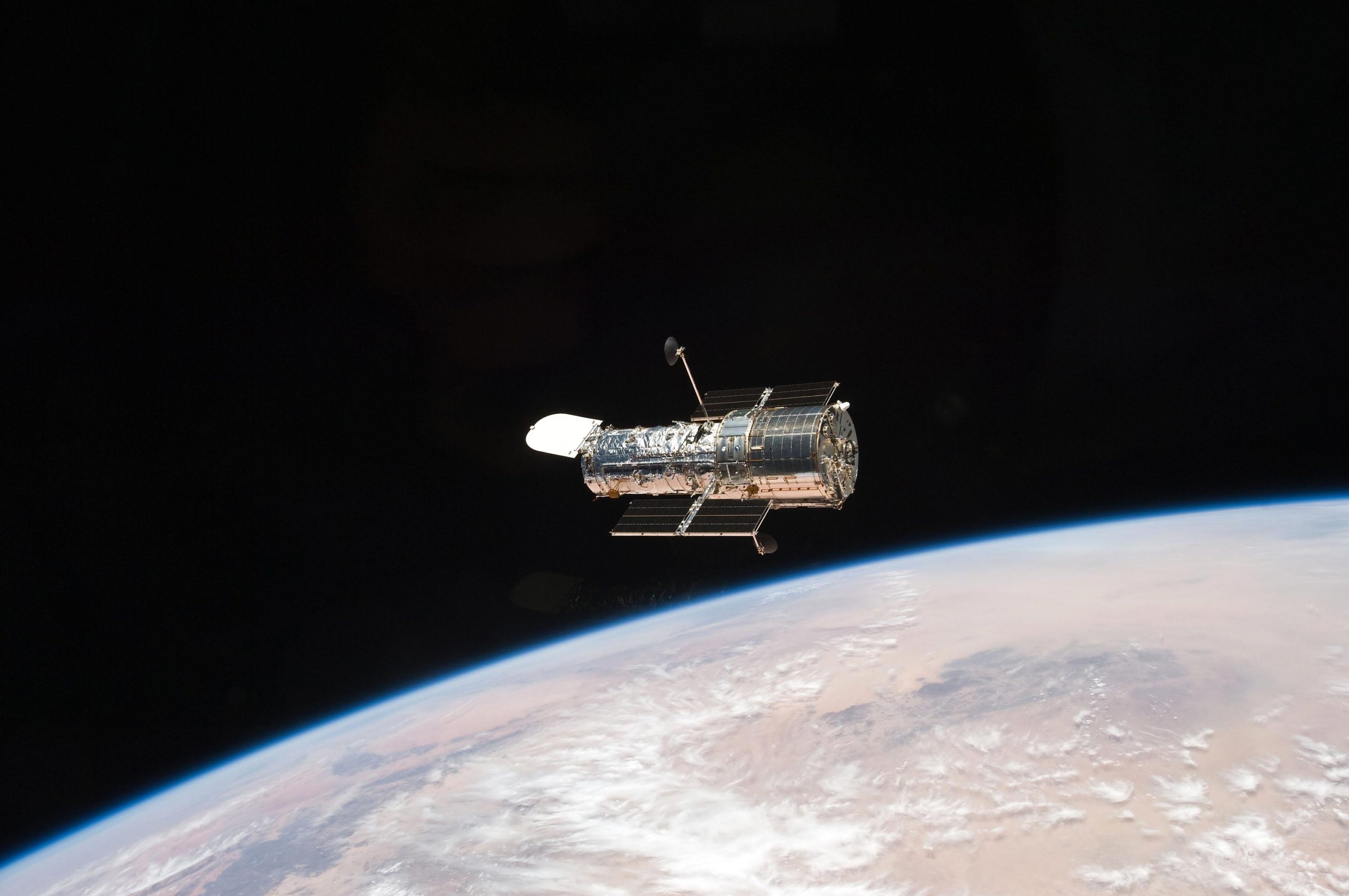
Among its long list of breakthroughs: Hubble’s deep field images unveiled myriad galaxies dating back to the early universe. The telescope also allowed scientists to precisely measure the universe’s expansion, find that supermassive black holes are common among galaxies, and make the first measurement of the atmospheres of exoplanets. Hubble also contributed to the discovery of dark energy, the mysterious phenomenon accelerating the expansion of universe, leading to the 2011 Nobel Prize in Physics.
The relentless pace of Hubble’s trailblazing discoveries kick-started a new generation of space telescopes for the 21st century. Hubble provided the first observational evidence that there were myriad distant galaxies for Webb to pursue in infrared wavelengths that reach even farther beyond Hubble’s gaze. Now, Hubble and Webb are often being used in complement to study everything from exoplanets to galaxy evolution.
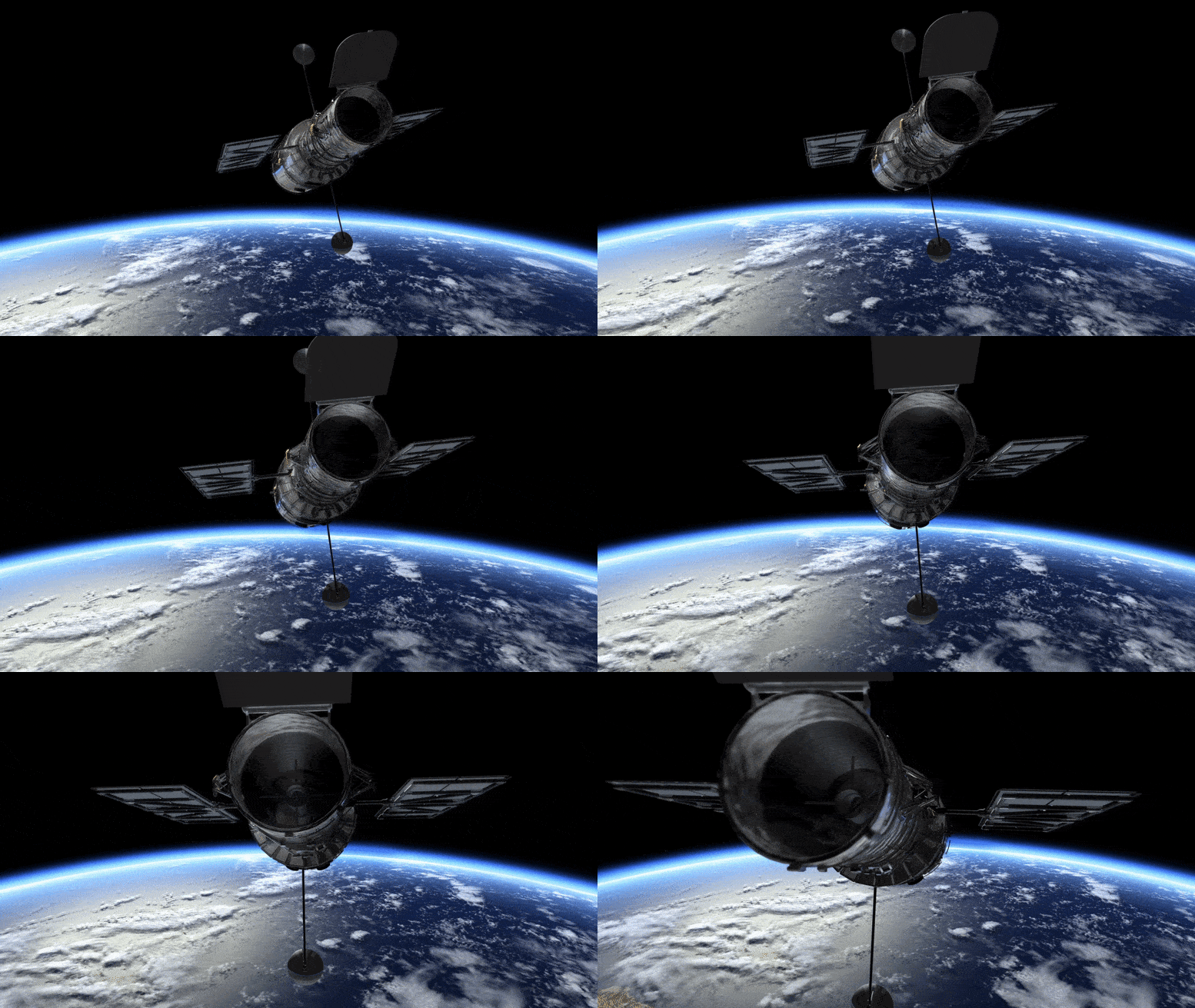
The Future: The Habitable Worlds Observatory
Hubble’s planned successor, the Habitable Worlds Observatory, will have a significantly larger mirror than Hubble’s to study the universe in visible and ultraviolet light. It will be considerably sharper than Hubble and up to 100 times more sensitive to starlight. The Habitable Worlds Observatory will advance science across all of astrophysics, as Hubble has done for over three decades. A major goal of the future mission is to identify terrestrial planets around neighboring stars that might be habitable.
The Hubble Space Telescope is one of the most important astronomical observatories in history, revolutionizing our understanding of the universe with its groundbreaking discoveries. Launched in 1990, Hubble is a joint project between NASA and the European Space Agency (ESA). It is managed by NASA’s Goddard Space Flight Center in Greenbelt, Maryland, with additional operational support from Lockheed Martin Space in Denver. Scientific operations are carried out by the Space Telescope Science Institute in Baltimore, operated by the Association of Universities for Research in Astronomy. For over three decades, Hubble has captured stunning images and vital data, transforming both science and public perception of the cosmos.
Never miss a breakthrough: Join the SciTechDaily newsletter.
Follow us on Google and Google News.