
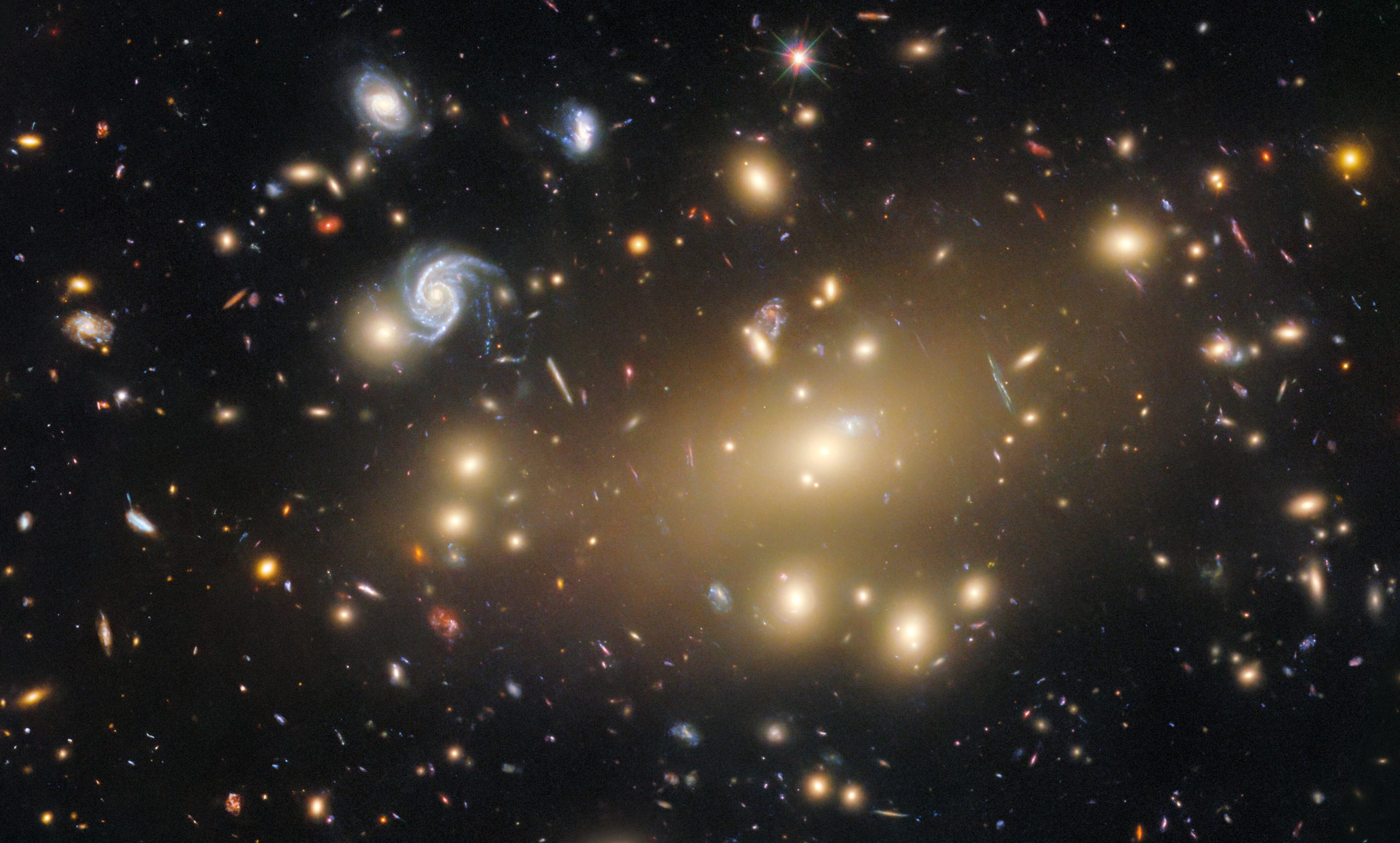
Hubble’s latest portrait zooms into Abell 209, a colossal galaxy cluster 2.8 billion light-years away whose gravity bends spacetime itself.
Beyond the glittering hundred-plus galaxies lies an invisible stew of X-ray-hot gas and dark matter that outweighs normal matter five to one. Subtle streaks from gravitational lensing reveal how astronomers map this hidden mass, providing crucial clues to the evolution of dark matter and dark energy.
Galactic Megacity: Abell 209 Up Close
A colossal cluster of galaxies is bending the very fabric of space—and it’s the focus of this week’s breathtaking image from the Hubble Space Telescope. Known as Abell 209, this enormous cluster lies about 2.8 billion light-years away in the constellation Cetus, also called The Whale.
Hubble’s image reveals more than a hundred galaxies glowing within the cluster, but what’s visible is only part of the story. These galaxies are separated by vast distances, millions of light-years apart, and the space between them isn’t empty. It’s filled with scorching, diffuse gas that only shows up in X-ray observations. Even more mysterious is the presence of dark matter, an invisible form of matter that doesn’t interact with light yet makes up a huge portion of the Universe. In fact, scientists estimate the cosmos is made of about 5% normal matter, 25% dark matter, and 70% dark energy.
Warped Light Unlocks Cosmic Secrets
By observing clusters like Abell 209, astronomers are able to study some of the Universe’s biggest mysteries, including dark matter and dark energy. These galaxy clusters are so massive they actually bend space itself, distorting the light from more distant galaxies behind them. This phenomenon, called gravitational lensing, acts like a natural cosmic magnifying glass, allowing scientists to study galaxies that would otherwise be too faint or far away to see.
While this image lacks the dramatic rings that gravitational lensing can sometimes create, Abell 209 still shows subtle signs of lensing at work, in the form of streaky, slightly curved galaxies within the cluster’s golden glow. By measuring the distortion of these galaxies, astronomers can map the distribution of mass within the cluster, illuminating the underlying cloud of dark matter. This information, which Hubble’s fine resolution and sensitive instruments help to provide, is critical for testing theories of how our Universe has evolved.
Never miss a breakthrough: Join the SciTechDaily newsletter.
Follow us on Google and Google News.
9 Comments
Hubble’s Warped Wonderland: Abell 209 Bends Space and Unmasks Dark Matter。
VERY GOOD!
Please ask the researchers to think deeply:
Is there a bending time in a Bends Space?
If you believes the evidence, please browse https://zhuanlan.zhihu.com/p/1917878197971816654 (If the link is not blocked).
Bending of spacetime,indicated by path of light is due to the dark matter’s gravity;gives the required pattern of DM’s distribution,in the galaxy cluster Abell 209,in modern cosmology.
Demonstrating, again, with a very recently uploaded fourth (of four) low budget senior lay American male videos (https://odysee.com/@charlesgshaver:d/5Gravity:c), motive gravity is locally induced to radiate from all cosmic objects in generally spherical fields of pulsing-angular-lines-of-attractive-force, with declining density and strength (in accordance with the inverse square law of attraction) as they expand across the entire universe. Intensification of gravity due to rotation, not hypothetical “dark matter,” can account for the additional lensing/distortions in the photo. Perhaps the reason it’s so difficult for so-called “experts” to appreciate what I so readily demonstrate (as opposed to merely calculate, misinterpret and/or postulate), repeatedly, is because dogmatic faith in the hypothetical “warping of space-time” doesn’t allow them to achieve the levels of insight and scientific objectivity needed to peer into some of the more subtle areas of reality. Who else has ever even imagined demonstrating the true nature of gravity in my ways?
VERY GOOD.
The current state of physics and so-called top-tier or authoritative publications—with their visible and hidden corruptions and ugliness—has become truly shocking. Defying empirical distinctions by defining the manifestly different θ and τ particles as identical. Two sets of artificially counter-rotating Co-60—whether symmetric or not—constitute mirror objects to each other. Perhaps only so-called peer-reviewed publications such as Nature, Science, and the Physical Review series would dare to act with such recklessness and shamelessness.
If you believes the evidence, please browse https://zhuanlan.zhihu.com/p/1925124100134790589 (If the link is not blocked).
Charles,
Warping of space-time isn’t hypothetical. It has been confirmed by numerous experiments.
It is possible to improve on the current theories of gravity – say, based on rotation – but you need math to verify the idea. How does this new gravity affect the orbits of the Earth and the moon? Now, if you say that the effect is too small and is only observable at galactic scales, then how are you confirming it with experiments right here on earth?
Thank you for a challenging, thought provoking reply. I did a brief search for convincing experiments to prove the existence of space-time with no success. Therefore, I will simply defer to the more obvious results of my own experiment with the old universal gravity that Newton explained for us so long ago. With both disks not only commencing to rotate as the bar slows, but to actually accelerate, it should be obvious that Einstein’s theory of space-time (which he doubted some himself) does not apply. And, as to distortions and lensing, photons are simply following a roughly spherical path of lines of gravity force around those objects. I’m not so sure even all of humanity, with all of it’s computers and AI, could ever calculate all of the intensified gravity due to the rotation of all of those black holes, stars, planets and moons in all of those galaxies; certainly not just I. However, I do have a rough idea of an equation for a single object.
Charles,
Thank you for your civilized and mature response.
You say: “I did a brief search for convincing experiments to prove the existence of space-time with no success.”
There are several that comes up in my search. I am not sure what the issue is: whether you did not get any search results or that you are not convinced with what you got. If you are not convinced, then note that without any supporting evidence, that is just a personal opinion which carry no scientific weight.
I think you still need to respond to the rest of my objections in my previous post – the lack of predictions about earth’s orbit and how an effect that only shows up at galactic scales should also show up with earthbound experiments.
I did look at the videos. First, you claim that the disks start rotating at the end. That is not true. They rotate right away – you can pause the video at various points to see that your markings have moved. Second, you claim that there is no “visible force” on the disks. Now, force is never visible – but it is obvious that the disks are constantly accelerated (they move in a circle), and thus have constant force on them according to Newtonian Mechanics. The force is delivered by nudges on the pin(?) that holds the disk on the bar. Finally, that force explains why the disks rotate – because the forces are never fully aligned with the centers of the disks.
Thanks for sticking to the scientific method by taking the effort with the experiment. In this case, however, the results of the experiment do not uncover any new science.
First, AG3, yes, the initial at-rest inertia of both disks did cause a partial rotation when the bar was first rotated. Then, they remained static on the bar until it slowed sufficiently for their weak local fields of gravity to ‘reengage’ with earth’s ambient field, ultimately cohering with it. It may not be obvious in that video but there was an obvious difference in the rotation rates of both disks on the bar, CW (faster) and CCW (slower), which I attribute to an angularity in earth’s pulsing field that homogenous space-time would not exhibit. Looking again for a convincing experiment in favor of warped space-time, those I found are not convincing. From local to galactic, the variables are probably only distances, masses and rates of rotation. With such limited space here, if also interested, how about you using the email address in the video, or suggest another, to continue this conversation?