
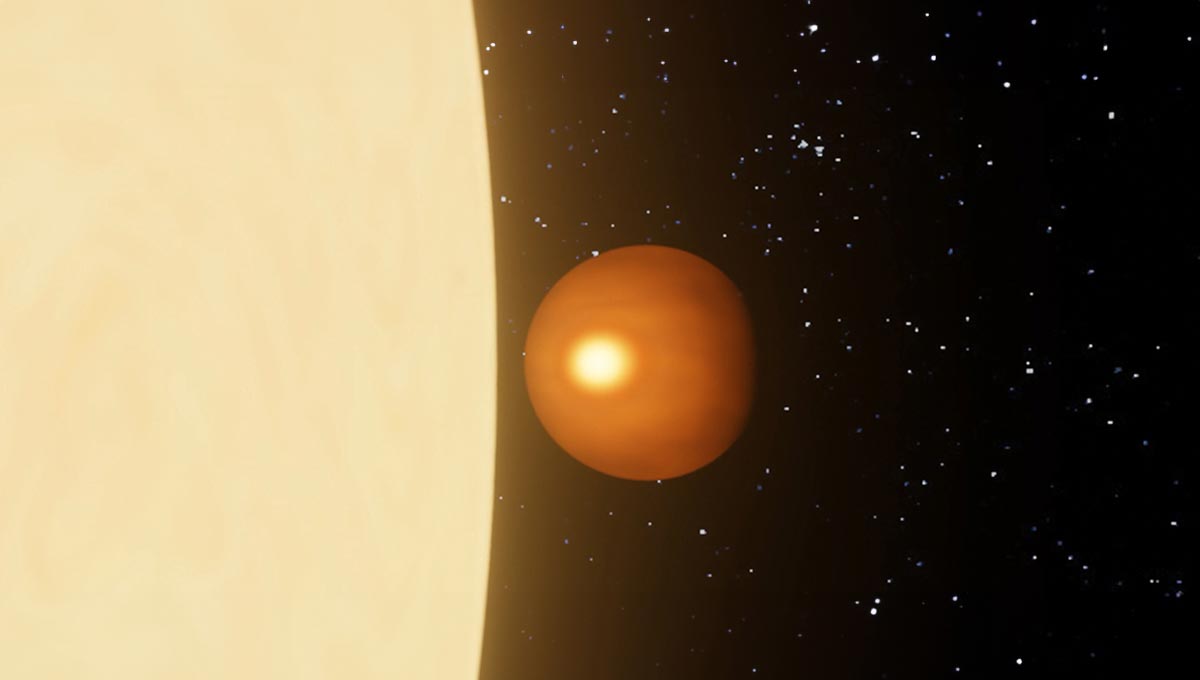
An international team has discovered that iron winds are blowing on the day side of the planet WASP-76 b.
Astronomers have discovered iron winds on the exoplanet WASP-76 b, revealing extreme atmospheric phenomena like iron rain and a unique ‘rainbow’ effect. Utilizing advanced instruments like the ESPRESSO spectrograph, these findings contribute to our understanding of exoplanetary climates, providing crucial data for 3D climate modeling and enhancing our knowledge of planetary dynamics in ultra-hot gas giants.
An international team of astronomers, including scientists from
The ultra-hot exoplanet WASP-76 b has been the subject of numerous studies since its discovery in 2013, revealing numerous extreme atmospheric phenomena. Previous research by international teams, including those at the UNIGE, has identified iron rain on its night side, the presence of barium in its upper atmosphere, and the existence of a “rainbow” at the boundary between its day and night sides.
Insights From Extensive Observations
“The work on WASP-76 b shows us just how extreme atmospheric conditions can be on ultra-hot Jupiters,” explains David Ehrenreich, associate professor in the Astronomy Department at the UNIGE Faculty of Science, member of the NCCR PlanetS and co-author of the study. “In-depth analysis of this type of planet provides us with valuable information for a better understanding of planetary climates as a whole.”
Flux of Iron Atoms
For this new study, the team of astronomers focused on the day side of WASP-76 b, which has a temperature of 2400 degrees Celsius, by observing it at high spectral resolution in the visible light. The main result was the detection of a stream of iron atoms moving from the lower to the upper layers of the planet’s atmosphere.
“This is the first time that such detailed optical observations have been made on the day side of this exoplanet, providing key data on its atmospheric structure,” explains Ana Rita Costa Silva, a doctoral student at the Instituto de Astrofísica e Ciências do Espaço (IA), on a long term visit at the Astronomy Department of the UNIGE Faculty of Science and first author of the study. “Our observations indicate the presence of powerful iron winds, probably fuelled by a hot spot in the atmosphere.”
Advanced Tools for Exoplanet Analysis
This breakthrough was made possible by the use of the ESPRESSO spectrograph, renowned for its precision and stability. The instrument, built largely by the UNIGE and installed on ESO’s Very Large Telescope (VLT) in Chile, was used to acquire high-resolution spectra of the planet. By analyzing this light, the team was able to identify the chemical signatures of iron moving in the planet’s atmosphere. This technique, known as high-resolution emission spectroscopy, is particularly powerful for studying the atmospheres of exoplanets.
“ESPRESSO’s ability to make such precise measurements is crucial,” says Christophe Lovis, associate professor in the Astronomy Department at the UNIGE Faculty of Science, member of the NCCR PlanetS and co-author of the study. “This level of precision allows us to explore the dynamic processes in the atmospheres of exoplanets like WASP-76 b with an unprecedented level of detail.”
Understanding Exoplanetary Climates
The successive discoveries made on WASP-76 b are paving the way for a better understanding of exoplanetary climates, particularly in the case of gas giants subjected to extreme irradiation from their host star. The detailed mapping of atmospheric winds and their chemical composition is helping astronomers to develop a complete model of the evolution of these distant worlds.
By detecting iron winds on WASP-76 b, the astronomers are providing crucial new information for building 3D models of this exoplanet’s climate, which could one day help them predict similar phenomena on other distant planets.
Reference: “ESPRESSO reveals blueshifted neutral iron emission lines on the dayside of WASP-76 b” by A.R. Costa Silva, O. D. S. Demangeon, N. C. Santos, D. Ehrenreich, C. Lovis, H. Chakraborty, M. Lendl, F. Pepe, S. Cristiani, R. Rebolo, M. R. Zapatero-Osorio, V. Adibekyan, Y. Alibert, R. Allart, C. Allende Prieto, T. Azevedo Silva, F. Borsa, V. Bourrier, E. Cristo, P. Di Marcantonio, E. Esparza-Borges, P. Figueira, J. I. González Hernández, E. Herrero-Cisneros, G. Lo Curto, C. J. A. P. Martins, A. Mehner, N. J. Nunes, E. Palle, S. Pelletier, J. V. Seidel, A. M. Silva, S. G. Sousa, A. Sozzetti, M. Steiner, A. Suárez Mascareño and S. Udry, 5 September 2024, Astronomy & Astrophysics.
DOI: 10.1051/0004-6361/202449935
Never miss a breakthrough: Join the SciTechDaily newsletter.
Follow us on Google and Google News.