

Astronomers using the James Webb Space Telescope have discovered Zhúlóng, the most distant known spiral galaxy, existing just one billion years after the Big Bang.
Defying expectations, Zhúlóng already sports a mature, Milky Way–like structure, showing that spiral arms and organized galactic forms can arise far earlier than previously believed. Its discovery through the groundbreaking PANORAMIC Survey not only hints at faster cosmic evolution but also opens the door to finding more unexpected galactic treasures lurking in the early Universe.
Discovery of the Most Distant Spiral Galaxy
An international team led by NSF NOIRLab astronomer Christina Williams has discovered the most distant spiral galaxy ever observed. Named Zhúlóng — after the “Torch Dragon” from Chinese mythology — this massive galaxy formed just one billion years after the Big Bang.[1] Despite its early appearance in cosmic history, Zhúlóng already shows a surprisingly mature, well-organized structure. The discovery was made during the PANORAMIC Survey, an ambitious project carried out using the James Webb Space Telescope (JWST).
Spiral galaxies like our own Milky Way are common in the modern Universe. However, astronomers have found them to be extremely rare in the early Universe, which aligns with theories suggesting that large, organized disks with spiral arms take billions of years to fully form. That makes Zhúlóng a remarkable find: it is not only the oldest but also the earliest known spiral galaxy ever detected.
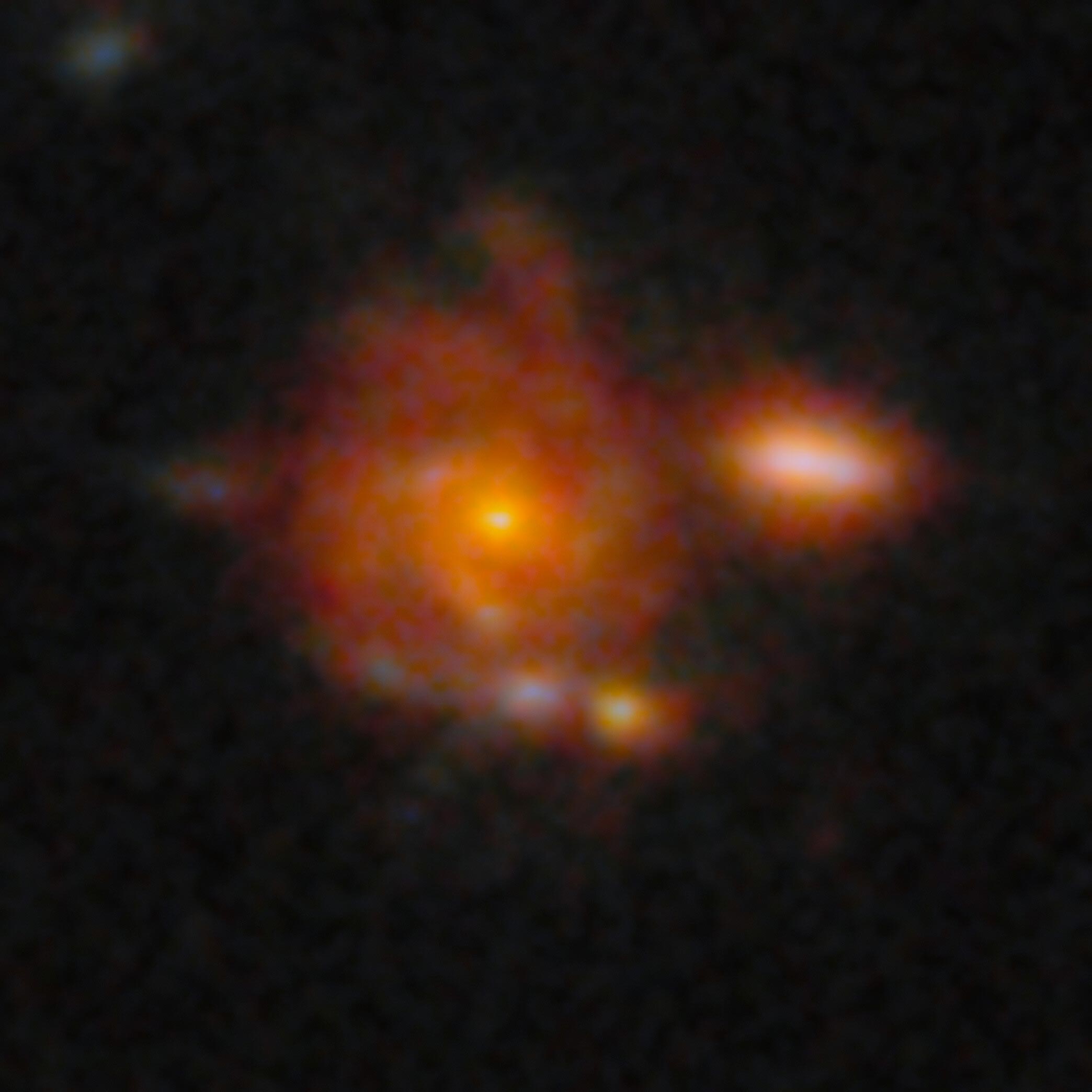
Zhúlóng: A Cosmic Torch Dragon
Zhúlóng, whose name comes from a legendary creature in Chinese mythology associated with light and cosmic cycles, stands out for its unexpected maturity. Its discovery was made through the PANORAMIC Survey, a wide-area imaging project designed to complement upcoming large-scale surveys. The survey is co-led by Christina Williams and Pascal Oesch of the University of Geneva (UNIGE), with observations collected by JWST.
The research was motivated by building a wide-area imaging survey using JWST to complement future wide-area surveys based out of NOIRLab, such as the upcoming Legacy Survey of Space and Time (LSST), which will be conducted using the NSF–DOE Vera C. Rubin Observatory.
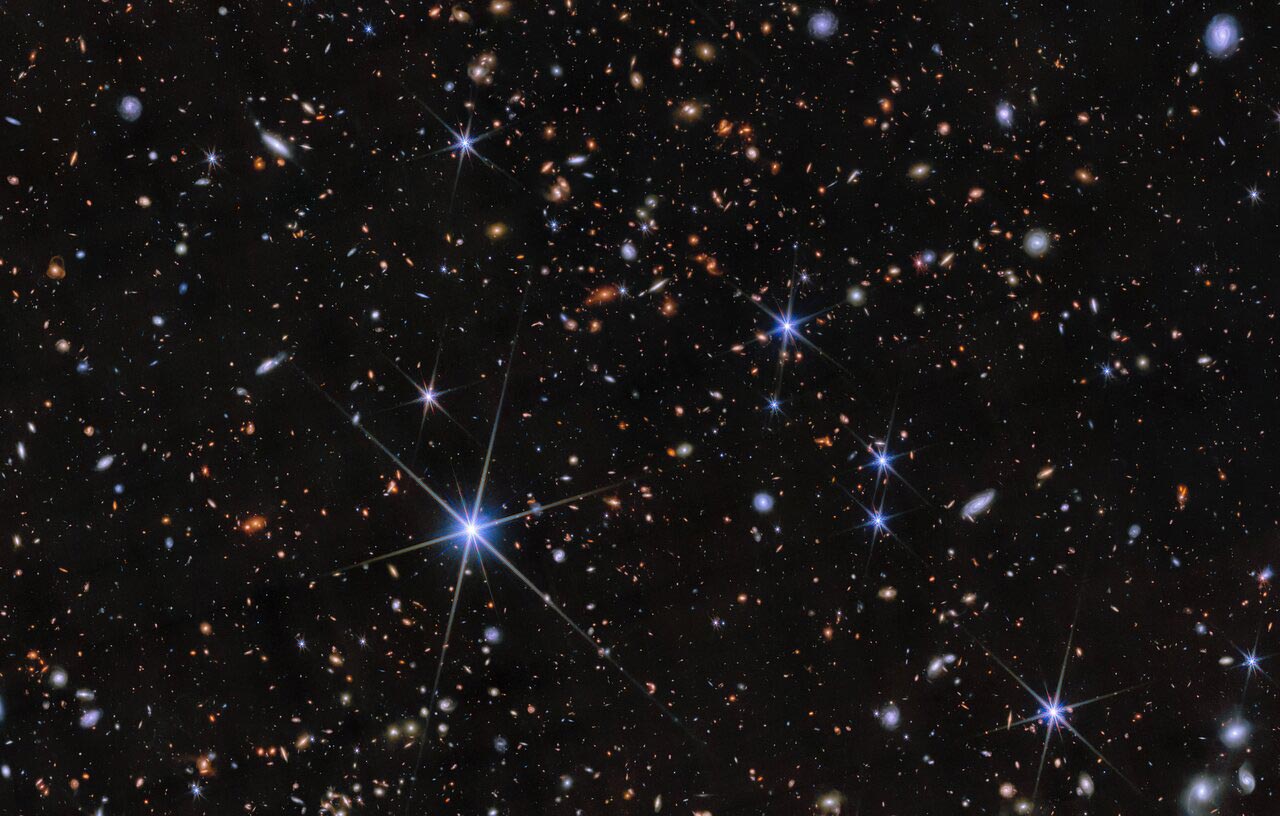
Rare and Massive Galaxy Sightings
“Wide-area surveys are necessary to discover rare, massive galaxies,” says Williams, co-author on the paper presenting these results. “We were hoping to discover massive and bright galaxies across the earliest epochs of the Universe to understand how massive galaxies form and evolve, which helps to interpret the later epochs of their evolution that will be observed with the LSST.”
Zhúlóng has a surprisingly mature structure that is unique among distant galaxies, which are typically clumpy and irregular. It resembles galaxies found in the nearby Universe and has a mass and size similar to those of the Milky Way. Its structure shows a compact bulge in the center with old stars, surrounded by a large disk of younger stars that concentrate in spiral arms.
Spiral Arms Forming Early
This is a surprising discovery on several fronts. First, it shows that mature galaxies that resemble those in our neighborhood can develop much earlier in the Universe than was previously thought possible. Second, it has long been theorized that spiral arms in galaxies take many billions of years to form, but this galaxy demonstrates that spiral arms can also develop on shorter timescales. There is no other galaxy like Zhúlóng that astronomers know of during this early era of the Universe.
“It is really exciting that this galaxy resembles a grand-design spiral galaxy like our Milky Way,” says Williams. “It is generally thought that it takes billions of years for this structure to form in galaxies, but Zhúlóng shows that this could also happen in only one billion years.”
The Fragility of Early Spiral Structures
The rarity of galaxies like Zhúlóng suggests that spiral structures could be short-lived at this epoch of the Universe. It’s possible that galactic mergers, or other evolutionary processes that are more common in the early Universe, might destroy the spiral arms. Thus, spiral structures might be more stable later in cosmic time, which is why they are more common in our neighborhood.
The PANORAMIC survey is novel in that it is one of the first JWST projects to use “pure parallel mode” — an efficient observing strategy in which a second camera collects additional images while JWST’s main camera is pointed elsewhere. “It was definitely an adventure to be one of the first to use a new observing mode on a new telescope,” says Williams.
A New Era of Galaxy Discoveries
Future JWST and Atacama Large Millimeter/submillimeter Array (ALMA) observations will help confirm Zhúlóng’s properties and reveal more about its formation history. As new wide-area extragalactic surveys continue, astronomers expect to find more such galaxies, offering fresh insights into the complex processes shaping the early Universe.
Notes
- Zhúlóng was discovered at redshift 5.2, which equates to a light-travel time of about 12.5 billion years.
Explore Further: 12-Billion-Year-Old Milky Way Twin Shocks Astronomers
More information
This research was presented in a paper titled “PANORAMIC: Discovery of an Ultra-Massive Grand-Design Spiral Galaxy at z∼5.2” appearing in Astronomy & Astrophysics. DOI: 10.1051/0004-6361/202453487
The team is composed of Mengyuan Xiao (University of Geneva), Christina C. Williams (NSF NOIRLab, University of Arizona), Pascal A. Oesch (University of Geneva, University of Copenhagen), David Elbaz (Université Paris Cité), Miroslava Dessauges-Zavadsky (University of Geneva), Rui Marques-Chaves (University of Geneva), Longji Bing (University of Sussex), Zhiyuan Ji (University of Arizona), Andrea Weibel (University of Geneva), Rachel Bezanson (University of Pittsburgh), Gabriel Brammer (University of Copenhagen), Caitlin Casey (University of California, University of Texas at Austin, University of Copenhagen), Aidan P. Cloonan (University of Massachusetts Amherst), Emanuele Daddi (Université Paris Cité), Pratika Dayal (University of Groningen), Andreas L. Faisst (Caltech/IPAC), Marijn Franx (Leiden University), Karl Glazebrook (Swinburne University of Technology), Anne Hutter (University of Copenhagen), Jeyhan S. Kartaltepe (Rochester Institute of Technology), Ivo Labbe (Swinburne University of Technology), Guilaine Lagache (Aix-Marseille Université), Seunghwan Lim (University of Cambridge), Benjamin Magnelli (Université Paris Cité), Felix Martinez (Rochester Institute of Technology), Michael V. Maseda (University of Wisconsin-Madison), Themiya Nanayakkara (Swinburne University of Technology), Daniel Schaerer (University of Geneva), and Katherine E. Whitaker (University of Massachusetts Amherst).
Never miss a breakthrough: Join the SciTechDaily newsletter.
Follow us on Google and Google News.
3 Comments
“Defying expectations…”
“How can you receive new wisdom when your cup is already full of expectations and conclusions.” – Zen saying
Really freaking cool… but I lost interest the 4th time it started repeating itself. This was either a writer not caring, or an AI article.
Yes. SciTech keeps on repeating the same stories.