

Sagittarius C, a turbulent region near the Milky Way’s center, is glowing with hot plasma and threaded by magnetic fields, slowing star formation despite its dense gas.
New images from the James Webb Space Telescope reveal never-before-seen details, including bizarre filaments and energetic protostars. Scientists now believe powerful magnetic forces are reshaping this stellar nursery, delaying its demise—but not for long.
Extreme Star-Forming Region Near the Galactic Center
Sagittarius C is one of the most extreme and active regions in the Milky Way. Located about 200 light-years from the supermassive black hole at our galaxy’s center, this dense, cloud-filled zone is packed with gas and dust. Over millions of years, parts of this material have collapsed under gravity, giving rise to thousands of new stars.
In a new study, scientists used NASA’s James Webb Space Telescope to observe Sagittarius C in unprecedented detail. The research was led by astrophysicist John Bally from the University of Colorado Boulder, along with Samuel Crowe at the University of Virginia, Rubén Fedriani at the Instituto de Astrofísica de Andalucía in Spain, and their colleagues.
The Central Molecular Zone’s Star Formation Mystery
Their observations could help answer a long-standing puzzle about the galaxy’s innermost region, known as the Central Molecular Zone (CMZ). Although the CMZ contains vast amounts of gas, far fewer stars are forming there than expected. Why?
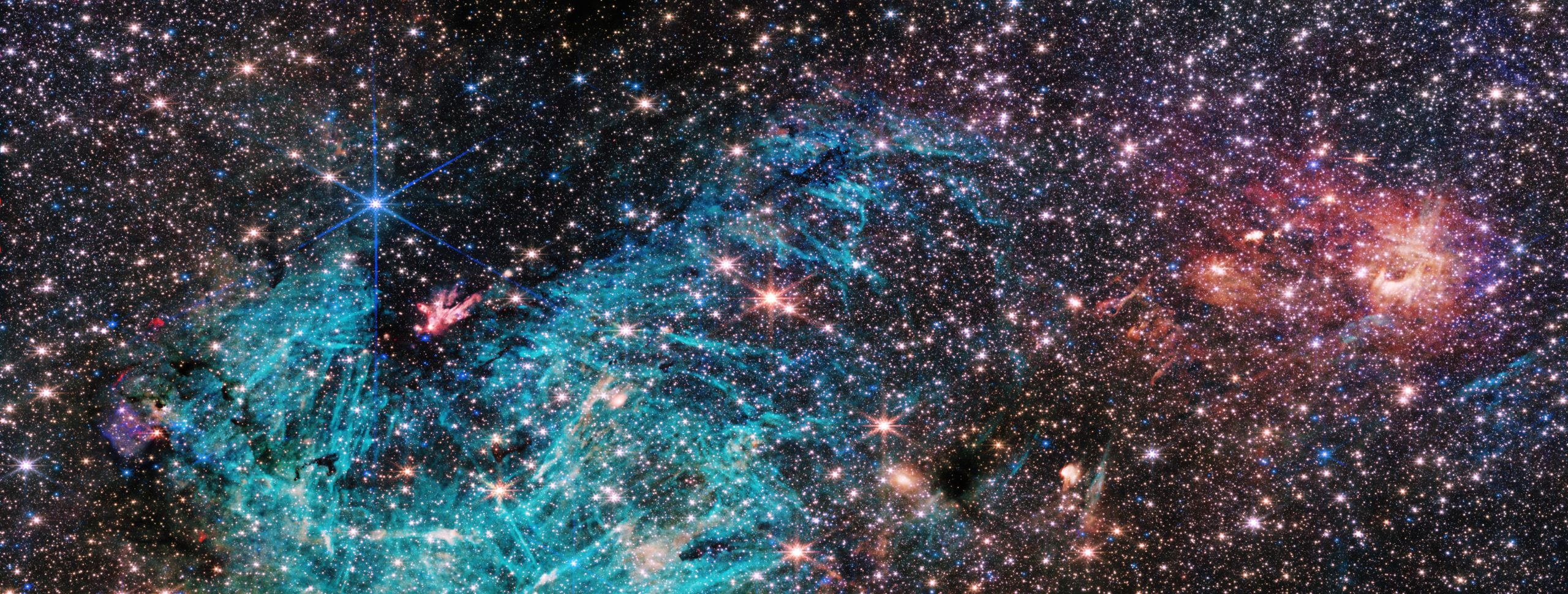
The team discovered that powerful magnetic fields appear to thread through Sagittarius C, creating long, glowing filaments of hot hydrogen gas, structures that resemble strands of spaghetti. These magnetic forces may be slowing the collapse of gas clouds, limiting the birth of new stars.
A Glimpse into the Galaxy’s Youth
“It’s in a part of the galaxy with the highest density of stars and massive, dense clouds of hydrogen, helium and organic molecules,” said Bally, professor in the Department of Astrophysical and Planetary Sciences at CU Boulder. “It’s one of the closest regions we know of that has extreme conditions similar to those in the young universe.”
He and his colleagues published their findings recently in The Astrophysical Journal. The research is part of an observation campaign proposed and led by Crowe, a fourth-year undergraduate student at the University of Virginia who was recently named a Rhodes Scholar.
And, Crowe noted, the Webb telescope’s startling images show Sagittarius C as it’s never been seen before.
“Because of these magnetic fields, Sagittarius C has a fundamentally different shape, a different look than any other star forming region in the galaxy away from the galactic center,” Crowe said.
How Stars Are Born—and Unmade
The research sheds light on the violent births and deaths of stars in the Milky Way Galaxy.
Stars tend to form within what scientists call “molecular clouds,” or regions of space containing dense clouds of gas and dust. The closest such stellar nursery to Earth lies in the Orion Nebula, just below Orion’s belt. There, molecular clouds have collapsed over millions of years, forming a cluster of new stars.
Such active sites of star formation also spell their own demise. As new stars grow, they begin to emit vast amounts of radiation into space. That radiation, in turn, blows away the surrounding cloud, stripping the region of the matter it needs to build more new stars.
“Even the sun, we think, formed in a massive cluster like this,” Bally said. “Over billions of years, all of our sibling stars have drifted away.”
In a separate study also published in The Astrophysical Journal, Crowe and his colleagues, including Bally, dove into the growing “protostars” forming in Sagittarius. Their data reveal a detailed picture of how these young stars are ejecting radiation and blowing away the gas and dust around them.
A Surprising Filamentary Structure
In the study led by Bally, the researchers explored Sagittarius C’s unusual appearance. Bally explained that while the Orion Nebula looks mostly smooth, Sagittarius C is anything but. Weaving in and out of this region are dozens of bright filaments, some several light-years long. These filaments are made up of plasma, a hot gas of charged particles.
“We were definitely not expecting those filaments,” said Rubén Fedriani, a co-author of the study and postdoctoral researcher at the Instituto de Astrofísica de Andalucía in Spain. “It was a completely serendipitous discovery.”
Bally noted that the secret to Sagittarius C’s filaments, and the nature of its star formation, likely comes down to magnetic fields.
A supermassive black hole with a mass about four million times greater than our sun sits at the center of the galaxy. The motion of gas swirling around this behemoth can stretch and amplify the surrounding magnetic fields. Those fields, in turn, shape the plasma in Sagittarius C.
Magnetic Forces vs. Star Birth
Bally suspects that the Orion Nebula looks much smoother because it resides within a much weaker magnetic environment.
Scientists, he added, have long known that the galaxy’s innermost regions are an important birthplace for new stars. But some calculations have suggested that the region should be producing a lot more young stars than observed. In the CMZ, magnetic forces may be strong enough to resist the gravitational collapse of molecular clouds, limiting the rate of new star formation.
The Twilight of Sagittarius C
Regardless, Sagittarius C’s own time may be drawing to a close. The region’s stars have blown away much of its molecular cloud already, and that nursery could disappear entirely in a few hundred thousand years.
“It’s almost the end of the story,” Bally said.
Explore Further: Webb Telescope Uncovers Star Birth Struggles in a Magnetic Maze at the Milky Way’s Core
References:
“The JWST-NIRCam View of Sagittarius C. I. Massive Star Formation and Protostellar Outflows” by Samuel Crowe, Rubén Fedriani, Jonathan C. Tan, Alva Kinman, Yichen Zhang, Morten Andersen, Lucía Bravo Ferres, Francisco Nogueras-Lara, Rainer Schödel, John Bally, Adam Ginsburg, Yu Cheng, Yao-Lun Yang, Sarah Kendrew, Chi-Yan Law, Joseph Armstrong and Zhi-Yun Li, 2 April 2025, The Astrophysical Journal.
DOI: 10.3847/1538-4357/ad8889
“The JWST-NIRCam View of Sagittarius C. II. Evidence for Magnetically Dominated H ii Regions in the Central Molecular Zone” by John Bally, Samuel Crowe, Rubén Fedriani, Adam Ginsburg, Rainer Schödel, Morten Andersen, Jonathan C. Tan, Zhi-Yun Li, Francisco Nogueras-Lara, Yu Cheng, Chi-Yan Law, Q. Daniel Wang, Yichen Zhang and Suinan Zhang, 2 April 2025, The Astrophysical Journal.
DOI: 10.3847/1538-4357/ad9d0b
Never miss a breakthrough: Join the SciTechDaily newsletter.
Follow us on Google and Google News.