
Close Menu
    Facebook X (Twitter) Instagram
    SciTechDaily
    • Biology
    • Chemistry
    • Earth
    • Health
    • Physics
    • Science
    • Space
    • Technology
    Facebook X (Twitter) Pinterest YouTube RSS
    SciTechDaily
    Home»Science»Loneliness and Social Anxiety Are Driven by Different Brain States
    Science

    Loneliness and Social Anxiety Are Driven by Different Brain States

    By Society for NeuroscienceFebruary 18, 2022No Comments2 Mins Read
    Facebook Twitter Pinterest Telegram LinkedIn WhatsApp Email Reddit
    Share
    Facebook Twitter LinkedIn Pinterest Telegram Email Reddit
    Brain Wave Graph
    Even though they exhibit similar symptoms, loneliness and social anxiety are caused by distinct brain states, according to new research.

    Behavioral interventions targeting social anxiety must be adapted to treat loneliness.

    Despite similar symptoms, loneliness and social anxiety are driven by different brain states, according to new research published in JNeurosci.

    Loneliness can have detrimental consequences on physical and mental health, yet there are currently few behavioral interventions for loneliness like there are for other conditions. Lieberz et al. explored the basis for these two conditions by comparing how people with social anxiety and high and low loneliness behaved in a social gambling task. Participants played a computer game where they could make a safe bet and win a smaller amount of money or make a riskier bet for a larger sum. If they took the riskier bet, they watched a video of a virtual human showing approval or disapproval.
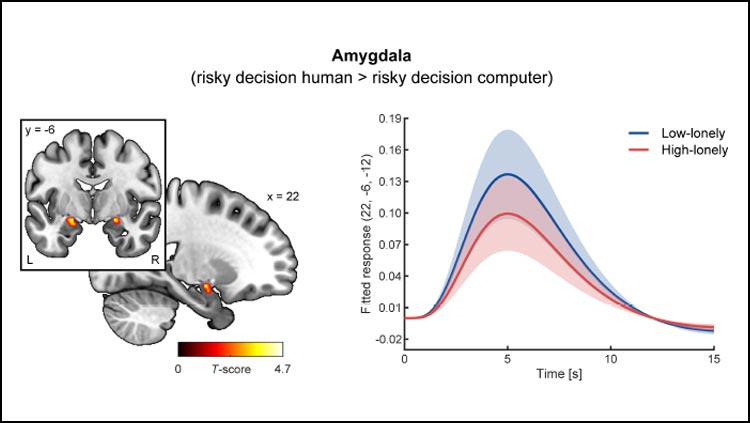
    Loneliness Social Anxiety Amygdala Activity
    Amygdala activity was significantly enhanced during the decision phase of the social gambling task when participants chose the risky option with a human partner compared to the computer partner. Credit: Lieberz et al., JNeurosci 2021

    People with social anxiety took the safe bet more often to avoid social feedback from the videos. But people with high loneliness did not display this social avoidance. By measuring the participants’ brain activity during the task with fMRI, the researchers found people with social anxiety displayed increased amygdala activation during the decision phase — a sign of heightened anxiety — and reduced nucleus accumbens activation during the feedback phase — a sign of reduced social reward. Neither activity pattern appeared in people with high loneliness, indicating loneliness is a unique condition requiring its own interventions.

    Reference: “Behavioral and neural dissociation of social anxiety and loneliness” by Jana Lieberz, Simone G. Shamay-Tsoory, Nira Saporta, Alisa Kanterman, Jessica Gorni, Timo Esser, Ekaterina Kuskova, Johannes Schultz, René Hurlemann and Dirk Scheele, 14 February 2022, JNeurosci.
    DOI: 10.1523/JNEUROSCI.2029-21.2022

    Never miss a breakthrough: Join the SciTechDaily newsletter.
    Follow us on Google and Google News.

    Anxiety Disorders Behavioral Science Neuroscience Society for Neuroscience
    Share. Facebook Twitter Pinterest LinkedIn Email Reddit

    Related Articles

    Managing Your Emotions: Targeted Brain Stimulation Dulls Social Pain

    Infant Brain Circuitry Shaped by Language Exposure

    “Area 32” – How the Brain Balances Emotion and Reason

    Why Time Sometimes Flies or Drags: How the Brain Creates the Experience of Time

    Motherhood Overrides the Brain’s Decision-Making – Prioritizes Offspring Over Cocaine

    Monkeys Experience the Uncanny Valley Effect, Just Like Humans

    Scientists Can See the Bias in Your Brain – Even Before You Make Your Decision

    Listening to Binaural Beats Synchronizes Brain Activity, but What Is the Effect on Mood, Focus and Anxiety?

    Dreams May Serve a Real Purpose: Preparing Us to Face Our Fears

    Leave A Reply Cancel Reply

    • Facebook
    • Twitter
    • Pinterest
    • YouTube

    Don't Miss a Discovery

    Subscribe for the Latest in Science & Tech!

    Trending News

    Largest-Ever Study Finds Medicinal Cannabis Ineffective for Anxiety, Depression, PTSD

    250-Million-Year-Old Egg Solves One of Evolution’s Biggest Mysteries

    Living With Roommates Might Be Changing Your Gut Microbiome Without You Knowing

    Century-Old Cleaning Chemical Linked to 500% Increased Risk of Parkinson’s Disease

    What if Your Memories Never Happened? Physicists Take a New Look at the Boltzmann Brain Paradox

    One of the Universe’s Largest Stars May Be Getting Ready To Explode

    Scientists Discover Enzyme That Could Supercharge Ozempic-Like Weight Loss Drugs

    Popular Sweetener Linked to DNA Damage – “It’s Something You Should Not Be Eating”

    Follow SciTechDaily
    • Facebook
    • Twitter
    • YouTube
    • Pinterest
    • Newsletter
    • RSS
    SciTech News
    • Biology News
    • Chemistry News
    • Earth News
    • Health News
    • Physics News
    • Science News
    • Space News
    • Technology News
    Recent Posts
    • Scientists Say This Overlooked Organ Could Hold the Key to Longer Life
    • Want Less Stress? Landmark Study Points to a Simple Habit
    • Scientists Reveal Eating Fruits and Vegetables May Increase Your Risk of Lung Cancer
    • AI Reveals Explosive Growth of Floating Algae Across the World’s Oceans
    • 5.5 Million Bees Discovered Living Beneath a New York Cemetery
    Copyright © 1998 - 2026 SciTechDaily. All Rights Reserved.
    • Science News
    • About
    • Contact
    • Editorial Board
    • Privacy Policy
    • Terms of Use

    Type above and press Enter to search. Press Esc to cancel.