
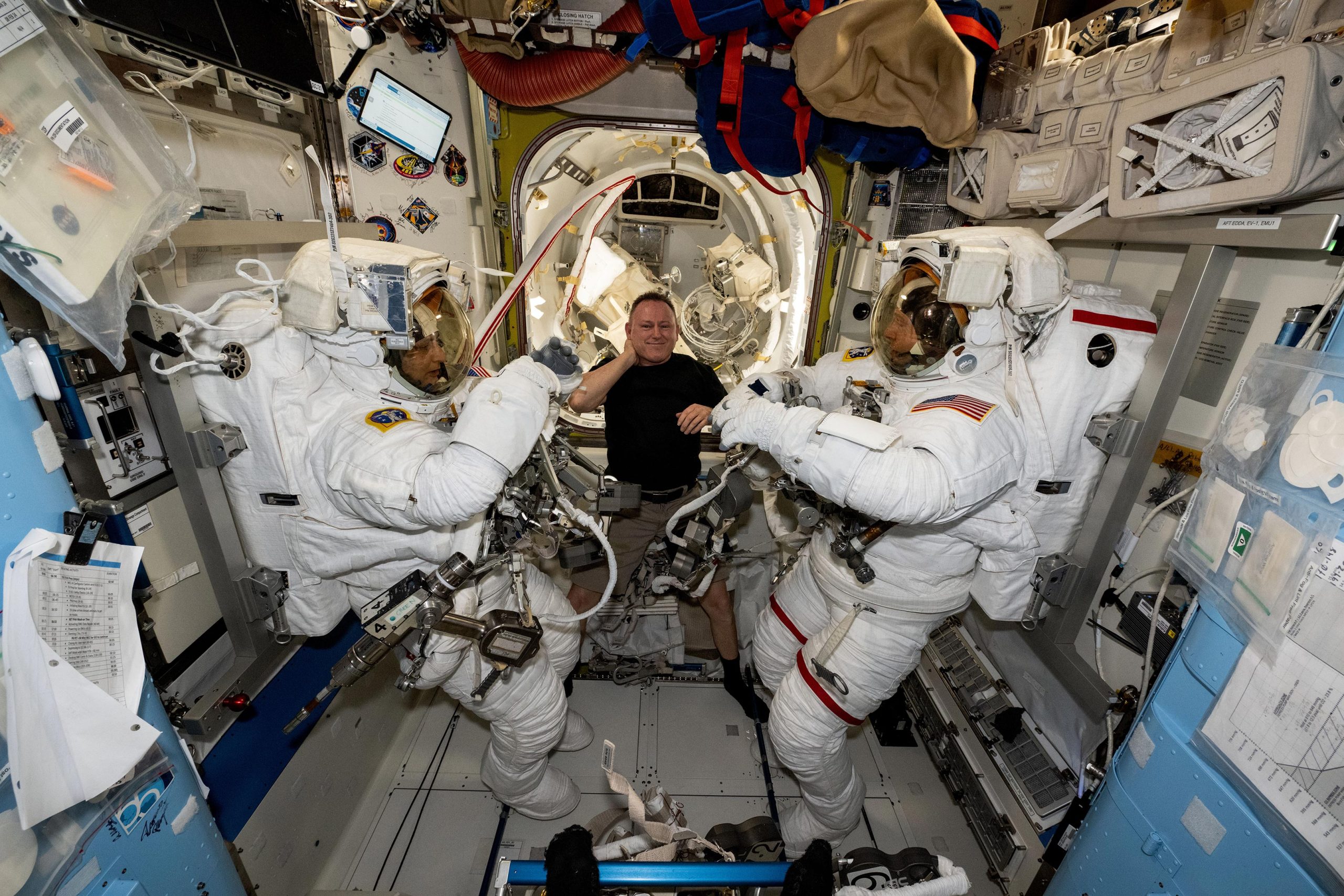
Preparations for an upcoming spacewalk continued aboard the International Space Station (ISS) as astronauts conducted health assessments and worked on their spacesuits. On Tuesday, the crew also dedicated time to biology, physics, and lab maintenance as part of Expedition 72’s busy schedule.
Suiting Up for Space
NASA astronauts Nick Hague, a Flight Engineer, and Suni Williams, the station’s Commander, began their day with routine health checks required before spacewalks. They measured vital signs such as heart rate, breathing rate, and temperature, and completed a hearing test. Afterward, the duo focused on preparing their spacesuits, installing lithium-ion batteries, and testing the suits’ electrical and communication systems. Fellow Flight Engineer Butch Wilmore assisted with the preparations, ensuring the spacesuits were camera-ready for the astronauts’ upcoming journey into the vacuum of space.
Countdown to the Spacewalk
Hague and Williams will set their spacesuits to battery power at approximately 8 a.m. EST on Thursday signifying the official start of the first spacewalk of 2025. The experienced spacewalkers will exit the Quest airlock and spend about six-and-a-half hours servicing astrophysics hardware including the NICER X-ray telescope and the Alpha Magnetic Spectrometer. Also on the task list, are the replacement of a rate gyro assembly to maintain station orientation and the replacement of a planar reflector to provide navigation data. NASA+ begins its spacewalk coverage at 6:30 a.m. on Thursday.
Scientific Endeavors Beyond Earth
Earlier in his shift, Wilmore set up and calibrated genetic sequencing hardware that analyzes station water samples to identify bacteria and fungi species. NASA Flight Engineer Don Pettit started his day on orbital plumbing tasks before removing and processing research samples collected from the Gradient Heating Furnace that enables semiconductor crystal growth research.
Research in Microgravity
Working in the orbital outpost’s Roscosmos segment, all three cosmonauts, including Flight Engineers Alexey Ovchinin, Ivan Vagner, and Aleksandr Gorbunov, studied how microgravity affects blood flow through the tiniest vessels in the human circulatory system. On Tuesday, the trio also replaced electronics gear and serviced orbital plumbing hardware throughout the day.
Never miss a breakthrough: Join the SciTechDaily newsletter.
Follow us on Google and Google News.