
Close Menu
    Facebook X (Twitter) Instagram
    SciTechDaily
    • Biology
    • Chemistry
    • Earth
    • Health
    • Physics
    • Science
    • Space
    • Technology
    Facebook X (Twitter) Pinterest YouTube RSS
    SciTechDaily
    Home»Space»NASA Gives Up: Lucy Mission Suspending Further Solar Array Deployment Activities
    Space

    NASA Gives Up: Lucy Mission Suspending Further Solar Array Deployment Activities

    By NASAJanuary 23, 20232 Comments3 Mins Read
    Facebook Twitter Pinterest Telegram LinkedIn WhatsApp Email Reddit
    Share
    Facebook Twitter LinkedIn Pinterest Telegram Email Reddit
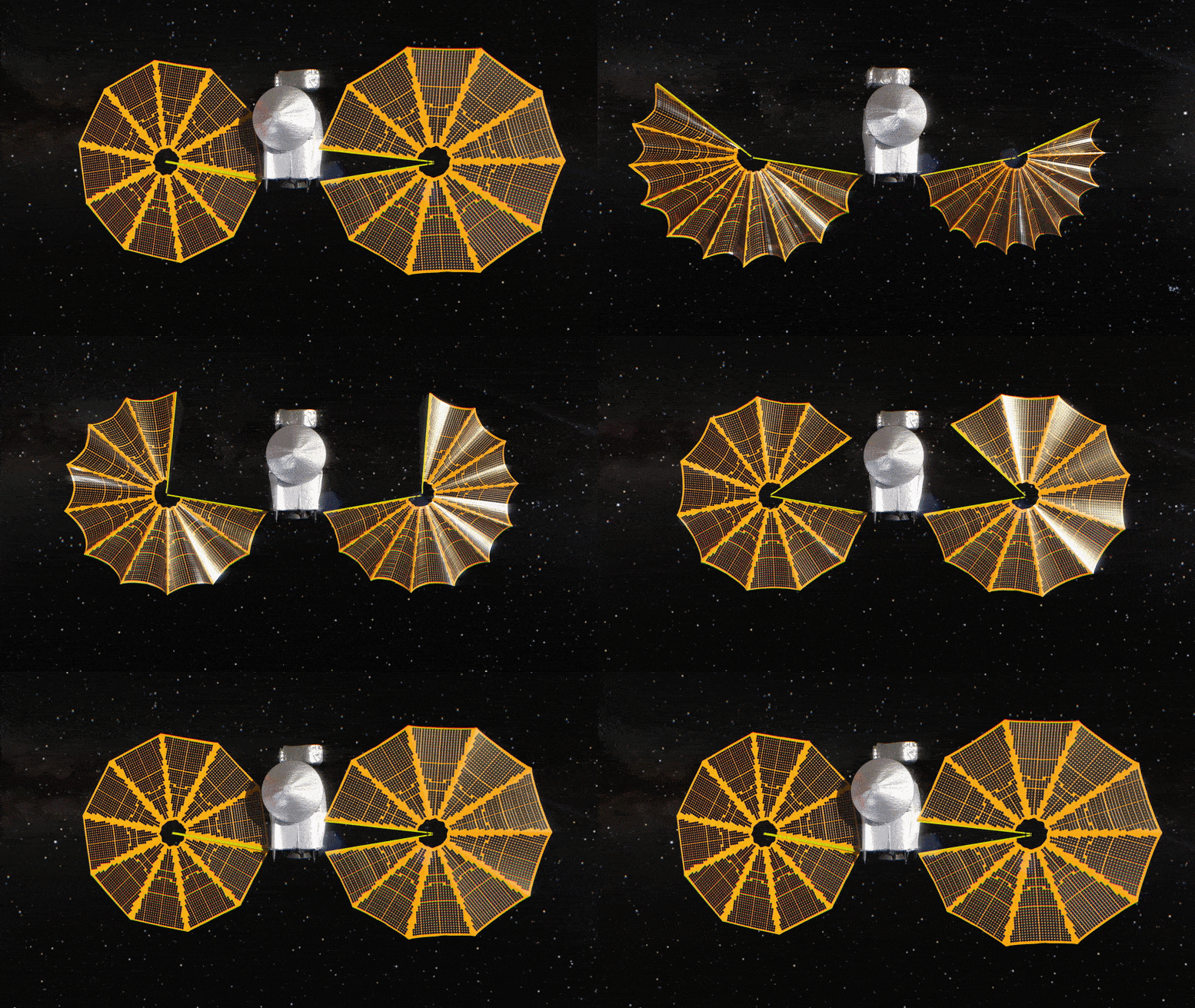
    NASA Lucy Mission Solar Array Anomaly
    Shortly after Lucy launched, one of its solar arrays failed to fully deploy, putting the mission at risk.
    NASA’s Lucy mission is heading to the Jupiter Trojans, two swarms of asteroids trapped in Jupiter’s orbit. Lucy made a picture-perfect launch in October 2021, but when the spacecraft began to unfurl its solar arrays, it encountered an anomaly. One of the arrays failed to fully deploy and latch shut, putting the mission at risk. For months, the flight operations team worked to address the issue – allowing Lucy to continue its journey to the Jupiter Trojans.
    This artist’s concept animation depicts Lucy’s solar array anomaly.
    Credit: NASA’s Goddard Space Flight Center Conceptual Image Lab

    NASA’s Lucy mission team has decided to suspend further solar array deployment activities. The team determined that operating the mission with the solar array in the current unlatched state carries an acceptable level of risk and further deployment activities are unlikely to be beneficial at this time. The spacecraft continues to make progress along its planned trajectory.

    Shortly after the spacecraft’s October 2021 launch, the mission team realized that one of Lucy’s two solar arrays had not properly unfurled and latched. A series of activities in 2022 succeeded in further deploying the array, placing it into a tensioned, but unlatched, state. Using engineering models calibrated by spacecraft data, the team estimates that the solar array is over 98% deployed, and it is strong enough to withstand the stresses of Lucy’s 12-year mission.

    The team’s confidence in the stability of the solar array was affirmed by its behavior during the close flyby of the Earth on October 16, 2022, when the spacecraft flew within 243 miles (392 km) of the Earth, through the Earth’s upper atmosphere. The solar array is producing the expected level of power at the present solar range and is expected to have enough capability to perform the baseline mission with margin.
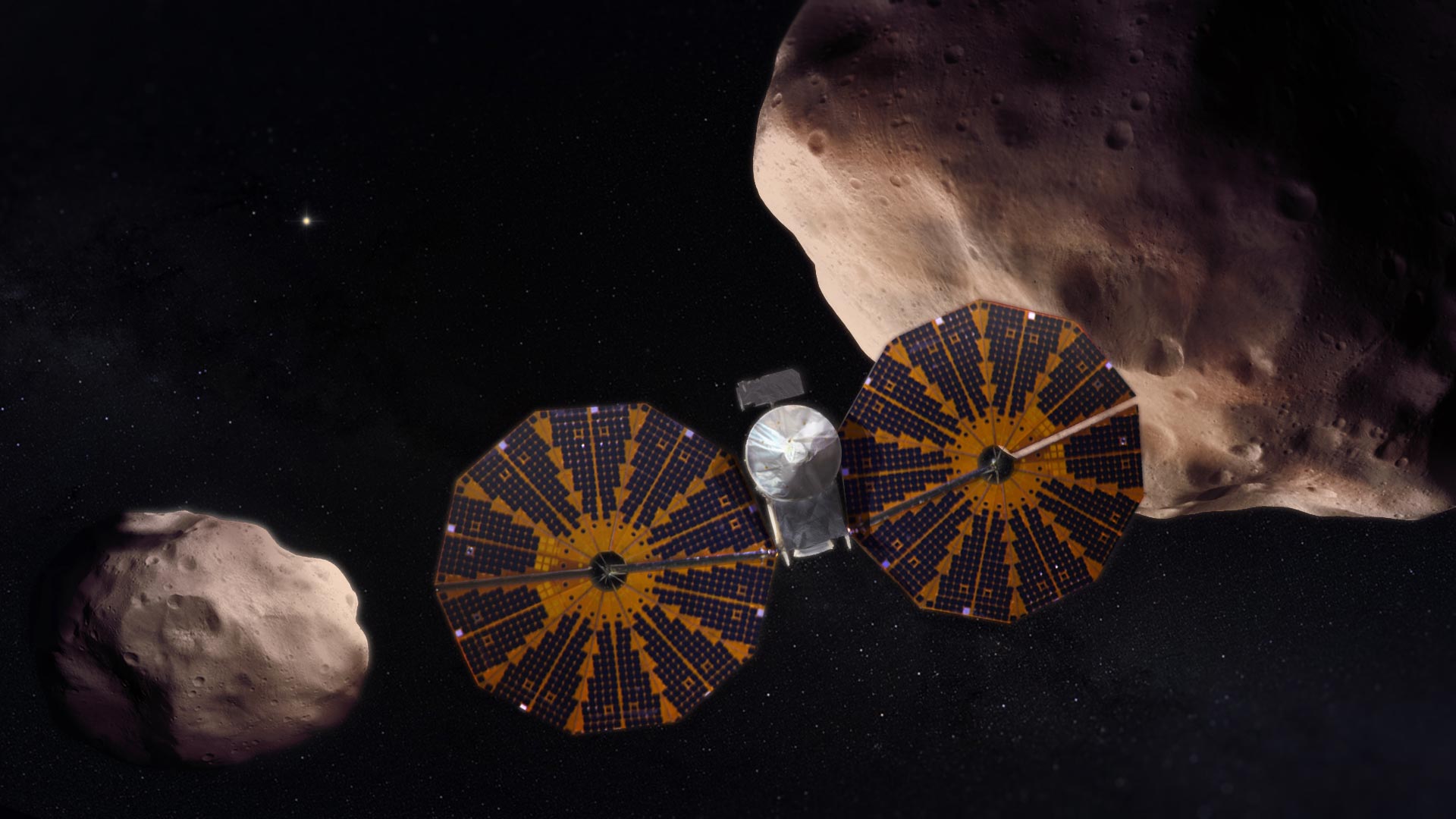
    Lucy Trojan Asteroid Mission
    Lucy will explore the Jupiter Trojan asteroids – thought to be “fossils of planet formation.” Credit: NASA’s Goddard Space Flight Center

    The team elected to suspend deployment attempts after the attempt on December 13, 2022, produced only small movement in the solar array. Ground-based testing indicated that the deployment attempts were most productive while the spacecraft was warmer, closer to the Sun. As the spacecraft is currently 123 million miles (197 million km) from the Sun (1.3 times farther from the Sun than the Earth) and moving away at 20,000 mph (35,000 km/hr), the team does not expect further deployment attempts to be beneficial under present conditions.

    Due to the energy boost that the spacecraft received during last October’s Earth gravity assist, the spacecraft is now on an orbit that will take it over 315 million miles (500 million km) from the Sun before returning to Earth for a second Earth gravity assist on December 12, 2024. Over the next year and a half, the team will continue to collect data on how the solar array behaves during flight. Most significantly, the team will observe how the array behaves during a maneuver in February 2024, when the spacecraft operates its main engine for the first time. As the spacecraft warms up during its approach to Earth in the fall of 2024, the team will re-evaluate if additional steps to reduce risk will be needed.

    Never miss a breakthrough: Join the SciTechDaily newsletter.
    Follow us on Google and Google News.

    Lucy Mission NASA
    Share. Facebook Twitter Pinterest LinkedIn Email Reddit

    Related Articles

    NASA Lucy Mission’s Message – Not for Unknown Aliens – But for the Future

    NASA’s Lucy Spacecraft Stretches Its Wings in Successful Solar Panel Deployment Test

    The Fascinating Story of How the Trojan Asteroids – Target of NASA’s Lucy Mission – Were Discovered and Named

    NASA’s Lucy Mission to Study Trojan Asteroids

    NASA’s Lucy Mission to the Trojan Asteroids Integrates its Second Scientific Instrument

    “Eagle Eyes” – First Scientific Instrument Installed on NASA’s Lucy Spacecraft

    NASA’s Big Plans to Explore Small Bodies: DART, Lucy, and Psyche Missions

    NASA’s First Mission to Explore the Trojan Asteroids Passes Critical Milestone

    NASA’s Mission to Jupiter’s Trojan Asteroids Confirms Discovery of “Bonus” Exploration Opportunity

    2 Comments

    1. Jmj on January 23, 2023 2:05 pm

      Wow! The perfection of science! Put these technicians on the Wuhan nih 91_divoc board!

      Reply
      • Mr Deer on January 24, 2023 3:32 am

        What’s with the deplorable QAnoners commenting on this science site? It’s getting worse and worse with each month.

        Reply
    Leave A Reply Cancel Reply

    • Facebook
    • Twitter
    • Pinterest
    • YouTube

    Don't Miss a Discovery

    Subscribe for the Latest in Science & Tech!

    Trending News

    Scientists May Have Found the Key to Jupiter and Saturn’s Moon Mystery

    Scientists Uncover Brain Changes That Link Pain to Depression

    Saunas May Do More Than Raise Body Temperature – They Activate Your Immune System

    Exercise in a Pill? Metformin Shows Surprising Effects in Cancer Patients

    Hidden Oceans of Magma Could Be Protecting Alien Life

    New Study Challenges Alzheimer’s Theories: It’s Not Just About Plaques

    Artificial Sweeteners May Harm Future Generations, Study Suggests

    Splashdown! NASA Artemis II Returns From Record-Breaking Moon Mission

    Follow SciTechDaily
    • Facebook
    • Twitter
    • YouTube
    • Pinterest
    • Newsletter
    • RSS
    SciTech News
    • Biology News
    • Chemistry News
    • Earth News
    • Health News
    • Physics News
    • Science News
    • Space News
    • Technology News
    Recent Posts
    • This Strange Material Can Turn Superconductivity on and off Like a Switch
    • Scientists Discover Game-Changing New Way To Treat High Cholesterol
    • Breakthrough Drug Delays Rheumatoid Arthritis for Years After Treatment Ends
    • This Small Change to Your Exercise Routine Could Be the Secret to Living Longer
    • Physicists Discover a Strange New Kind of One-Dimensional Particle
    Copyright © 1998 - 2026 SciTechDaily. All Rights Reserved.
    • Science News
    • About
    • Contact
    • Editorial Board
    • Privacy Policy
    • Terms of Use

    Type above and press Enter to search. Press Esc to cancel.