

Draper of Cambridge, Massachusetts has been given a contract by NASA to send Artemis scientific missions to the Moon in 2025. The commercial delivery is a component of NASA’s Artemis Commercial Lunar Payload Services (CLPS) program.
Draper is responsible for end-to-end delivery services, including payload integration, transport from Earth to the Moon’s surface, and payload operations. Draper will receive $73 million for the deal. This award marks the eighth surface delivery task award issued to a CLPS vendor.
“This lunar surface delivery to a geographic region on the Moon that is not visible from Earth will allow science to be conducted at a location of interest but far from the first Artemis human landing missions,” said Joel Kearns, deputy associate administrator for exploration in NASA’s Science Mission Directorate in Washington. “Understanding geophysical activity on the far side of the Moon will give us a deeper understanding of our solar system and provide information to help us prepare for Artemis astronaut missions to the lunar surface.”
Schrödinger Basin, a large lunar impact crater on the far side of the Moon, not far from the lunar South Pole, is the destination of the experiments that will ride aboard Draper’s SERIES-2 lander. This fascinating geological location has a diameter of around 200 miles (320 kilometers). The inner ring of the basin is notable for its smooth floor deposits, which may be a mix of both impact melt and volcanic material, whereas the outer ring is made up of impact melt meteorites.
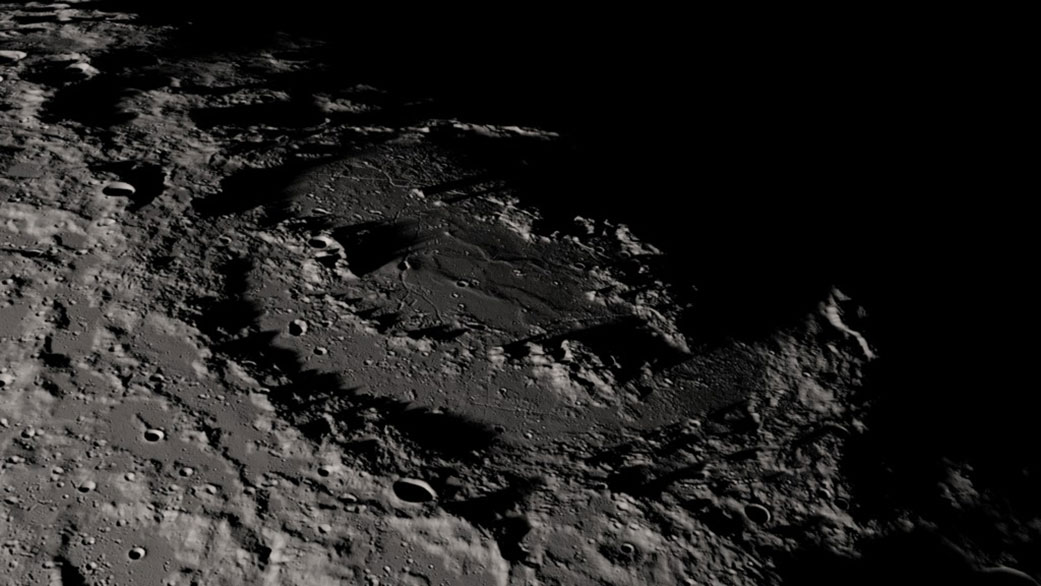
“The payload delivery location is a first for us. Operations from the far side of the Moon will help improve how we track activities from this location to address scientific goals – all while we gather data from the payloads,” said Chris Culbert, CLPS program manager at NASA’s Johnson Space Center in Houston. “The vendor-provided services will prepare for future, more complex lunar surface operations.”
Schrödinger Basin is one of the youngest impact basins on the lunar surface whose impact uplifted the deep crust and upper mantle of the Moon in its peak ring. Later, a large volcanic eruption took place in the inner basin. Researchers hope to study the thermal and geophysical properties of the lunar interior as well as electric and magnetic properties in a landing location that is shielded from Earth’s electromagnetic fields.
- Two of the three investigations selected for this flight are part of NASA’s Payloads and Research Investigations on the Surface of the Moon (PRISM) call for proposals. Draper will deliver the three investigations that will collectively weigh about 209 pounds (95 kilograms) in mass and include the Farside Seismic Suite (FSS), which aims to return NASA’s first lunar seismic data from the far side of the Moon. This new data could help scientists better understand tectonic activity on this region of the Moon, reveal how often the lunar far side is impacted by small meteorites, and provide new information on the internal structure of the Moon. The instrument consists of the two most sensitive seismometers ever built for spaceflight. FSS is one of two PRISM selections. It is funded through NASA in collaboration with the Centre National d’Etudes Spatiales (CNES) – the French Space Agency – and is led by NASA’s Jet Propulsion Laboratory in Southern California.
- The Lunar Interior Temperature and Materials Suite (LITMS), also a PRISM selection, is a suite of two instruments: the Lunar Instrumentation for Thermal Exploration with Rapidity, a subsurface heat-flow probe and pneumatic drill; and the Lunar Telluric Currents, an electric field instrument. This payload suite aims to investigate the heat flow and subsurface electrical conductivity structure of the lunar interior in Schrödinger Basin. The combination of these measurements is a way to resolve the thermal and compositional structure of the surface of the Moon. LITMS is funded by NASA and is led by the Southwest Research Institute.
- The Lunar Surface ElectroMagnetics Experiment (LuSEE), which will make comprehensive measurements of electromagnetic phenomena on the surface of the Moon. LuSEE uses DC electric and magnetic field measurements to study the conditions that control the electrostatic potential of the lunar surface, which, in turn, plays a controlling role in dust transport. LuSEE also uses plasma wave measurements to characterize the lunar ionosphere and the interaction of the solar wind and magnetospheric plasma with the lunar surface and crustal magnetic fields. In addition, this payload will make sensitive radio frequency measurements to measure solar and planetary radio emissions. LuSEE is funded by NASA in collaboration with CNES, and is led by University of California, Berkeley’s Space Science Laboratory.
Multiple commercial deliveries continue to be part of NASA’s plans at the Moon. Future payloads delivered with CLPS could include more science experiments, including technology demonstrations that support for the agency’s Artemis missions. Through Artemis, NASA will land the first woman and the first person of color on the Moon, paving the way for a long-term, sustainable lunar presence and serving as a stepping stone for future astronaut missions to Mars. Artemis I is scheduled to launch no earlier than August 29, 2022, with a subsequent test flight with crew scheduled to occur in 2024 in advance of NASA sending humans to the surface of the Moon no earlier than 2025.
Never miss a breakthrough: Join the SciTechDaily newsletter.
Follow us on Google and Google News.