
Close Menu
    Facebook X (Twitter) Instagram
    SciTechDaily
    • Biology
    • Chemistry
    • Earth
    • Health
    • Physics
    • Science
    • Space
    • Technology
    Facebook X (Twitter) Pinterest YouTube RSS
    SciTechDaily
    Home»Technology»NASA Unveils Cutting-Edge Tech To Make Supersonic Flights Quieter
    Technology

    NASA Unveils Cutting-Edge Tech To Make Supersonic Flights Quieter

    By NASADecember 15, 20242 Comments5 Mins Read
    Facebook Twitter Pinterest Telegram LinkedIn WhatsApp Email Reddit
    Share
    Facebook Twitter LinkedIn Pinterest Telegram Email Reddit
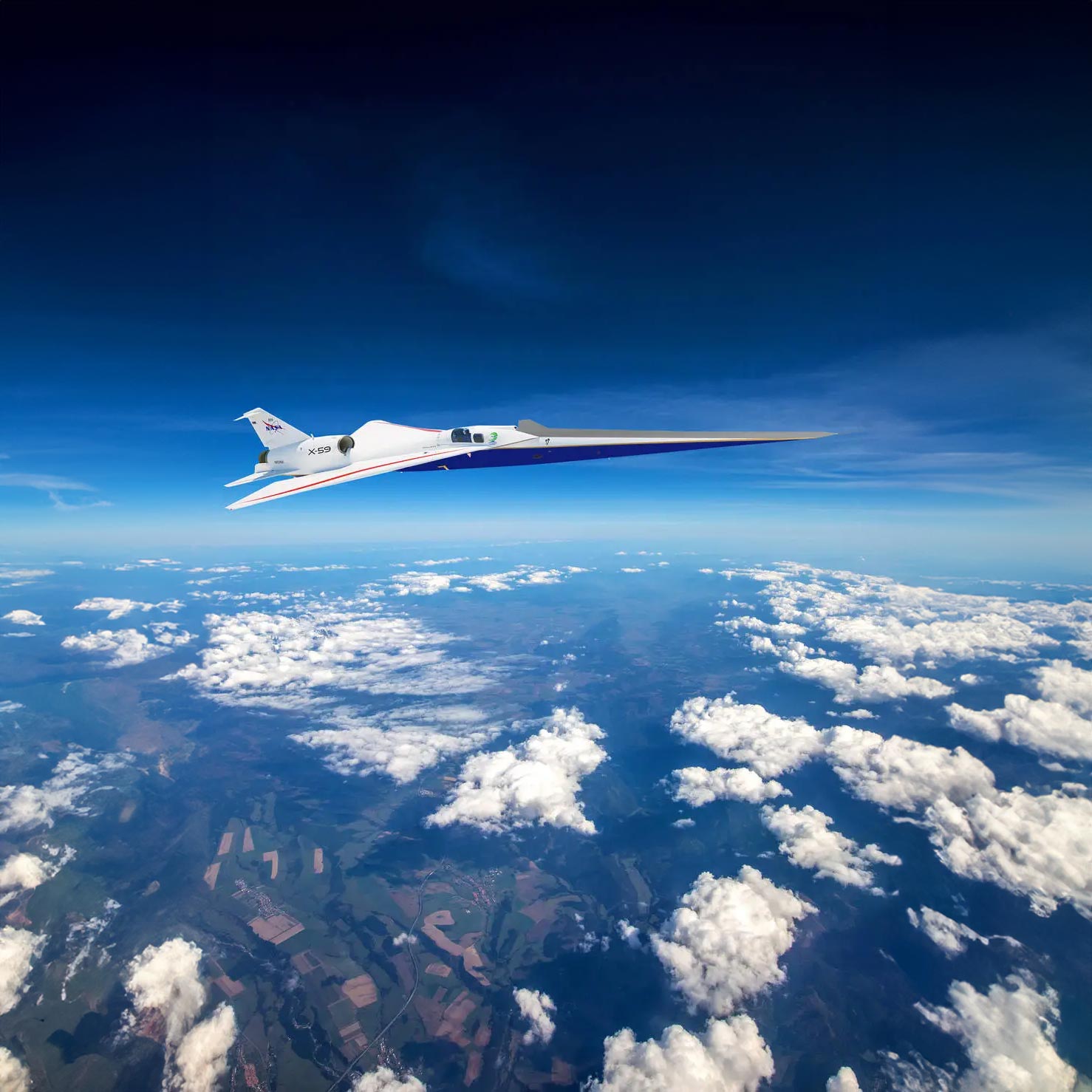
    Lockheed Martin NASA X-59 Illustration
    NASA’s X-59, seen in this illustration, is designed to fly faster than sound but generate quieter sonic “thumps” rather than booms. Credit: Lockheed Martin

    NASA is set to test improved tools for assessing the quieter sonic thumps produced by its X-59 supersonic aircraft.

    These tools include a shock-sensing probe that collects detailed pressure data from shock waves generated during supersonic flight. These probes, crucial for validating the computer models that predict shock wave strength, come in two versions targeting different measurement fields, and will be tested using an F-15B aircraft in various flight configurations.

    NASA’s Sonic Thump Measurement Tool

    NASA is preparing to test advancements in a key tool designed to measure the distinctive “sonic thumps” produced by its quiet supersonic research aircraft, the X-59.

    This tool, known as a shock-sensing probe, is a cone-shaped air data device specifically engineered to capture the unique shock waves generated by the X-59. Researchers at NASA’s Armstrong Flight Research Center in Edwards, California, have developed two versions of the probe to collect precise pressure data during supersonic flight. One version is optimized for near-field measurements, capturing shock waves close to the aircraft’s source. The other probe is designed for mid-field measurements, gathering data at altitudes ranging from 5,000 to 20,000 feet below the X-59.

    NASA Shock-Sensing Probe
    A close-up of NASA’s shock-sensing probe highlights its pressure ports, designed to measure air pressure changes during supersonic flight. The probe will be mounted on NASA’s F-15B Aeronautics Research Test Bed for calibration flights, validating its ability to measure shock waves generated by the X-59 as part of NASA’s Quesst mission to provide data on quiet supersonic flight. Credit: NASA/Lauren Hughes

    Supersonic Flight Testing and Data Collection

    When an aircraft flies supersonic, it generates shockwaves that travel through the surrounding air, producing loud sonic booms. The X-59 is designed to divert those shock waves, reducing the loud sonic booms to quieter sonic thumps. During test flights, an F-15B aircraft with a shock-sensing probe attached to its nose will fly with the X-59. The roughly 6-foot probe will continuously collect thousands of pressure samples per second, capturing air pressure changes as it flies through shock waves. Data from the sensors will be vital for validating computer models that predict the strength of the shock waves produced by the X-59, the centerpiece of NASA’s Quesst mission.

    NASA F-15B Aeronautics Research Test Bed Performs Calibration Flight
    NASA’s F-15B Aeronautics Research Test Bed performs a calibration flight of the shock-sensing probe over Edwards, California, on August 6, 2024. The probe will measure shock waves from NASA’s X-59, providing data that may change limits for overland supersonic flight from being speed-based to sound-based. This work is part of NASA’s Quesst mission, with the X-59 as its flagship aircraft. Credit: NASA/Steve Freeman

    “A shock-sensing probe acts as the truth source, comparing the predicted data with the real-world measurements,” said Mike Frederick, NASA principal investigator for the probe.

    For the near-field probe, the F-15B will fly close behind the X-59 at its cruising altitude of approximately 55,000 feet, utilizing a “follow-the-leader” setup allowing researchers to analyze shock waves in real-time. The mid-field probe, intended for separate missions, will collect more useful data as the shock waves travel closer to the ground.

    NASA F-15B Aeronautics Research Test Bed Shock Sensing Probe
    During a test flight over Edwards, California, NASA’s F-15B Aeronautics Research Test Bed evaluates a shock-sensing probe. The probe will capture detailed shock wave data from the X-59, advancing research in quiet supersonic travel. Credit: NASA/Steve Freeman

    Advances in Shockwave Analysis Technology

    The probes’ ability to capture small pressure changes is especially important for the X-59, as its shock waves are expected to be much weaker than those of most supersonic aircraft. By comparing the probes’ data to predictions from advanced computer models, researchers can better evaluate their accuracy.

    “The probes have five pressure ports, one at the tip and four around the cone,” said Frederick. “These ports measure static pressure changes as the aircraft flies through shock waves, helping us understand the shock characteristics of a particular aircraft.” The ports combine their measurements to calculate the local pressure, speed, and direction of airflow.

    NASA F-15B Aeronautics Research Test Bed Calibration Flight
    NASA’s F-15B Aeronautics Research Test Bed, equipped with a shock-sensing probe, soars over Edwards, California. The probe’s data will help refine supersonic flight models and support NASA’s mission to reduce sonic booms to quieter “sonic thumps.” Credit: NASA/Steve Freeman

    Upgrades to Shock-Sensing Technology

    Researchers will soon evaluate upgrades to the near-field shock-sensing probe through test flights, where the probe, mounted on one F-15B, will collect data by chasing a second F-15 during supersonic flight. The upgrades include having the probe’s pressure transducers – devices that measure the air pressure on the cone – just 5 inches from its ports. Previous designs placed those transducers nearly 12 feet away, delaying recording time and distorting measurements.

    NASA F-15B Aeronautics Research Test Bed Shock-Sensing Probe Calibration Flight
    NASA’s F-15B Aeronautics Research Test Bed flies over Edwards, California, carrying a shock-sensing probe designed to measure supersonic shock waves from the X-59. This crucial data supports NASA’s Quesst mission to enable quieter supersonic flight over land. Credit: NASA/Steve Freeman

    Temperature sensitivity on previous designs also presented a challenge, causing fluctuations in accuracy with changing conditions. To solve this, the team designed a heating system to maintain the pressure transducers at a consistent temperature during flight.

    “The probe will meet the resolution and accuracy requirements from the Quesst mission,” Frederick said. “This project shows how NASA can take existing technology and adapt it to solve new challenges.”

    Never miss a breakthrough: Join the SciTechDaily newsletter.
    Follow us on Google and Google News.

    NASA NASA X-59 Quesst Plane
    Share. Facebook Twitter Pinterest LinkedIn Email Reddit

    Related Articles

    On the Brink of Revolution: NASA’s Quiet Supersonic X-59 Moves Toward Maiden Flight

    NASA’s X-59 Quesst: Overturning the 50-Year-Old Supersonic Speed Limit

    Silencing Sonic Booms: NASA’s X-59 Quiet Supersonic Aircraft Passes Critical Milestone

    NASA X-59 Experimental Aircraft’s Quiet Revolution in Supersonic Flight

    NASA’s X-59: A Supersonic Aircraft’s Patriotic Paint Transformation

    Jet Engine Installed on NASA’s X-59 QueSST Quiet Supersonic Aircraft

    Major Milestone As NASA’s X-59 QueSST Quiet SuperSonic Technology Aircraft Comes Together

    NASA to Build a Quieter Supersonic Passenger Jet

    NASA to Test Jet Engine With a Helping of Cereal and Crayons

    2 Comments

    1. Boba on December 15, 2024 6:13 pm

      The quietest is if they don’t fly at all.

      Reply
    2. Eric M. Jones on December 16, 2024 8:19 am

      Millionaire transportation. Oh, God how to I vote against this?

      Reply
    Leave A Reply Cancel Reply

    • Facebook
    • Twitter
    • Pinterest
    • YouTube

    Don't Miss a Discovery

    Subscribe for the Latest in Science & Tech!

    Trending News

    Popular Sugar-Free Sweetener Linked to Liver Disease, Study Warns

    What Is Hantavirus? The Deadly Disease Raising Alarm Worldwide

    Scientists Just Discovered How the Universe Builds Monster Black Holes

    Scientists Unveil New Treatment Strategy That Could Outsmart Cancer

    A Simple Vitamin May Hold the Key to Treating Rare Genetic Diseases

    Scientists Think the Real Fountain of Youth May Be Hiding in Your Gut

    Ravens Don’t Follow Wolves, They Predict Them

    This Common Knee Surgery May Be Doing More Harm Than Good

    Follow SciTechDaily
    • Facebook
    • Twitter
    • YouTube
    • Pinterest
    • Newsletter
    • RSS
    SciTech News
    • Biology News
    • Chemistry News
    • Earth News
    • Health News
    • Physics News
    • Science News
    • Space News
    • Technology News
    Recent Posts
    • NASA’s Psyche Spacecraft Is About To Fly Shockingly Close to Mars
    • This Mars Rock Refused To Let Go of NASA’s Curiosity Rover
    • James Webb Telescope Reveals the Universe’s Hidden Cosmic Web in Stunning Detail
    • Scientists Build a Living AI Device Using Real Brain Cells
    • Why Are So Many New Fathers Dying? Scientists Say the U.S. Has a Dangerous Blind Spot
    Copyright © 1998 - 2026 SciTechDaily. All Rights Reserved.
    • Science News
    • About
    • Contact
    • Editorial Board
    • Privacy Policy
    • Terms of Use

    Type above and press Enter to search. Press Esc to cancel.