
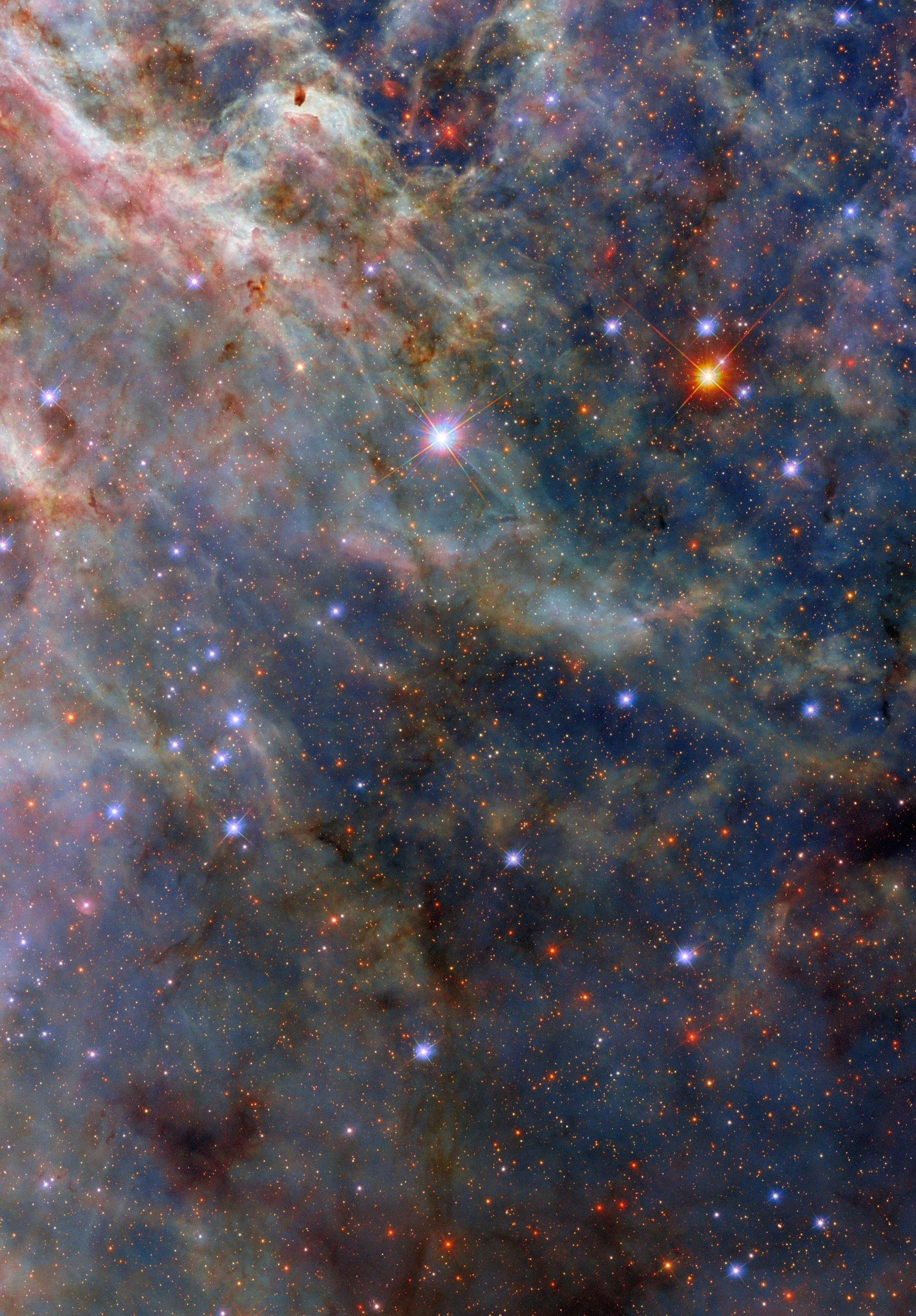
The Tarantula Nebula glows with powerful stars and chaotic dust, captured in vivid detail by the Hubble Space Telescope. It’s a star factory outside our galaxy—raging with stellar winds and cosmic drama.
A vibrant glimpse into a stellar nursery is captured in this newest featured image from the Hubble Space Telescope. It reveals striking detail within the dusty gas clouds of the Tarantula Nebula, a region where new stars are being born. What makes this view especially remarkable is that the nebula isn’t located in our own galaxy. Instead, it resides in the Large Magellanic Cloud, a dwarf galaxy approximately 160,000 light-years from Earth in the direction of the constellations Dorado and Mensa.
The Large Magellanic Cloud is the most prominent of several small satellite galaxies that orbit the Milky Way. Among all nearby galaxies in this group, the Tarantula Nebula stands out as the largest and most luminous region where stars are actively forming.
Within the Tarantula Nebula are some of the most massive stars ever observed, with a few reaching up to 200 times the mass of the Sun. The area shown in this image is not at the nebula’s center, which hosts a super star cluster known as R136. However, it is located close to an extraordinary type of star known as a Wolf–Rayet star. These stars are extremely hot and bright, having shed their outer hydrogen layers and now producing powerful, fast-moving stellar winds.
This nebula is a frequent target for Hubble, whose multiwavelength capabilities are critical for capturing sculptural details in the nebula’s dusty clouds. The data used to create this image come from an observing programme called Scylla, named for a multi-headed sea monster from the Greek myth of Ulysses. The Scylla programme was designed to complement another Hubble observing programme called ULYSSES (Ultraviolet Legacy library of Young Stars as Essential Standards). ULYSSES targets massive young stars in the Small and Large Magellanic Clouds, while Scylla investigates the structures of gas and dust that surround these stars.
Never miss a breakthrough: Join the SciTechDaily newsletter.
Follow us on Google and Google News.
1 Comment
Note 2508100732_Source1.Reinterpreting【
Source 1.
https://scitechdaily.com/nasas-hubble-captures-a-stellar-storm-so-intense-its-reshaping-a-galaxy/
1.
NASA Hubble has captured a star storm intense enough to reshape the galaxy.
ESA/Hubble Presented August 4, 2025
Hubble’s latest images captured breathtaking images of the Tarantula Nebula, a huge star-forming region nestled in a neighboring galaxy 160,000 light-years away.
1-1.
-The Tarantula Nebula, captured by the Hubble Space Telescope, glows with powerful stars and chaotic dust.
_This nebula is a star factory outside the Milky Way, full of stellar winds and cosmic drama.
>>>>>><<<<<^!^
The nucleus of the ^msbase galaxy is originally a neat example 1. However, the surrounding sidems form layers full of dust and gas.
View 1. Nucleus of the Galaxy (*new)
04110613
14051203
15080902
01100716
^ In the nucleus, vix.blackhole and vixx.neutron_stars are present.
^ This is due to the presence of standing wave gap sides.orbit(*) in the hole of the star-making proto-plate.
^ This is the reason why the electrons of the atom have a gap between the normal wave orbits of de Broglie electrons, so the sides act as primordial disks. There are various layers around the nucleus.
1-2.
-This latest special photo taken by the Hubble Space Telescope shows amazing details in dust clouds in the Tarantula Nebula, the birthplace of the stars.
_The Tarantula Nebula is where new stars are born.
<<<>>>^!^
^The nebula is the sidems. It forms a matter-wave orbital layer of dust and gas, providing the source of the protoplanetary disks of stars. Uh-huh.
^(*)sidems create the x-axis of the tension of the diameter and circumference of the force, gradually making msbase.galaxy lighter at the center of the radius of the vertical y-axis, generating energy at the speed of light as a cone in space-time, creating acceleration qvix.qcell gravity. Uh-huh.
^The reason for the rotation of galactic nuclei, whether spin rotation or revolution, may also be due to the tension of sidems.qms.qcell(*).
_The reason this picture is particularly surprising is that this nebula is not in our galaxy, but in the direction of Sparrow and Mensar on Earth,
_This is because it is located in the Large Magellanic Cloud, a dwarf galaxy about 160,000 light years away.
>>><<<^_^
^What's more interesting is that it is a nebula located about 160,000 light years from Earth, and within centuries, you can see the emergence of new stars or planets in person at a short distance. Huh. A new world unfolds.
^ Furthermore, tragically, a sudden death in the solar system in the early decades of the century could also be caused by the generation of sidems tension. It's a idle pretense that we have to wait 4.5 billion years for the end of the sun. End or luck is not limited to natural time. Uh-huh.
2.
-The Large Magellanic Cloud is the most visible of the many small satellite galaxies orbiting our own galaxy.
_Among the nearby galaxies in this group, the Tarantula Nebula is considered the largest and brightest region where stars are actively generated.
-The Tarantula Nebula has some of the heaviest stars ever observed, some up to 200 times the mass of the Sun.
<<>>>^!^
^ What’s amazing about this is that the stars created in the sids are mostly located around the galaxy,
The msbase that forms the core of the ^(*) galaxy becomes a black hole galaxy. Ugh.
^This scenario seems to be an exquisite reinterpretation of the natural msbase.sidems…Ze-Woo!
2-1.
The region shown in this photo is not the core of the nebula, which has a super-sized cluster called R136.
Instead, it is located near an unusual type of star called the Wolf-Rayet star. These stars are very hot and bright, peeling off layers of hydrogen from their outer walls and producing strong, fast-moving stellar winds.
2-2.
-This nebula is a frequent observation by Hubble.
_Hubble’s ability to observe multiple wavelengths is essential for capturing the patchy details in the cloud of dust in the nebula.