
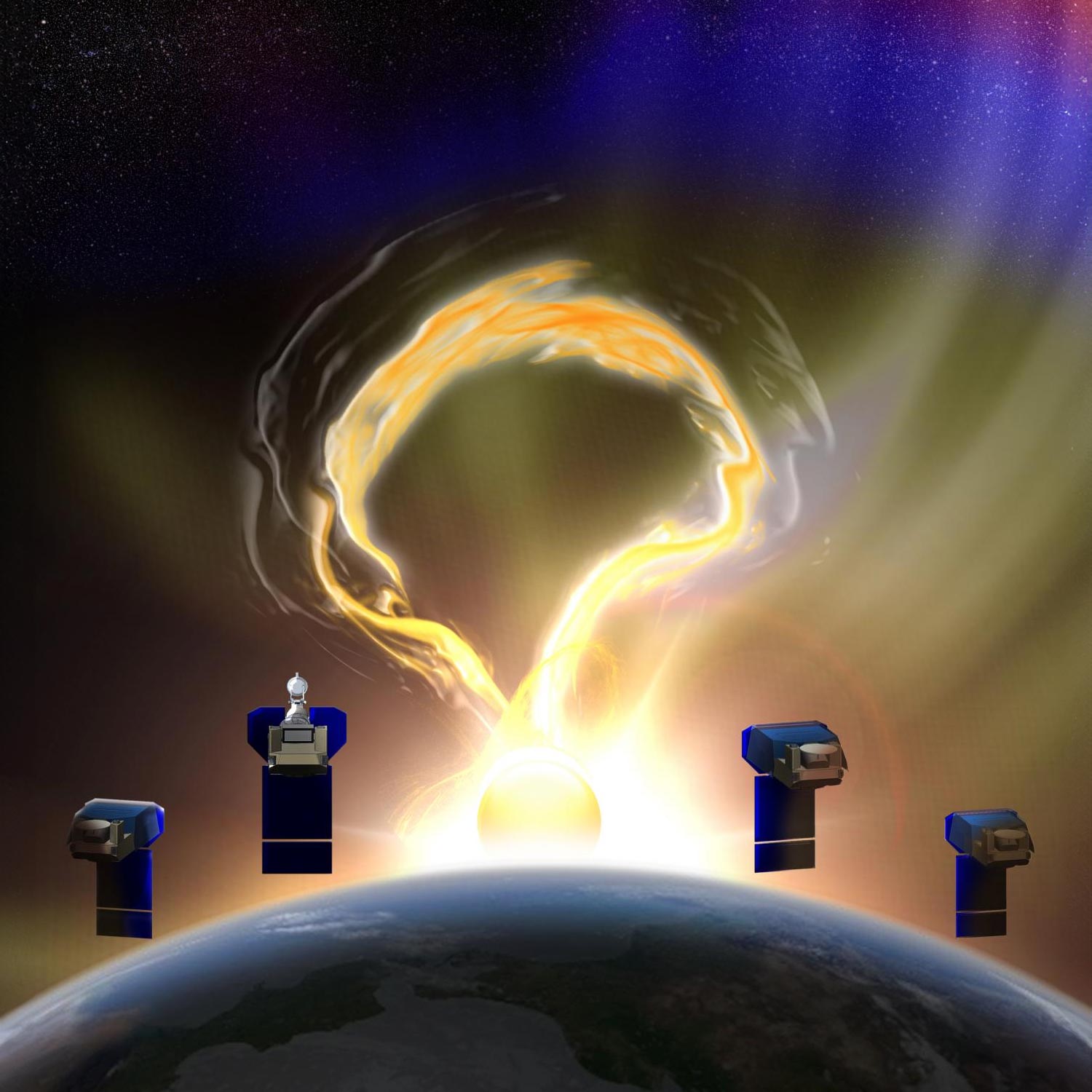
NASA’s new PUNCH mission just opened its eyes to space, capturing its first images of the Sun’s outer atmosphere and the surrounding solar system.
With four satellites now fully activated, scientists are calibrating their instruments to peel away light pollution and unveil the delicate strands of solar wind as they drift through space. These early steps pave the way for a revolutionary view of how the Sun’s corona evolves and launches streams of charged particles that shape space weather.
PUNCH Mission Begins with First Light
NASA’s PUNCH (Polarimeter to Unify the Corona and Heliosphere) mission has successfully completed its spacecraft commissioning phase. Last week, the team opened the instrument doors, allowing the spacecraft to capture “first light” — its first images of the Sun’s outer atmosphere and the surrounding space. These early observations mark a key milestone in the mission’s goal to better understand how the Sun’s outer atmosphere extends and flows through the solar system. The team will now move into the next stage of commissioning: preparing and fine-tuning the onboard instruments for scientific operations.
On April 14, the mission’s Narrow Field Imager (NFI) and one of three Wide Field Imagers (WFI) were the first to open their doors and begin capturing data. Two days later, on April 16, the remaining WFIs followed. The first image from the NFI shows a star-filled field with the Sun near the center. To better highlight background stars, the image was processed to reduce the effect of zodiacal light—a faint glow caused by sunlight scattering off dust particles orbiting the Sun.

Calibrating to Uncover the Solar Corona
During the rest of the commissioning phase, scientists will calibrate the instruments to reveal finer details of the Sun’s corona — its wispy, outermost layer. This process involves removing about 99% of the overwhelming light from the Sun itself, making it possible to trace the delicate, faint streams of solar material as they move through space.
The WFI image below, taken April 14, shows the wide field of view from WFI and is marked with labeled constellations. As commissioning progresses, the PUNCH team will be removing the star fields and other background light from all images to highlight the faint stream of solar wind as it travels toward Earth.
These early images confirm a crucial milestone: the cameras onboard PUNCH’s four satellites are in focus and functioning as designed.

Exploring the Origins of Space Weather
The PUNCH mission will make global, 3D observations of the inner solar system and the Sun’s outer atmosphere, the corona, to learn how its mass and energy become the solar wind, a stream of charged particles blowing outward from the Sun in all directions. The mission will explore the formation and evolution of space weather events such as coronal mass ejections, which can create storms of energetic particle radiation that can endanger spacecraft and astronauts.
During this first phase of the commissioning period, the team at mission control at Southwest Research Institute in Boulder, Colorado, worked to assure that the four satellites were functioning correctly and are moving into the proper orbit around Earth and distance from each other to create the PUNCH constellation.
Instruments for a 3D Solar Perspective
The PUNCH satellites include one NFI and three WFIs. The NFI is a coronagraph, which blocks out the bright light from the Sun to better see details in the Sun’s corona. The WFIs are heliospheric imagers that view the very faint, outermost portion of the solar corona and the solar wind itself. Once the PUNCH satellites reach their targeted alignment, the images from these instruments will be stitched together to create the wide view of the journey of the Sun’s corona and solar wind to Earth.
Once the commissioning is complete, PUNCH will provide the first-ever imagery of the solar wind and coronal mass ejections in polarized light, enabling scientists to discern new information about this activity.
The PUNCH (Polarimeter to Unify the Corona and Heliosphere) mission is a NASA initiative designed to study how the Sun’s outer atmosphere, or corona, extends into space to form the solar wind. Using four small satellites working together as a single observatory, PUNCH will capture unprecedented images of the Sun’s corona and the solar wind in polarized light, helping scientists better understand space weather and its effects on Earth.
The mission is led by Southwest Research Institute, headquartered in San Antonio, Texas, with operations for the spacecraft conducted from its Boulder, Colorado, facilities. PUNCH is managed by the Explorers Program Office at NASA’s Goddard Space Flight Center in Greenbelt, Maryland, on behalf of NASA’s Science Mission Directorate in Washington, D.C.
Never miss a breakthrough: Join the SciTechDaily newsletter.
Follow us on Google and Google News.