
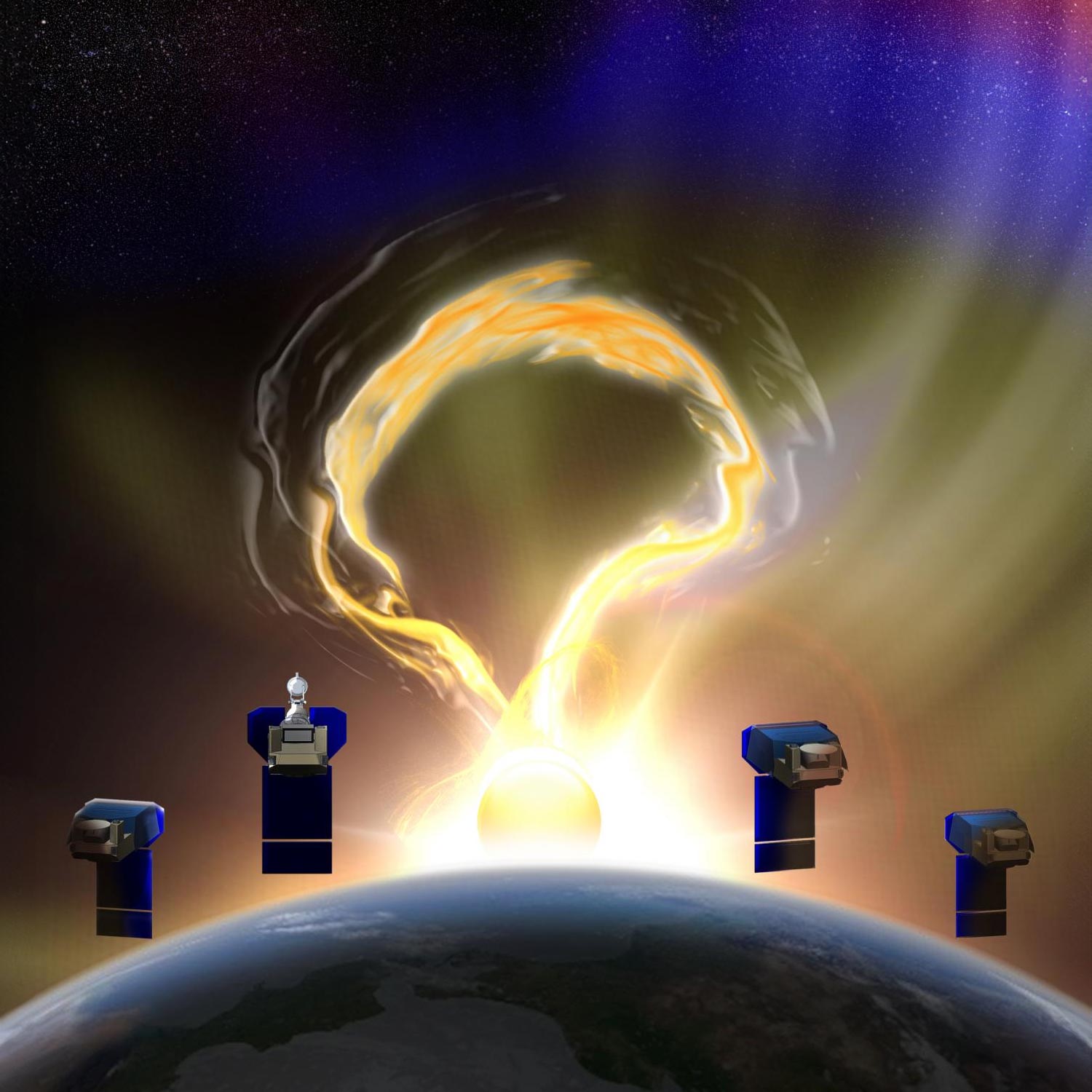
NASA’s PUNCH mission is launching to study the Sun’s corona and solar wind using a network of four small satellites.
By acting as a single, large-scale instrument, these spacecraft will provide a clearer, three-dimensional view of solar storms and space weather. This innovation could revolutionize how we predict and respond to space weather events affecting Earth.
PUNCH Mission Prepares for Launch
Four small spacecraft, each about the size of a suitcase, are set to launch from Vandenberg Space Force Base in California no earlier than February 28. Designed and built by the Southwest Research Institute (SwRI) in San Antonio, these spacecraft are part of NASA’s Polarimeter to Unify the Corona and Heliosphere (PUNCH) mission. They will share a ride into space with NASA’s Spectro-Photometer for the History of the Universe, Epoch of Reionization, and Ices Explorer (SPHEREx) observatory.
“The PUNCH mission will study the solar corona, the Sun’s outer atmosphere, and the solar wind that fills and defines our solar system as a unified, integrated system,” said PUNCH Principal Investigator Dr. Craig DeForest of SwRI’s Solar System Science and Exploration Division located in Boulder, Colo. “This has not been possible before because we used different kinds of instruments to characterize these regions. PUNCH will integrate our understanding of the role the corona plays in heating and accelerating the solar wind, which washes across the Earth and the rest of the planets in our solar system.”
A Virtual Telescope in Space
Following launch, the PUNCH constellation of satellites will spread out in a low-Earth orbit along the day-night line, so the spacecraft will remain in sunlight with a clear view in all directions.
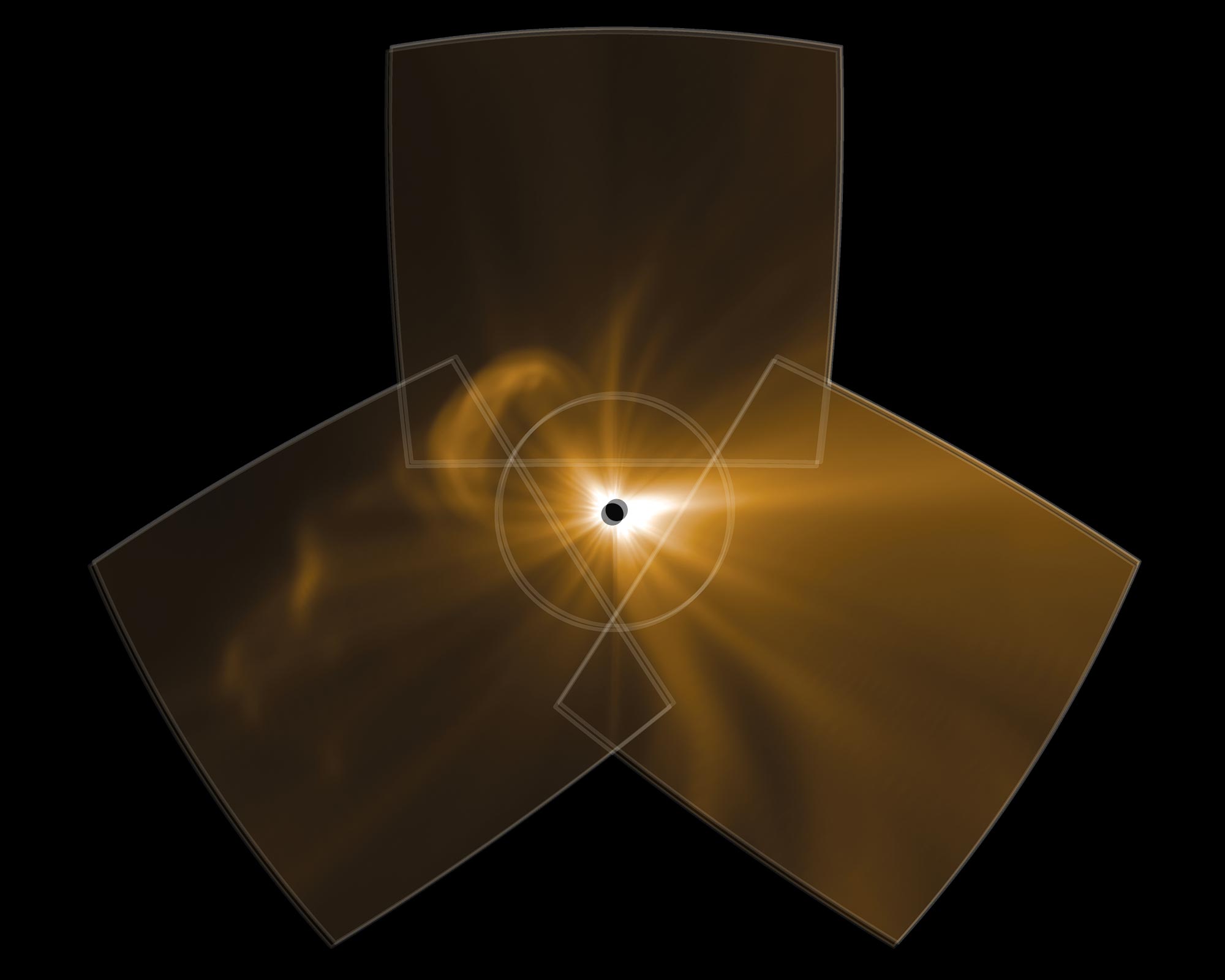
“To get the data we need, we had to create an instrument as large as the Earth,” DeForest said. “That wasn’t possible, so we used four small spacecraft, synchronized and spread around the Earth, to create a virtual instrument 8,000 miles wide, imaging a quarter of the sky, centered on the Sun.”
Advanced Imaging to Reveal the Invisible
One satellite carries a coronagraph, the Narrow Field Imager developed by the U.S. Naval Research Laboratory, that images the Sun’s corona continuously. The other three carry SwRI-developed Wide Field Imagers, designed to view the very faint outermost portion of the solar corona and the solar wind itself.
“PUNCH is going to make the invisible visible,” DeForest said. “Deep baffles in our wide-field imagers reduce direct sunlight by over 16 orders of magnitude or a factor of 10 million billion — the ratio between the mass of a human and the mass of a cold virus. Then state-of-the-art processing on the ground removes the background starfield, over 99% of the light in each image, to reveal the extremely faint glimmer of the solar wind.”
Tracking Space Storms in Three Dimensions
Each spacecraft includes a camera, developed by RAL Space, to collect three raw images, through three different polarizing filters, every four minutes. In addition, each spacecraft will produce a clear unpolarized image every eight minutes, for calibration purposes. This new perspective will allow scientists to discern the exact trajectory and speed of coronal mass ejections as they move through the inner solar system, improving on current instruments that only measure the corona itself and cannot measure motion in three dimensions.
Revolutionizing Space Weather Forecasting
“While PUNCH is a research mission, we will be able to track space storms, or coronal mass ejections, in three dimensions as they approach the Earth — this is critical to forecasting space weather and how it might affect us as a space-faring society,” DeForest said. “We hope PUNCH will help revolutionize space weather forecasting in the same way that geosynchronous satellites revolutionized weather forecasting on Earth.”
NASA’s Small Explorers (SMEX) program offers frequent opportunities for groundbreaking space science missions, using innovative and cost-effective approaches in heliophysics and astrophysics. As the lead organization for the PUNCH mission, the Southwest Research Institute (SwRI) will also oversee operations for the four spacecraft. The PUNCH team includes the U.S. Naval Research Laboratory, which developed the Narrow Field Imager, and RAL Space in Oxfordshire, England, which supplied the detector systems for the mission’s four visible-light cameras.
Never miss a breakthrough: Join the SciTechDaily newsletter.
Follow us on Google and Google News.