
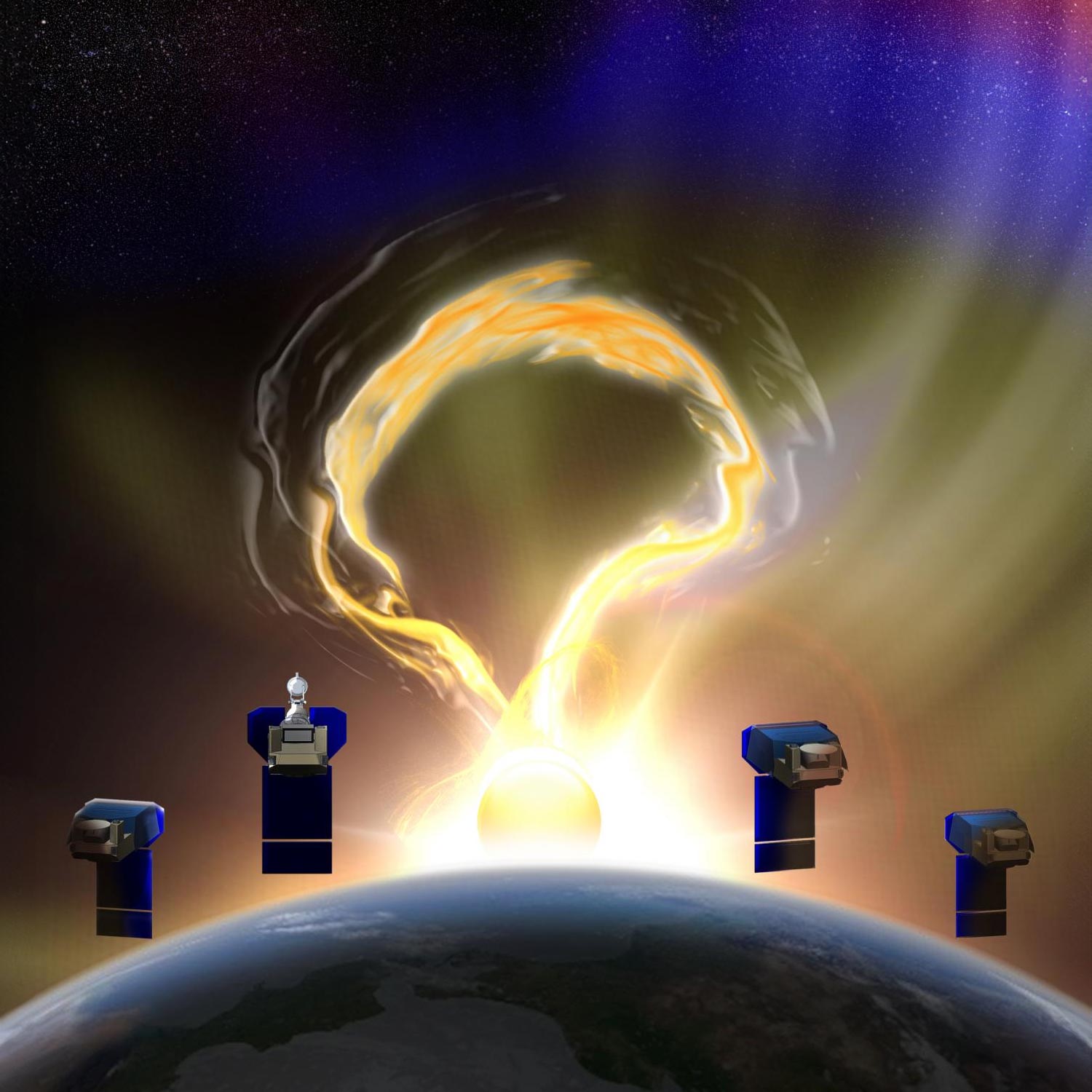
The Sun isn’t just a distant ball of fire—it’s constantly bombarding Earth with charged particles in the form of solar wind. NASA’s PUNCH mission is set to capture this invisible force like never before, giving scientists an unprecedented look at how the Sun’s outer atmosphere connects with the solar wind.
By imaging this vast system as a whole, PUNCH could help predict space weather impacts on satellites, astronauts, and even Earth’s power grids.
PUNCH: A Groundbreaking Solar Mission
Earth is constantly bathed in a steady stream of charged particles flowing from the Sun, known as the solar wind. This invisible force shapes space weather, creating dazzling auroras, disrupting satellites and astronauts in orbit, and even affecting technology on Earth’s surface.
NASA’s PUNCH (Polarimeter to Unify the Corona and Heliosphere) mission will be the first to capture images of both the Sun’s outer atmosphere, or corona, and the solar wind in a single, unified view. By studying how these elements interact, scientists hope to better understand the Sun’s influence on Earth and the surrounding space environment.
Scheduled to launch no earlier than February 28, 2025, aboard a SpaceX Falcon 9 rocket from Vandenberg Space Force Base in California, PUNCH will provide new insights into how solar storms and other space weather events form and evolve. This data could improve predictions of when these events will reach Earth, helping to protect satellites, astronauts, and robotic space explorers.
NASA’s Polarimeter to Unify the Corona and Heliosphere, or PUNCH mission, is a constellation of four small satellites in low Earth orbit that will make global, 3D observations of the Sun’s corona to better understand how the mass and energy there becomes the solar wind that fills the solar system.
Four Satellites, One Expansive View
The mission consists of four compact, suitcase-sized satellites with overlapping fields of view, allowing them to capture a wider expanse of the sky than any previous mission focused on the corona and solar wind. Once in low Earth orbit, these satellites will work together to create a continuous global image of the solar corona as it transitions into the solar wind. They will also track powerful solar eruptions, such as coronal mass ejections. Positioned in a Sun-synchronous orbit, the satellites will have an almost constant view of the Sun, with only brief interruptions when Earth blocks their line of sight.
Following a 90-day commission period after launch, PUNCH is scheduled to conduct science for at least two years. The mission is launching as a rideshare with NASA’s next astrophysics observatory, SPHEREx (Spectro-Photometer for the History of the Universe, Epoch of Reionization and Ices Explorer).
The PUNCH mission is led by Southwest Research Institute’s offices in San Antonio, Texas, and Boulder, Colorado. The mission is managed by the Explorers Program Office at NASA’s Goddard Space Flight Center in Greenbelt, Maryland, for NASA’s Science Mission Directorate in Washington.
Never miss a breakthrough: Join the SciTechDaily newsletter.
Follow us on Google and Google News.