
Robotics and additive manufacturing lead to stronger concrete.
Researchers at Princeton Engineering have enhanced the crack resistance of concrete components by drawing inspiration from nature. They combined innovative designs with additive manufacturing techniques and utilized industrial robots to meticulously control the deposition of materials.
In an article published Aug. 29 in the journal Nature Communications, researchers led by Reza Moini, an assistant professor of civil and environmental engineering at Princeton, describe how their designs increased resistance to cracking by as much as 63% compared to conventional cast concrete.
The researchers were inspired by the double-helical structures that make up the scales of an ancient fish lineage called coelacanths. Moini said that nature often uses clever architecture to mutually increase material properties such as strength and fracture resistance.
Innovative Concrete Design and Manufacturing
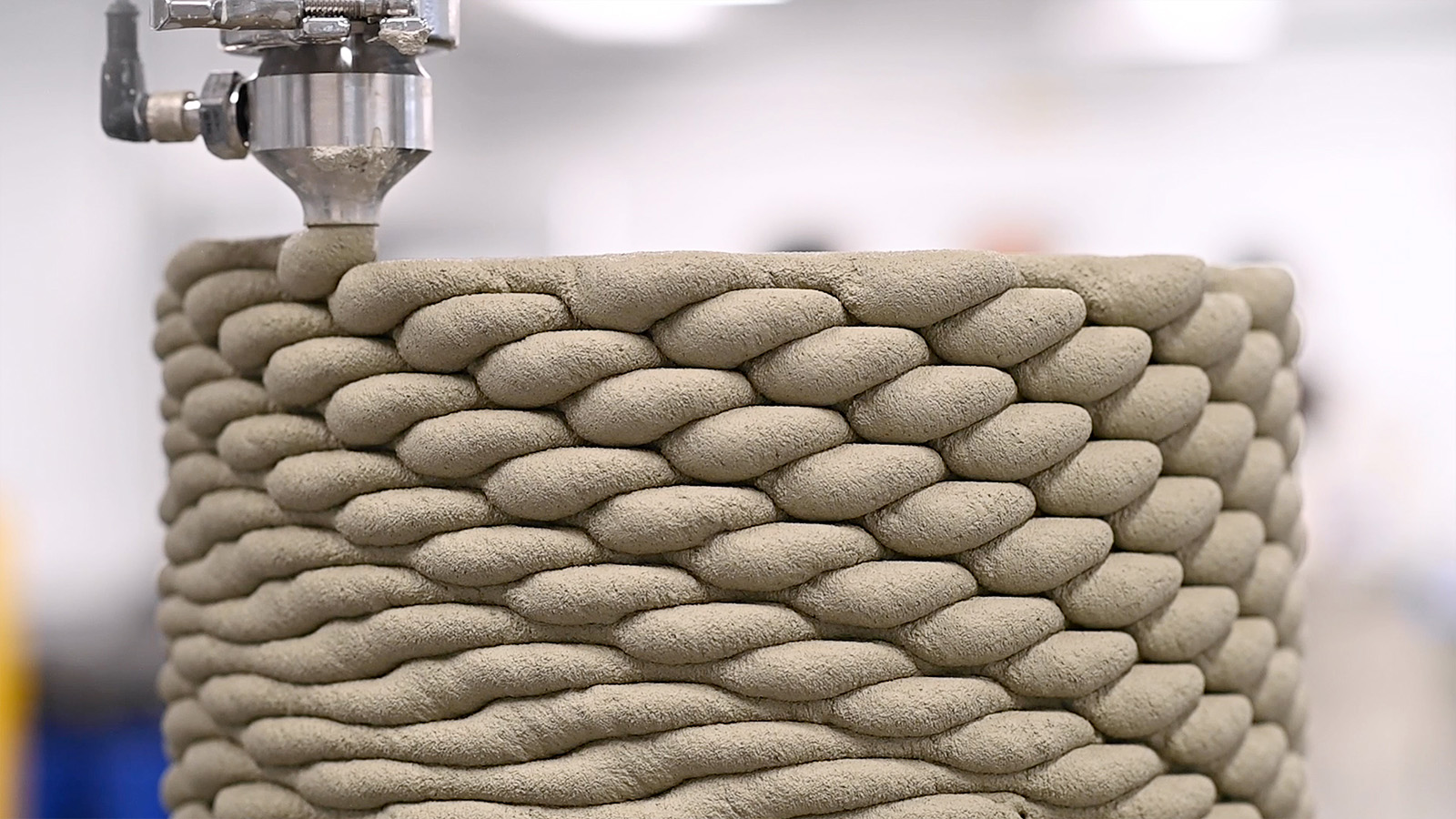
To generate these mechanical properties, the researchers proposed a design that arranges concrete into individual strands in three dimensions. The design uses robotic additive manufacturing to weakly connect each strand to its neighbor. The researchers used different design schemes to combine many stacks of strands into larger functional shapes, such as beams. The design schemes rely on slightly changing the orientation of each stack to create a double-helical arrangement (two orthogonal layers twisted across the height) in the beams that is key to improving the material’s resistance to crack propagation.
The paper refers to the underlying resistance in crack propagation as a ‘toughening mechanism.’ The technique, detailed in the journal article, relies on a combination of mechanisms that can either shield cracks from propagating, interlock the fractured surfaces, or deflect cracks from a straight path once they are formed, Moini said.
Role of Robotics in Architectural Concrete
Shashank Gupta, a graduate student at Princeton and co-author of the work, said that creating architected concrete material with the necessary high geometric fidelity at scale in building components such as beams and columns sometimes requires the use of robots. This is because it currently can be very challenging to create purposeful internal arrangements of materials for structural applications without the automation and precision of robotic fabrication.
Additive manufacturing, in which a robot adds material strand-by-strand to create structures, allows designers to explore complex architectures that are not possible with conventional casting methods. In Moini’s lab, researchers use large, industrial robots integrated with advanced real-time processing of materials that are capable of creating full-sized structural components that are also aesthetically pleasing.
As part of the work, the researchers also developed a customized solution to address the tendency of fresh concrete to deform under its weight. When a robot deposits concrete to form a structure, the weight of the upper layers can cause the concrete below to deform, compromising the geometric precision of the resulting architected structure. To address this, the researchers aimed to better control the concrete’s rate of hardening to prevent distortion during fabrication.
They used an advanced, two-component extrusion system implemented at the robot’s nozzle in the lab, said Gupta, who led the extrusion efforts of the study. The specialized robotic system has two inlets: one inlet for concrete and another for a chemical accelerator. These materials are mixed within the nozzle just before extrusion, allowing the accelerator to expedite the concrete curing process while ensuring precise control over the structure and minimizing deformation. By precisely calibrating the amount of accelerator, the researchers gained better control over the structure and minimized deformation in the lower levels.
Reference: “Tough double-bouligand architected concrete enabled by robotic additive manufacturing” by Arjun Prihar, Shashank Gupta, Hadi S. Esmaeeli and Reza Moini, 29 August 2024, Nature Communications.
DOI: 10.1038/s41467-024-51640-y
Support for the project was provided in part by the National Science Foundation CMMI Advanced Manufacturing Program (Award # 2217985).
Never miss a breakthrough: Join the SciTechDaily newsletter.
Follow us on Google and Google News.
1 Comment
Put some Basalt fiber/rebar in your concrete. No spalling caused by rusting steel.