
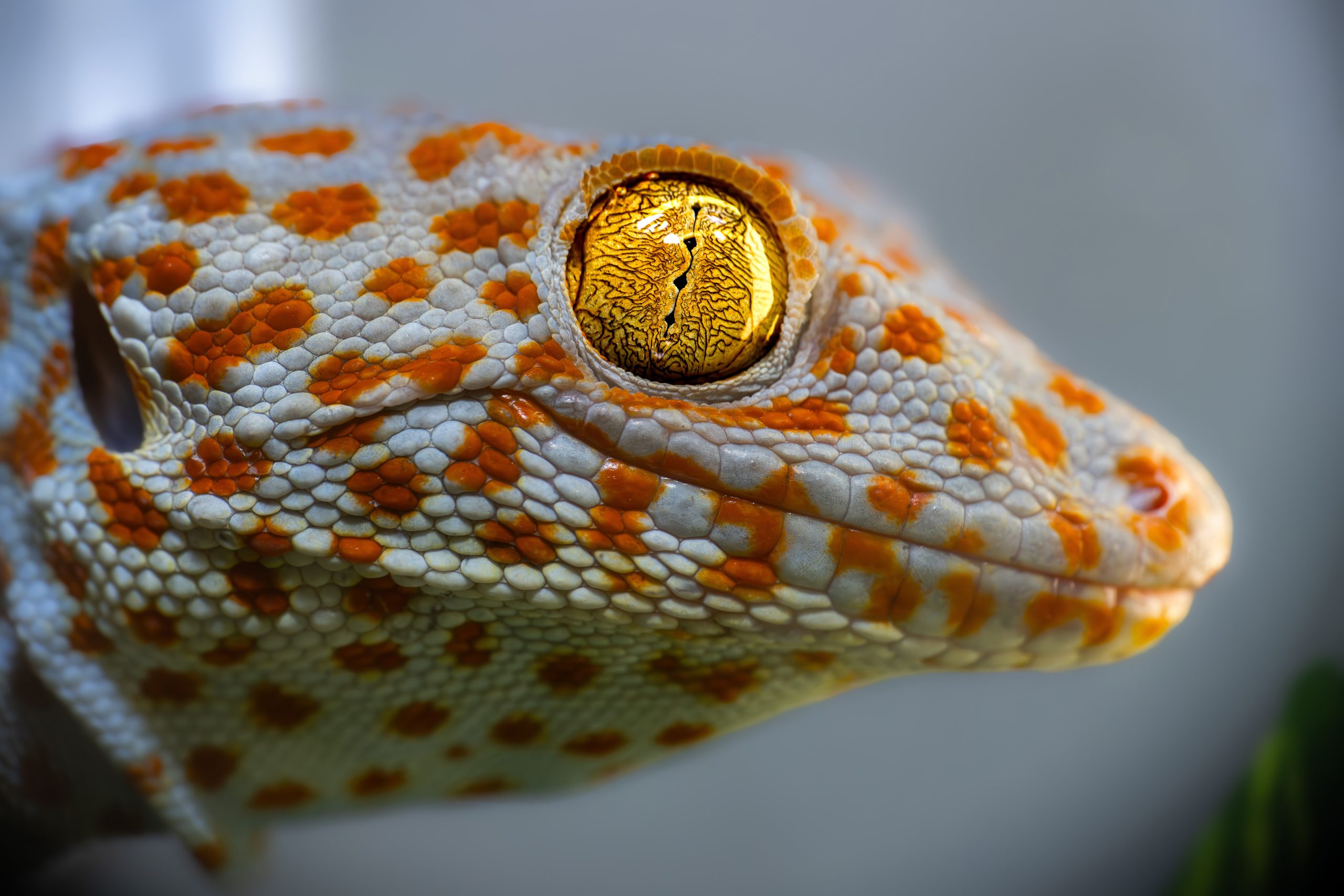
Researchers at the University of Maryland have found that geckos utilize a mechanism typically linked to balance to detect vibrations, providing fresh insights into how animals perceive auditory and tactile stimuli.
Biologists at the University of Maryland have discovered a previously unknown talent in geckos that’s shaking up what we thought we knew about animal hearing.
In a new study published in Current Biology on October 4, 2024, the researchers revealed that geckos use the saccule—a part of their inner ear traditionally associated with maintaining balance and body positioning—to detect low-frequency vibrations. According to the researchers, this special “sixth sense” also plays a complementary role to the geckos’ normal hearing and the way they sense the world around them. The team believes that this previously unrecognized hearing mechanism may be present in other reptilian species as well, challenging existing ideas about how animal sensory systems evolved and diverged over time.
A New Role for the Saccule in Gecko Hearing
“The ear, as we know it, hears airborne sound. But this ancient inner pathway, which is typically linked to balance, helps geckos detect vibrations that travel through mediums like the ground or water,” said study co-author Catherine Carr, a Distinguished University Professor of Biology at UMD. “This pathway exists in amphibians and fish, and now it’s proven to be preserved in lizards as well. Our findings shed light on how the auditory system evolved from what you see in fish to what you see in land animals including humans.”
The saccule can detect faint vibrations ranging from 50 and 200 Hz, a spectrum well below what geckos can usually hear through their ears. Researchers say this indicates that the saccule serves a distinct yet complementary function to the geckos’ regular auditory system. While geckos can hear airborne sound, many other reptiles do not have that ability. The study’s lead author Dawei Han, a postdoctoral researcher and former graduate student at UMD, says that the discovery of the saccule’s role in gecko hearing may lead to a better understanding of communication and behavior in other animals previously considered to have limited auditory capabilities.
Broader Implications for Reptiles and Evolution
“A lot of snakes and lizards were thought to be ‘mute’ or ‘deaf’ in the sense that they do not vocalize sounds or hear sounds well,” Han explained. “But it turns out they could potentially be communicating via vibrational signals using this sensory pathway instead, which really changes the way scientists have thought about animal perception overall.”
The existence of this shared sensory pathway in modern reptiles offers a unique window into the evolutionary history of vertebrate sensory systems, suggesting that the transition from aquatic to terrestrial environments likely involved more complex and gradual changes in hearing mechanisms than previously thought.
Although these findings are not directly connected to how humans hear, the researchers believe that there’s always more than meets the eye—or in this case, ear.
“Think about when you’re at a live rock concert,” Carr said. “It’s so loud that you can feel your whole head and body vibrate in the sound field. You can feel the music, rather than just hearing it. That feeling suggests that the human vestibular system may be stimulated during those loud concerts, meaning our sense of hearing and balance may also be linked closely.”
Carr and Han hope their findings will prompt more investigations into mammalian hearing, especially in the context of this sensory pathway. They believe that the established link between hearing and balance opens up new avenues for research, including the connection between human hearing and balance disorders.
“The implications of this research extend beyond the world of reptiles,” Han said. “As we uncover these hidden mechanisms, we’re also gaining a richer and more nuanced picture of how animals perceive and interact with their environments—and potentially, new insights into our own sensory experiences.”
Reference: “Auditory pathway for detection of vibration in the tokay gecko” by Dawei Han and Catherine E. Carr, 4 October 2024, Current Biology.
DOI: 10.1016/j.cub.2024.09.016
This research was supported by the National Institutes of Health (Grant No. R01DC019341).
Never miss a breakthrough: Join the SciTechDaily newsletter.
Follow us on Google and Google News.
28 Comments
Humans have something similar. There’s even more undiscovered ‘head features’ we have.
How is this really new information? Have you ever actually tried to catch a frog or toad before? You can be as quiet as you want, the second you take a step, they usually jump. Even if your steps are light, it doesn’t matter, they sense it / hear it. Idk, maybe it’s just me, but it became very obvious to me that reptiles and amphibians are very in tune to vibrations after trying to catch them in the wild throughout my life.
No scientist has the knowledge of those who grew up with nature. Your wisdom goes far beyond the lab. Blessings:()
Good Research and hard work indeed. Thanks and continue doing more research.
You’re assuming no scientist had grown up with nature around them. It may be precisely that they had observed this in nature (while growing up) which lead them to research on how it happens.
Couldn’t have said it. Etyer
I’ve had a tookay geko living out side my window for 6 + years. They make, I think a mating call at all hours of night and early morning… They talk to each other…
Yes like the old saying draw a squiggly line on the ground behind a frog(mimicking the movement of a snake) and the frog will jump into a fire to hide from the snake. They both sense each other without ears one without legs or feet
They literally said its observed in amphibians and fish.. This is reptiles they’ve discovered it in now.
That could also go with just about any animal. The fact it’s linked through a balance bone is the biggest thing in this article not the fact they know you, a large being
EXACTLY!!!
They could use that to locate chirping or gnawing insects. Not real loud but low frequency.
Leopard gecko live in abaout 20 yeare
Tockai gecko can walking upon glas in aquarium and in Asia they eate bad bugs inside hose.
I can hear a distance through vibrating machinery, like fan blades twirling. The voices carry through with the metal vibrations. It’s still a strange concept to me as I have never heard of such a thing happening. I have noticed that the more deeper in the ground the more the sound has to be to be distinguished as what the sound is and where it is coming from. It’s all vibrations.
Interesting research and comnents. Read somewhere that lizards also have a third eye. I wonder if that is true.
The tuatara does. It’s related to the pineal gland.
All things that vibrate in this existence emit photons…
I’ve always heard that too always thought it was a myth but looks to be a real thing on a sensory scale
Really?
I got a leopard gecko for a pet when I was 9 years old. After a few months of feeding cleaning and hanging out with my new pets it became obvious the holes on the side of their head are ear canals leading to a ear drum.
Watch how a leopard gecko reacts to sound coming from behind it.
They don’t turnaround,well not immediately. they’ll tip their head to the side in order to detect quieter noises.
Also, incase anyone is curious, bearded dragons are also able to hear . And based on my observations as a child , it appeared bearded dragons used their sense of hearing often and efficiently than leapord geckos.
Oh another interesting behavior is if you have two leopard geckos in an enclosure one leopard gecko will help the other by cleaning out those ear canals with its tongue. First time I saw it I was amazed. Odds are it wasn’t to clean out ear wax but more likely skin that didn’t fall off during shutting since those ear canals also shed.
I have heard something like that. It’s like a microphone in another room at the news desk or some kind of echo from a radio broadcast back in the ’20s(lol) maybe. There are corners of house walls where I hear something I can’t describe it’s like inaudible almost but not
The tuatara lizard has a 3rd pineal eye.
This seems to be old news because in my Evolution textbook it says our hearing evolved from structures that detected vibrations through the lower jaw in animals that were closer to the ground, think ancient crocodile. This is nothing new unless I am missing something.
Of course there is a relationship between hearing and balance. It is already documented that humans have difficulty maintaining sustained balance in an anechoic (silent) chamber. It will be interesting to see results of further studies into the mechanisms involved.
I’m thinking of the hair filiments eventually being implanted in the human ear. It’s a stretch, but someone is projecting that idea as I speak. It will more than likely move through it’s trails at an expedited pace.
Why too kool. Good read, thanks University of Maryland 🙌🏾
Looks like the txtbooks on auditory processes in mamals migh have to be revised? Only God knows! Praise the creator for the beauty he has bestowed upon us. Eternal life is what he promises us?God protect Isreal.
Amen!
This has nothing to do with Israel let’s keep it that way. Buddy stick to the topic at hand
Bruh.