
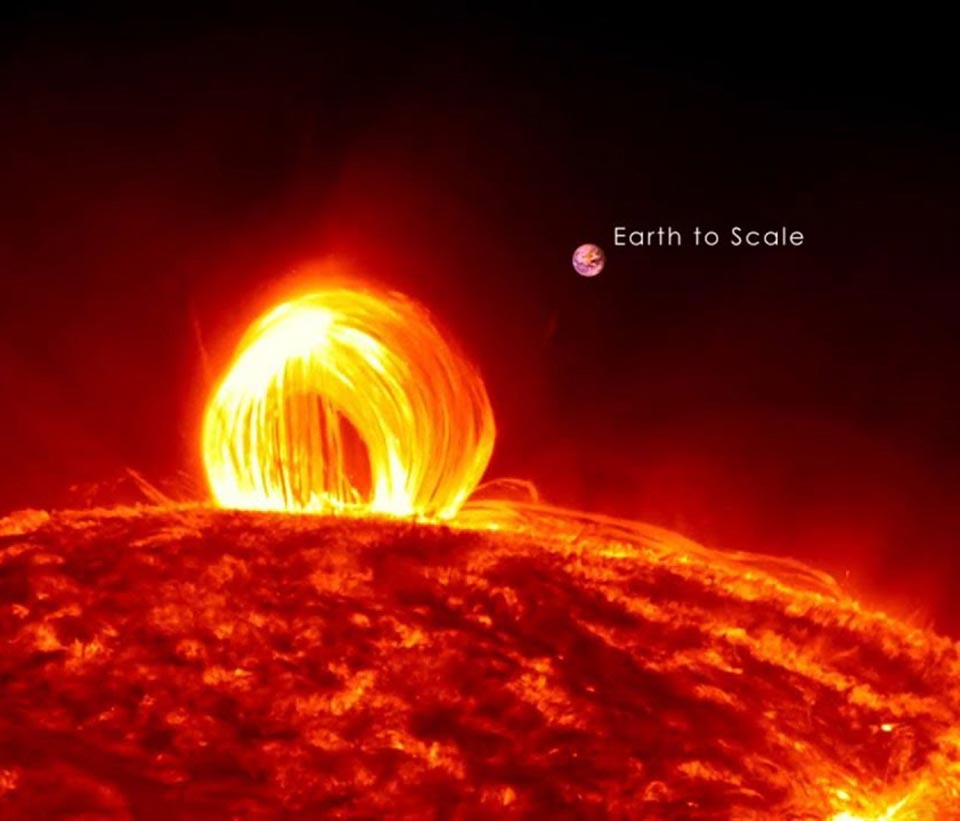
A research team has identified a new type of quiescent coronal rain forming along open magnetic structures due to interchange magnetic reconnection. This mechanism could explain previously unaccounted for on-disk solar condensation events.
Rain is a common phenomenon on Earth. There is a similar phenomenon on the Sun, called coronal rain. It is related to the coronal heating and magnetic field, and plays a fundamental role in the mass cycle between the hot, tenuous corona and the cool, dense chromosphere.
Coronal rain usually takes place in post-flare loops and the non-flaring active region coronal loops. It is generally classified into two categories: flare-driven and quiescent coronal rain, depending on its relation to the flare. Both kinds of coronal rain form along structures that are magnetically closed.
Recently, a research team led by Dr. LI Leping from the National Astronomical Observatories of the Chinese Academy of Sciences (NAOC) found a new type of coronal rain forming along open magnetic structures, away from the magnetically closed region.
A series of studies has been issued since 2018, among which the latest paper was published in The Astrophysical Journal on April 1.
Interchange Reconnection as a New Formation Mechanism
The researchers proposed a new formation mechanism for coronal rain along open magnetic structures facilitated by interchange magnetic reconnection between open and closed magnetic structures.
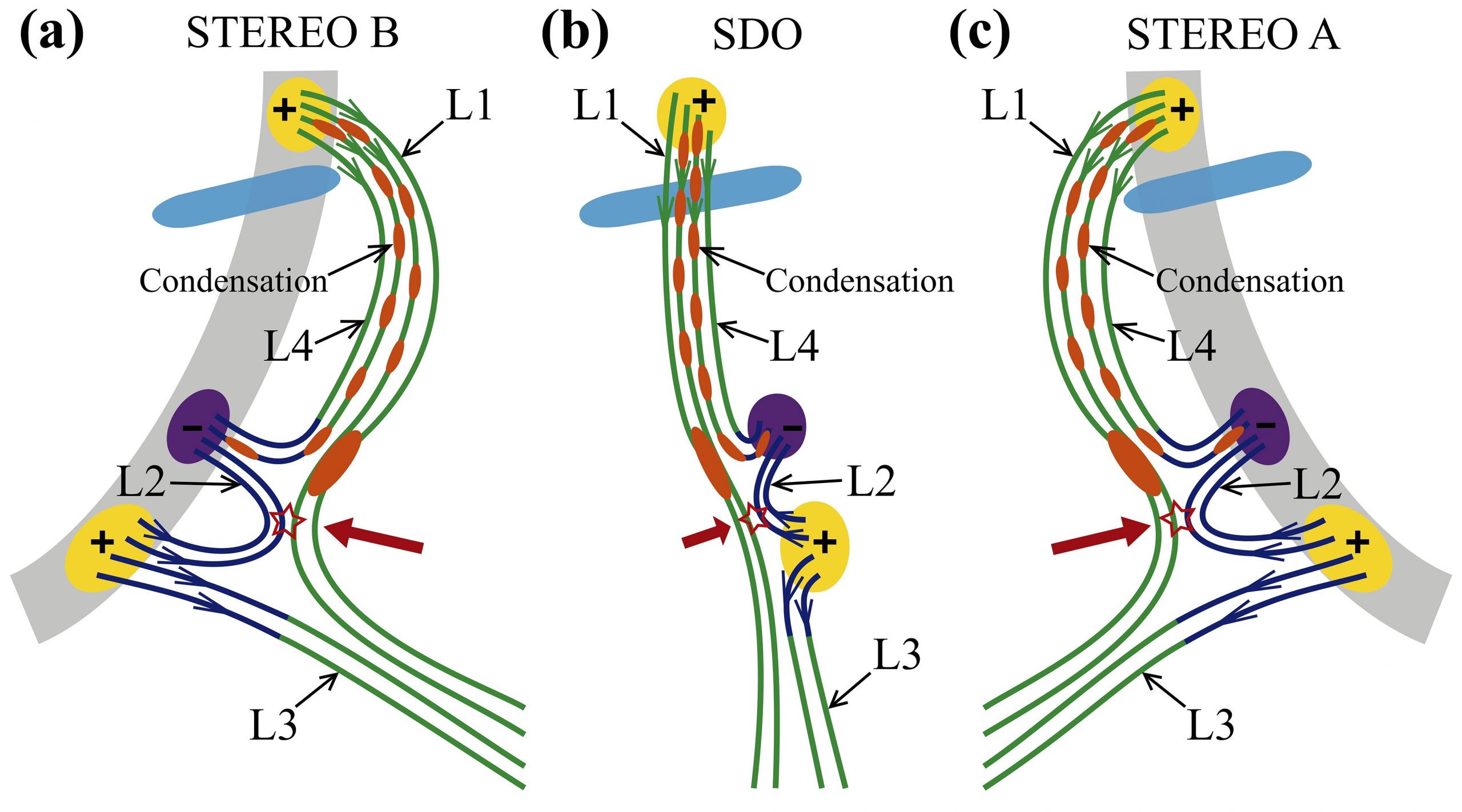
In this formation mechanism, the higher-lying open structures reconnect with the lower-lying closed loops, forming a magnetic dip in the former. The plasma, surrounding the dip, converges into the dip, resulting in the enhancement of plasma density in the dip. The density enhancement triggers thermal instability. Cooling and condensation of hot coronal plasma in the dip thus occurs. The cool condensation falls toward the solar surface as coronal rain.
A Distinct Quiescent Coronal Rain Type
No flare was detected during the reconnection and condensation process. The new type of coronal rain thus belongs to the category of quiescent coronal rain.
“The quiescent coronal rain forming along the open structures is quite different from the flare-driven coronal rain in post-flare loops and the quiescent coronal rain in non-flaring active region loops that occur in the closed loops,” said Dr. LI Leping, the first author of the series of studies.
All the reconnection and condensation events investigated before took place above the limb.
“Whether the condensation facilitated by reconnection can still be observed on the disk, and how it performs, are open questions,” said Prof. Hardi Peter from the Max Planck Institute for Solar System Research (MPS), a co-author of the series of studies.
The researchers found that the reconnection condensation events from September 2010 – September 2011, observed above the eastern (western) limb of the Solar Terrestrial Relations Observatory (STEREO A (B)), occurred on the disk of the Solar Dynamics Observatory (SDO).
“The event presented is important for understanding the global picture of condensation formation in the solar atmosphere and the combined observations bring a very interesting means to analyze this type of coronal condensation events,” the reviewer of the paper commented.
Off-Limb Clarity vs. On-Disk Ambiguity
Above the limb, the bright condensations and the subsequent coronal rain, facilitated by reconnection between open and closed structures, were clearly detected. However, on the disk, the reconnection structures were difficult to observe. Moreover, dark condensations appeared and moved to the surface as on-disk coronal rain.
“If only the on-disk observations are available, the relation between the condensations and reconnection, shown clearly by the off-limb observations, could not be identified,” said Dr. LI. “We propose that some on-disk condensation events seen in the transition region and chromospheric lines could be facilitated by interchange reconnection.”
Reference: “On-disk Solar Coronal Condensations Facilitated by Magnetic Reconnection between Open and Closed Magnetic Structures” by Leping Li, Hardi Peter, Lakshmi Pradeep Chitta and Hongqiang Song, 30 March 2021, The Astrophysical Journal.
DOI: 10.3847/1538-4357/abe537
Never miss a breakthrough: Join the SciTechDaily newsletter.
Follow us on Google and Google News.