
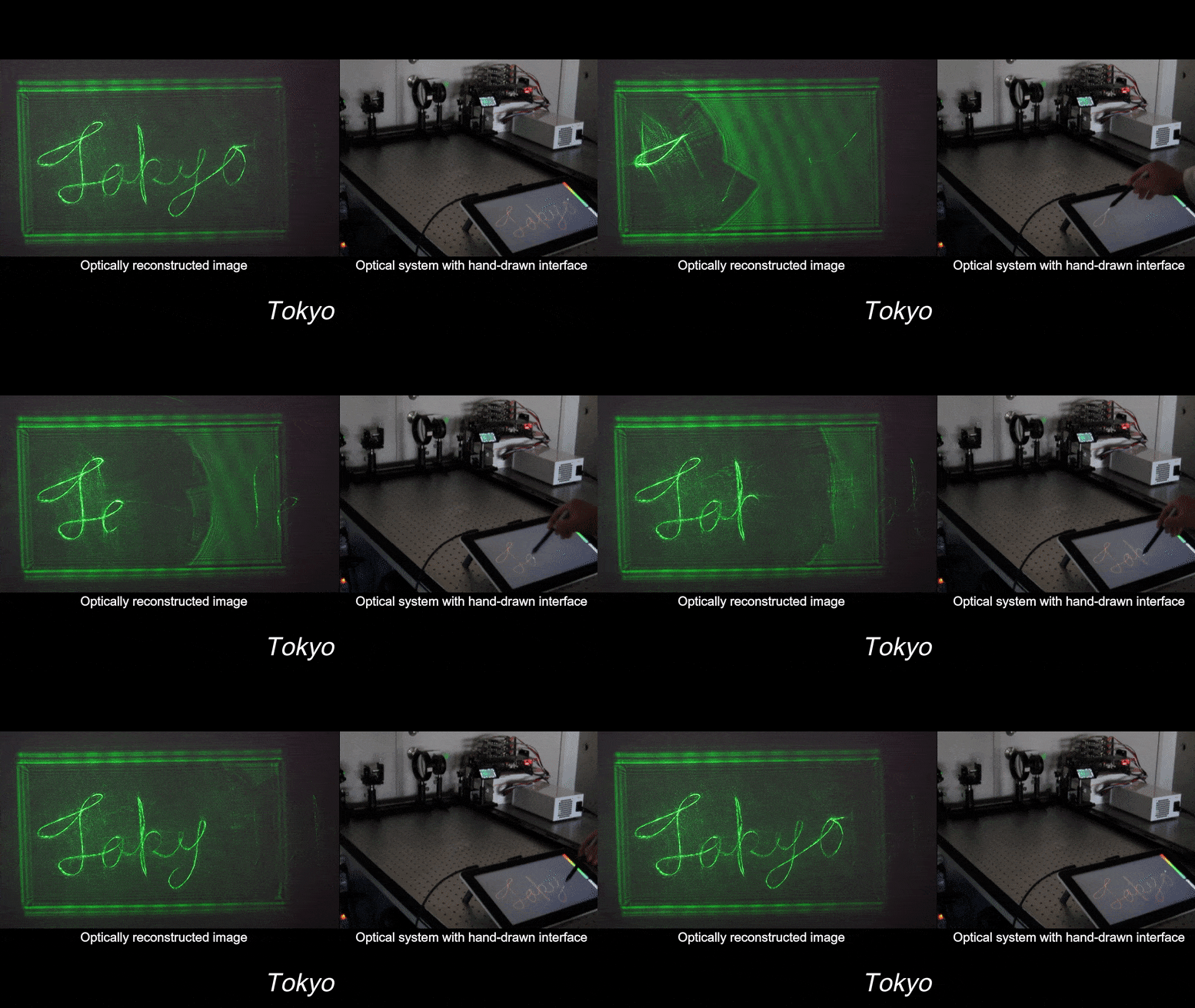
A new algorithm from Tokyo Metropolitan University makes it possible to create real-time holograms from simple drawings using low-power, everyday computers. This opens up a path for integrating holography into navigation and technical support systems.
Researchers from Tokyo Metropolitan University have devised and implemented a simplified algorithm for turning freely drawn lines into holograms on a standard desktop CPU. They dramatically cut down the computational cost and power consumption of algorithms that require dedicated hardware. It is fast enough to convert writing into lines in real-time, and makes crisp, clear images that meet industry standards. Potential applications include hand-written remote instructions superimposed on landscapes and workbenches.
Flying cars, robots, spaceships…whatever sci-fi future you can imagine, there is always a common feature: holograms. But holography isn’t just about aesthetics. Its potential applications include important enhancements to vital, practical tasks, like remote instructions for surgical procedures, electronic assembly on circuit boards, or directions projected on landscapes for navigation. Making holograms available in a wide range of settings is vital to bringing this technology out of the lab and into our daily lives.
One of the major drawbacks of this state-of-the-art technology is the computational load of hologram generation. The kind of quality we’ve come to expect in our 2D displays is prohibitive in 3D, requiring supercomputing levels of number crunching to achieve. There is also the issue of power consumption. More widely available hardware like GPUs in gaming rigs might be able to overcome some of these issues with raw power, but the amount of electricity they use is a major impediment to mobile applications. Despite improvements to available hardware, the solution is not something we can expect from brute-force.
Handwriting on a tablet is converted into 3D images in real-time using a standard desktop PC. Credit: Tokyo Metropolitan University
A Streamlined Approach Using 3D Lines
A key solution is to limit the kind of images that are projected. Now, a team led by Assistant Professor Takashi Nishitsuji have proposed and implemented a solution with unprecedented performance. They specifically chose to exclusively draw lines in 3D space. Though this may sound drastic at first, the number of things you can do is still impressive. In a particularly elegant implementation, they connected a tablet to a PC and conventional hologram generation hardware i.e. a laser and a spatial light modulator. Their algorithm is fast enough that handwriting on the tablet could be converted to images in the air in real-time. The PC they used was a standard desktop with no GPU, significantly expanding where it might be implemented. Though the images were slightly inferior in quality to other, more computationally intensive methods, the sharpness of the writing comfortably met industry standards.
All this means that holograms might soon be arriving in our homes or workplaces. The team is especially focused on implementations in heads-up displays (HUDs) in helmets and cars, where navigation instructions might be displayed on the landscape instead of voice instructions or distracting screens. The light computational load of the algorithm significantly expands the horizons for this promising technology; that sci-fi “future” might not be the future for much longer.
Reference: “An interactive holographic projection system that uses a hand-drawn interface with a consumer CPU” by Takashi Nishitsuji, Takashi Kakue, David Blinder, Tomoyoshi Shimobaba and Tomoyoshi Ito, 8 January 2021, Scientific Reports.
DOI: 10.1038/s41598-020-78902-1
This work was supported by JSPS KAKENHI Grants-in-Aid for Scientific Research (20K19810, 19H01097), the Inoue Foundation for Science, the Takayanagi Kenjiro Foundation and Fonds Wetenschappelijk Onderzoek (12ZQ220N, VS07820N).
Never miss a breakthrough: Join the SciTechDaily newsletter.
Follow us on Google and Google News.