
Close Menu
    Facebook X (Twitter) Instagram
    SciTechDaily
    • Biology
    • Chemistry
    • Earth
    • Health
    • Physics
    • Science
    • Space
    • Technology
    Facebook X (Twitter) Pinterest YouTube RSS
    SciTechDaily
    Home»Technology»New Possibilities for Graphene in Thin-Film Photovoltaics
    Technology

    New Possibilities for Graphene in Thin-Film Photovoltaics

    By Helmholtz-Zentrum BerlinOctober 9, 2013No Comments3 Mins Read
    Facebook Twitter Pinterest Telegram LinkedIn WhatsApp Email Reddit
    Share
    Facebook Twitter LinkedIn Pinterest Telegram Email Reddit
    Researchers Take a Major Leap Towards Graphene for Solar Cells
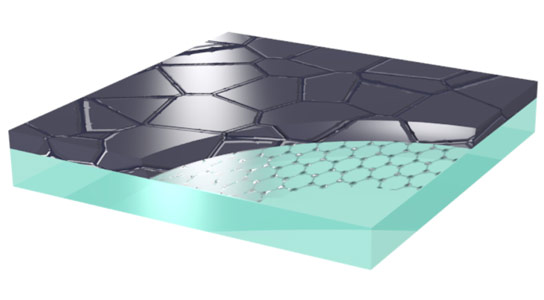
    Graphene was deposited onto a glass substrate. The ultrathin layer is but one atomic layer thick (0.3 Angström, or 0.03 nanometers), although charge carriers are able to move about freely within this layer. This property is retained even if the graphene layer is covered with amorphous or polycrystalline silicon. Credit: Marc A. Gluba/HZB

    In a newly published study, researchers from the HZB Institute for Silicon Photovoltaics have shown that graphene retains its properties when coated with a thin silicon film, paving the way for new possibilities in solar cells.

    Graphene has extreme conductivity and is completely transparent while being inexpensive and nontoxic. This makes it a perfect candidate material for transparent contact layers for use in solar cells to conduct electricity without reducing the amount of incoming light – at least in theory. Whether or not this holds true in a real world setting is questionable as there is no such thing as “ideal” graphene – a free floating, flat honeycomb structure consisting of a single layer of carbon atoms: interactions with adjacent layers can change graphene’s properties dramatically. Now, Dr. Marc Gluba and Prof. Dr. Norbert Nickel of the HZB Institute for Silicon Photovoltaics have shown that graphene retains its impressive set of properties when it is coated with a thin silicon film. These findings have paved the way for entirely new possibilities to use in thin-film photovoltaics.

    “We examined how graphene’s conductive properties change if it is incorporated into a stack of layers similar to a silicon based thin film solar cell and were surprised to find that these properties actually change very little,” Marc Gluba explains.

    To this end, they grew graphene on a thin copper sheet, next transferred it to a glass substrate, and finally coated it with a thin film of silicon. They examined two different versions that are commonly used in conventional silicon thin-film technologies: one sample contained an amorphous silicon layer, in which the silicon atoms are in a disordered state similar to a hardened molten glas; the other sample contained poly-crystalline silicon to help them observe the effects of a standard crystallization process on graphene’s properties.

    Even though the morphology of the top layer changed completely as a result of being heated to a temperature of several hundred degrees C, the graphene is still detectable.

    “That’s something we didn’t expect to find, but our results demonstrate that graphene remains graphene even if it is coated with silicon,” says Norbert Nickel. Their measurements of carrier mobility using the Hall-effect showed that the mobility of charge carriers within the embedded graphene layer is roughly 30 times greater than that of conventional zinc oxide based contact layers. Says Gluba: “Admittedly, it’s been a real challenge connecting this thin contact layer, which is but one atomic layer thick, to external contacts. We’re still having to work on that.” Adds Nickel: “Our thin film technology colleagues are already pricking up their ears and wanting to incorporate it.”

    The researchers obtained their measurements on one square centimeter samples, although in practice it is feasible to coat much larger areas than that with graphene.

    Reference: “Embedded graphene for large-area silicon-based devices” by M. A. Gluba, D. Amkreutz, G. V. Troppenz, J. Rappich and N. H. Nickel, 12 August 2013, Applied Physics Letters.
    DOI: 10.1063/1.4818461

    Never miss a breakthrough: Join the SciTechDaily newsletter.
    Follow us on Google and Google News.

    Graphene Green Technology Helmholtz-Zentrum Berlin Materials Science Photovoltaics
    Share. Facebook Twitter Pinterest LinkedIn Email Reddit

    Related Articles

    Researchers Demonstrate a New Paradigm for Solar Cell Construction

    Aluminum Studs Improve Solar Panel Efficiency

    New 3D Graphene Material – An Inexpensive Replacement for Platinum in Solar Cells

    Disordered Nature of Plastic Polymers Can Improve Performance of Plastic Solar Cells

    Scientists Achieve Solar Hydrogen Production Breakthrough

    Organic Photovoltaics Potentially As Inexpensive as Paint

    Layered Oxide Heterostructures Produce Efficient Solar Cells

    Black Silicon Improves the Efficiency of Solar Cells

    Highly Transparent Polymer Solar Cell Produces Energy by Absorbing Near-Infrared Light

    Leave A Reply Cancel Reply

    • Facebook
    • Twitter
    • Pinterest
    • YouTube

    Don't Miss a Discovery

    Subscribe for the Latest in Science & Tech!

    Trending News

    AI Could Detect Early Signs of Alzheimer’s in Under a Minute – Far Before Traditional Tests

    What if Dark Matter Has Two Forms? Bold New Hypothesis Could Explain a Cosmic Mystery

    This Metal Melts in Your Hand – and Scientists Just Discovered Something Strange

    Beef vs. Chicken: Surprising Results From New Prediabetes Study

    Alzheimer’s Breakthrough: Scientists Discover Key Protein May Prevent Toxic Protein Clumps in the Brain

    Quantum Reality Gets Stranger: Physicists Put a Lump of Metal in Two Places at Once

    Scientists May Have Found the Key to Jupiter and Saturn’s Moon Mystery

    Scientists Uncover Brain Changes That Link Pain to Depression

    Follow SciTechDaily
    • Facebook
    • Twitter
    • YouTube
    • Pinterest
    • Newsletter
    • RSS
    SciTech News
    • Biology News
    • Chemistry News
    • Earth News
    • Health News
    • Physics News
    • Science News
    • Space News
    • Technology News
    Recent Posts
    • Living With Roommates Might Be Changing Your Gut Microbiome Without You Knowing
    • Simple and Cheap Blood Test Could Detect Cancer and Other Diseases Before Symptoms Appear
    • Century-Old Cleaning Chemical Linked to 500% Increased Risk of Parkinson’s Disease
    • What if Your Memories Never Happened? Physicists Take a New Look at the Boltzmann Brain Paradox
    • Students Found an Ancient Star That Shouldn’t Be in the Milky Way
    Copyright © 1998 - 2026 SciTechDaily. All Rights Reserved.
    • Science News
    • About
    • Contact
    • Editorial Board
    • Privacy Policy
    • Terms of Use

    Type above and press Enter to search. Press Esc to cancel.