
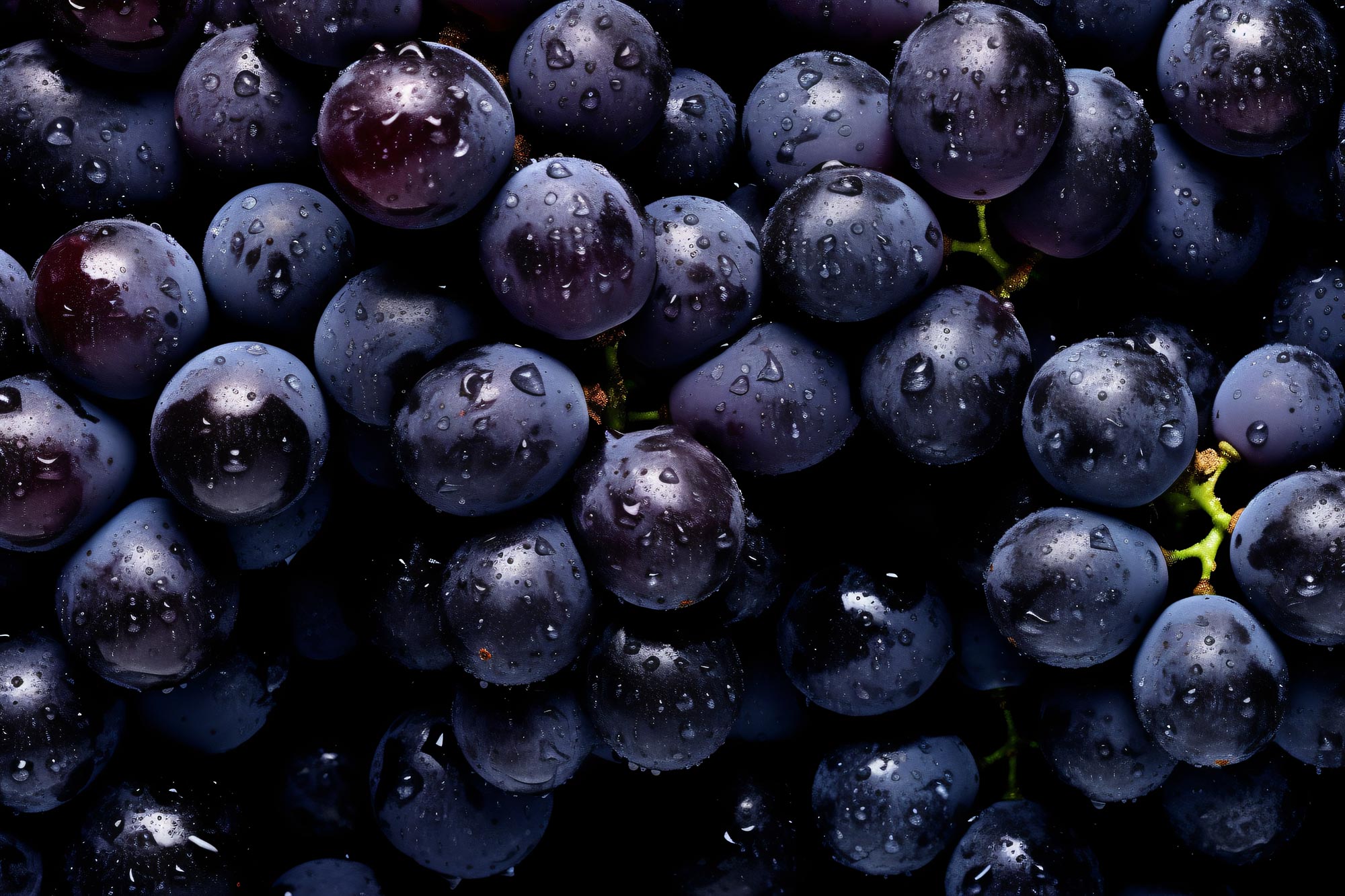
A new peer-reviewed article argues that grapes deserve a place among today’s top superfoods.
A recent article published in the peer-reviewed Journal of Agriculture and Food Chemistry takes a closer look at the term “superfoods” and presents a compelling argument that fresh grapes deserve a top spot among them. The author, Dr. John M. Pezzuto, a prominent expert in resveratrol and cancer research and Dean of the College of Pharmacy and Health Sciences at Western New England University, provides a detailed overview supported by a wide range of scientific evidence.
According to the article, the word “superfood” is widely used but lacks an official scientific definition or standardized criteria. Foods commonly referred to as superfoods are often part of the Mediterranean Diet and are typically packed with natural plant-based compounds that support overall health. Dr. Pezzuto first explores the broader landscape of what constitutes a superfood, then shifts focus to grapes, emphasizing that they are frequently overlooked compared to better-known options like berries, despite offering similar health benefits.
A Complex and Powerful Fruit
Grapes are a natural source of over 1,600 compounds, including antioxidants and other polyphenols such as flavonoids, anthocyanidins, catechins, phenolic acids, resveratrol, and more. Polyphenols are credited with the health benefits of grapes, via antioxidant activity and influencing cellular processes. It is the whole grape and the unique matrix of these compounds within it that creates the biological effects, not a single component.
Over sixty peer-reviewed studies have been published in the scientific literature on grapes and health. The role of grapes on cardiovascular health is well established, including promoting relaxation of blood vessels and healthy circulation, as well as modulating cholesterol levels.
Clinical trials also show that grapes support brain health (help maintain healthy brain metabolism and beneficial impacts on cognition), skin health (enhanced resistance to UV radiation and DNA damage in skin cells), gut health (modulating the gut microbiome and increasing diversity in the gut), and eye health (retinal impact via increase in macular pigment optical density).
Grapes and Nutrigenomics
Finally, in the realm of nutrigenomics – the study of foods on gene expression in the body – grape consumption has been shown to positively alter gene expression in relevant body systems. Pezzuto suggests that it is these activities at the genetic level that are likely the driving force behind the health benefits of grapes.
“Dr. Pezzuto shows that based on the science, grapes are indeed a superfood, and should be recognized as such,” said Ian LeMay, president of the California Table Grape Commission, “and we are hopeful that using this nomenclature in association with grapes becomes common practice. Luckily, whether consumed for health or sheer enjoyment as a healthy snack, eating California grapes is a win for consumers.”
Reference: “Perspective: Are Grapes Worthy of the Moniker Superfood?” by John M. Pezzuto, 23 July 2025, Journal of Agricultural and Food Chemistry.
DOI: 10.1021/acs.jafc.5c05738
The research was funded by the California Table Grape Commission.
Never miss a breakthrough: Join the SciTechDaily newsletter.
Follow us on Google and Google News.
11 Comments
A new peer-reviewed article argues that grapes deserve a place among today’s top superfoods.
very good!
Please ask the researchers to think deeply:
1. Is there any suspicion of commercial hype in the naming of superfoods?
2. Is the peer-reviewed article really that credible?
3. Have the so-called peer-reviewed publications already been commercialized and unrelated to science?
The so-called peer-reviewed publications (including Physical Review Letters, Science, Nature, etc) deliberately ignore the core mathematical structures of general relativity’s geometric dynamics, quantum field theory’s renormalization framework, cosmic inflation models, and quantum gravity theories all implicitly rely on the uniformity, continuity, and isotropy of background space, obstinately cling to the ideal fluid characteristics of space—inviscid, incompressible, and isotropic are unverified. Ask to these so-called peer-reviewed publications (including Physical Review Letters, Science, Nature, etc): Where should things in space come from? Do things in space originate from the dynamic evolution of space itself, or from God, Demons, or Angels?
These so-called peer-reviewed publications collude to propagate and doggedly adhere to the notion that two sets of cobalt-60 rotating in opposite directions—whether symmetrical or not—constitute mirror images of each other. In the physical world they (including Physical Review Letters, Nature, Science, etc.) construct, different particles can be defined as the same particle, and topological vortices and their twin antivortices can be defined as two vortices with completely different spatiotemporal manifolds. God, Demons, Angels, and their pet Cats have always dominated the highly acclaimed physical world of these so-called peer-reviewed publications. Let us continue to witness with facts the dirtiest and ugliest epoch in the history of science and humanity.
Correct knowledge will benefit researchers. If researchers are interested in knowledge, please browse https://zhuanlan.zhihu.com/p/1933828835322856603.
Grapes must be fed to us by lovlies in leather mink skirts to work their magic
When I wrote this comment using my other name I was blocked
You poor thing.
Any research funded by the very people who would benefit commercially if the results came out the way they wanted shouldn’t be trusted. This research is simply garbage with no credibility even if there is any truth to it. Such a huge conflict of interest discredited it. It belongs to the marketing department, not to scientific work.
Organic grapes are super foods…. Sprayed grapes are cancer.
Grapes have been designated as a sugar bomb by my doctor and should be avoided particularly by diabetics.
Nonsense. They use large amounts of fluoride on most grapes in the form of cryolite. This is a neurotoxin. And grapes have been tested and seem to have the most fluoride of any food tested. And the sugar is potentially a factor in the development of diabetes, as it is very available, unlike many fruits where there is a lot of fiber to slow absorption.
I do take grape seed extract. I think that is probably okay. I was concerned that there may be heavy metal in it, but when I had my doc check my lead levels, they were very low (reported as <1.0 mcg/dl).
I did buy some organic grapes a few months ago. I think variety is a good thing. But even if I could get organic regularly, I wouldn't.
The paper is paywalled, but the same author published another similar paper in 2008. And that was funded by the California Table Grape Commission.
In 2008, GlaxoSmithKline (GSK) acquired Sirtris Pharmaceuticals for $720 million for the rights to resveratrol. That is widely seen as a blunder, because resveratrol promptly failed tests. The tests that it earlier passed turned out to be because of some common lab chemical. I don’t remember the details.
Some antiaging biohackers still take it, but I think most no longer take it. If something fails, most people move on to other things like spermidine, sulforaphane, urolithin A, ergothioneine, epicatechin, curcumin, sodium butyrate, valproic acid, periplocin, ginkgetin, acarbose, canagliflozin, fisetin, taurine, 17α-estradiol, resveratrol, nicotinamide riboside, nordihydroguaiaretic acid, and many other things. Peptides are huge right now, even though we don’t have much in the way of even mouse studies yet.
If we ate everything that was supposed to keep us alive longer, we’d all weigh 500 pounds.