
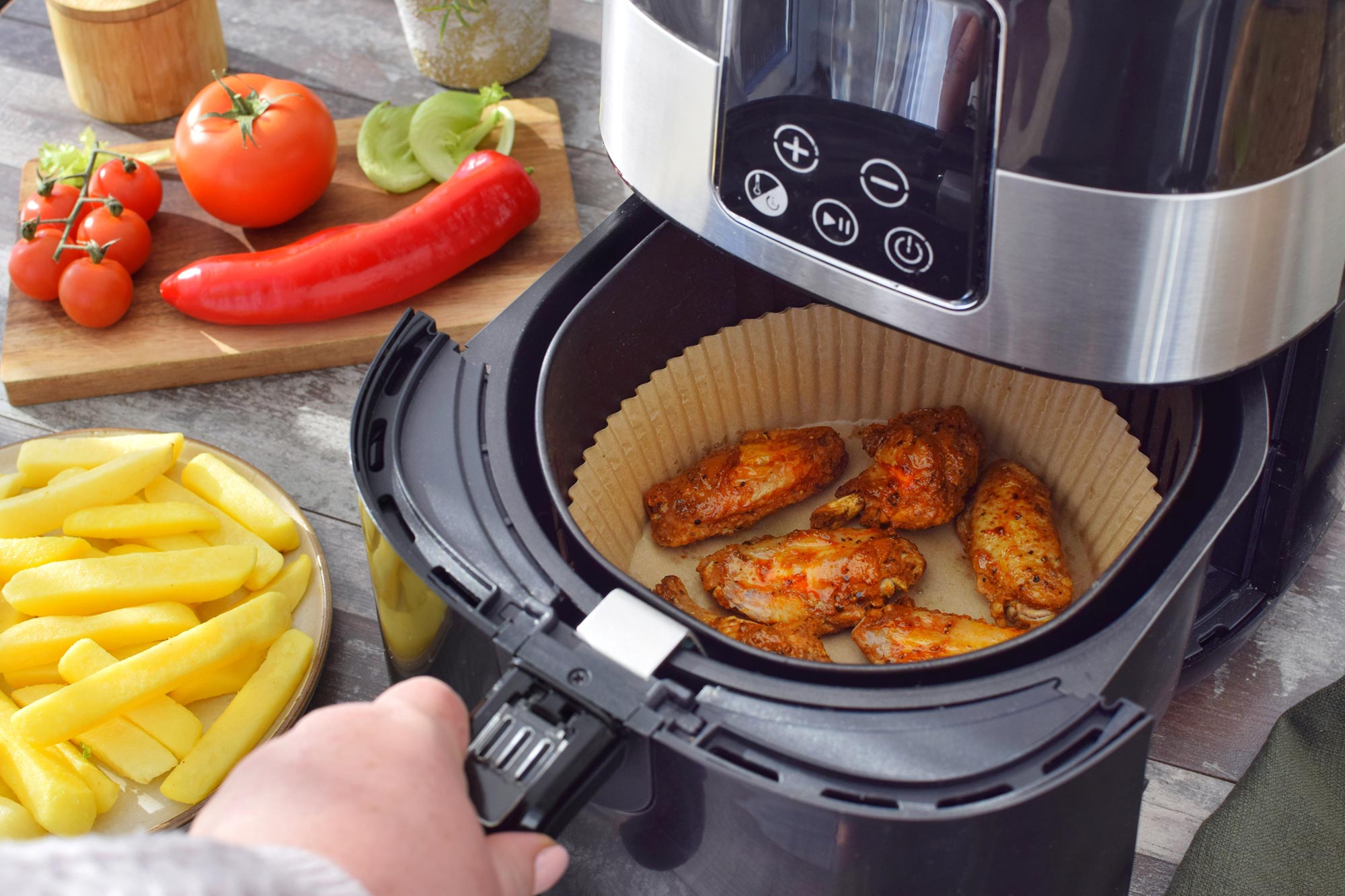
As air fryers become a staple in modern kitchens, scientists are beginning to examine how they affect the air inside our homes.
A new study from the University of Birmingham suggests that air fryers can cut down on the pollution released during frying, even when the food is very high in fat. Compared with common frying techniques, the researchers found air frying produces fewer airborne particles.
The work, published in the American Chemical Society journal ES&T Air, is among the first to map out the full mix of pollutants released during air frying. That matters because surveys indicate air fryers are quickly becoming a standard appliance in many UK kitchens. Across several foods, the team measured lower emissions of volatile organic compounds (VOCs) and ultrafine particles than they typically saw with shallow frying or deep fat frying.
The study also follows earlier results from the same group showing that air frying chicken breast released far fewer VOCs. This time, the researchers focused on whether the fat content of foods changes what ends up in the air. VOCs and ultrafine particles have both been linked to health concerns, but indoor sources like cooking have received much less attention than outdoor pollution.
Measuring Emissions From Different Foods
To capture cooking emissions in detail, the University of Birmingham team ran experiments inside custom-built air quality chambers designed to detect small changes in VOCs and other airborne particles. They used a commercially available 4.7l air fryer and cooked batches of frozen fried foods, fresh low-fat foods, and fresh high-fat foods so the results could be compared under consistent conditions.
Even within the air fryer, some foods stood out. Frozen onion rings (possibly due to pre-fried oil coating), along with smoked bacon and unsmoked bacon (both of which contain cured fat and their thin shape leading to near instantaneous frying of fats), produced the highest levels of cooking-related emissions in the tests.
But the largest differences appeared when the same type of high-fat cooking was done another way. Using a deep fat fryer produced VOC levels that were 10 to 100 times higher. The researchers say this aligns with their earlier work in a research kitchen, where cooking lean chicken breast in oil with different methods led to similarly elevated pollutant levels compared with air frying.
Health Implications and Expert Insights
Professor Christian Pfrang from the University of Birmingham and lead author of the study said: “This study is the latest that shows the potential benefits for indoor air quality of using air fryers for cooking. While our previous study only looked at one type of food – lean chicken – we wanted to look at a greater range of foodstuffs including ones with higher fat content to see how they compare specifically when cooked in an air fryer.”
Ruijie Tang, first author and the final year PhD student at the University of Birmingham who carried out the experiments said: “The results confirmed that while foods with high fat content do produce more emissions in the air fryer, they produce only a fraction of what we see in cooking methods such as shallow or deep-fat frying. Using a bespoke air quality chamber for this latest study has allowed us to get a much more detailed look at emissions from air frying too, helping us to focus only on the contributions to air pollutants from cooking.”
Prolonged use without deep cleaning leads to background emissions
The team also found that the air fryers began emitting VOCs and ultra-fine particles during an empty tray test to look at residual emissions.
Tests with an air fryer used more than 70 times revealed 23% more cooking-related VOCs and more than twice as many ultra-fine particles emitted. The team attributes this to the build-up of residues on the air fryer in areas that the team could not reach for cleaning.
Cooking-related ultra-fine particles measured in these tests, including the background emissions from an older machine, were still significantly lower than those from other cooking techniques.
The study also provides a detailed analysis of the types of VOCs emitted during cooking, which have been linked with health concerns. Ketones, aldehydes and alkenes from heated oils and food browning were observed across all food stuffs cooked, but total levels of all VOCs were many times lower than recommended limits set by UK Government Buildings Regulations.
Professor Christian Pfrang said: “Our study shows that repeated use of air fryers without being able to clean the more inaccessible cooking surfaces can negate some of the benefits for indoor air quality. While the effects are not producing emissions that families should be concerned about, this finding does make a case for air fryer design that allows for a deep clean to keep emissions low in the long term.
“Air quality in the home and other indoor environments is being increasingly recognized as an important factor, and our body of work will provide households with a better understanding of how kitchen activities affect the air we breathe in our homes.”
Reference: “Quantification of Volatile Organic Compounds (VOCs), Nitrogen Oxides (NOx), and Ultrafine Particles (UFPs) Emitted by Domestic Air Fryers: A Chamber Study of Indoor Air Quality Impacts” by Ruijie Tang, Yizhou Su, William Joe F. Acton, Lara K. Dunn and Christian Pfrang, 27 January 2026, ACS ES&T Air.
DOI: 10.1021/acsestair.5c00363
Never miss a breakthrough: Join the SciTechDaily newsletter.
Follow us on Google and Google News.