
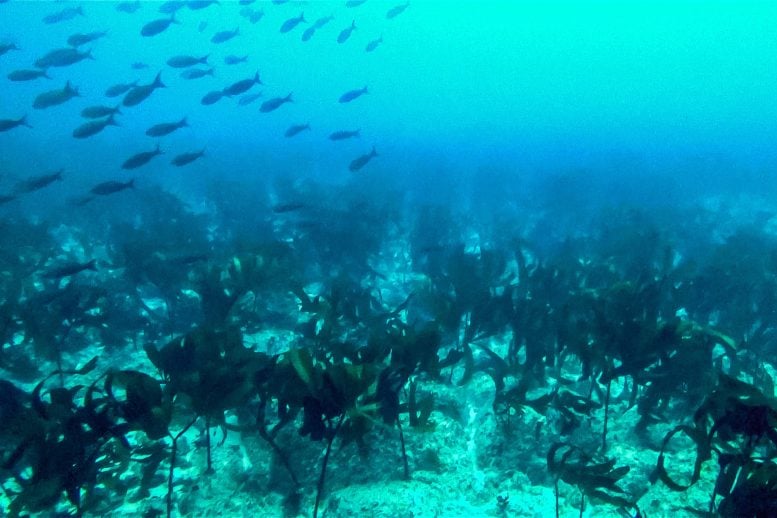
The Charles Darwin Foundation-led research holds importance due to the discovery of a new species of this type of alga, previously mostly found in colder waters.
María Altamirano, a researcher from the University of Malaga’s Department of Botany and Plant Physiology, is part of the scientific team collaborating on the Charles Darwin Foundation (CDF)-led Seamounts Project. The project has uncovered a vast kelp forest on the top of a seamount at a depth of approximately 50 meters in the southern Galapagos Islands.
The significance of the research, published in Marine Biology, lies in the discovery of a new species of kelp in the region and possibly in science. Conducted in collaboration with the Galapagos National Park Directorate and National Geographic, this research has characterized the ecology of this new ecosystem.
Refuges for Diversity
Kelps are brown algal seaweeds, famous for reaching very large sizes, which form marine forests in high densities. Similar to coral reefs and mangroves, these forests are very important for the maintenance of marine biodiversity, as they provide protection and food for many species.
As kelps are cold-water species, most of these forests are found exclusively in warm-cold or polar regions and shallow coastal areas because they need constant light. However, this kelp forest of the Galapagos Marine Reserve is located in a tropical region away from coastal areas.
The significance of this research, led by the Charles Darwin Foundation, lies in a new species record of this type of alga that, until now, it has been mostly found in colder waters. Credit: Charles Darwin Foundation/University of Malaga
“This is the first time that such an extensive and dense kelp forest has been registered in this part of the Galapagos and at such depths, since what we found looks very different from the Eisenia galapagensis kelp species, discovered in this area in 1934”, explains Salomé Buglass, CDF scientist and lead researcher, who adds that it is almost twice the normal size.
Remotely Operated Vehicles
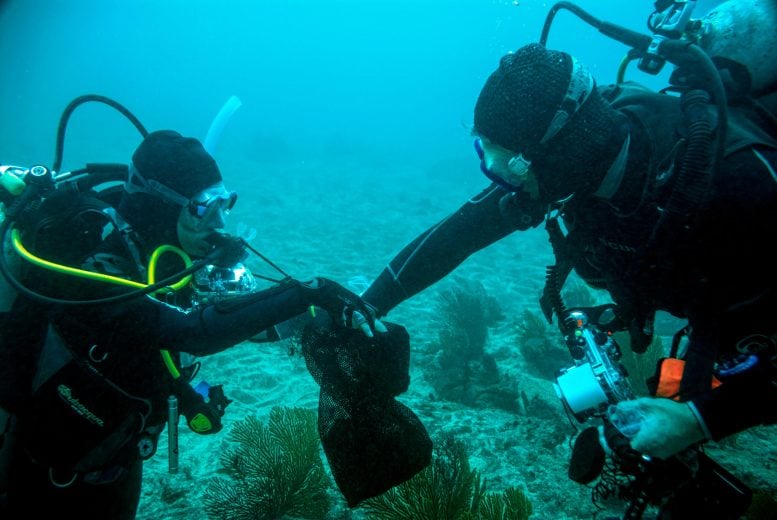
As standard scuba diving is restricted to depths of 40 meters, CDF’s research teams relied on new technologies, such as remotely operated vehicles (ROVs), to explore, document, and characterize these deep-sea ecosystems.
In fact, thanks to the installation of a mechanical claw to the ROV, in 2018 Professor María Altamirano, who was in the archipelago as coordinator of a collaboration project of the University of Malaga, together with the researcher at the University of Granada Julio de la Rosa, were able to analyze specimens of this newly registered alga, “which is essential to determine its taxonomy and is still under study”.
Explore and Protect
“Despite their enormous importance as ecosystem engineers and as support for the fascinating marine life of the Galapagos Islands, the macroalgae of this area have been widely ignored among the marine ecosystems of the archipelago”, says Altamirano. “This discovery offers the opportunity to highlight its significance as habitat for other species and their role in carbon sequestration within deep-sea areas”.
The scientists conclude that knowing that there are entire marine forests teeming with life that we were unaware of at only 50 m depth, serves as a reminder of how much remains to be explored, discovered, learned, and protected.
Reference: “Novel mesophotic kelp forests in the Galápagos archipelago” by Salome Buglass, Hiroshi Kawai, Takeaki Hanyuda, Euan Harvey, Simon Donner, Julio De la Rosa, Inti Keith, Jorge Rafael Bermúdez and María Altamirano, 23 November 2022, Marine Biology.
DOI: 10.1007/s00227-022-04142-8
Never miss a breakthrough: Join the SciTechDaily newsletter.
Follow us on Google and Google News.