
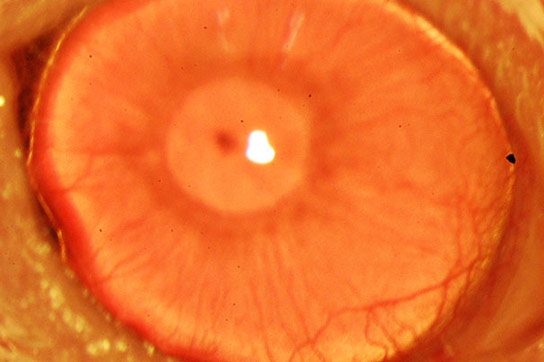
Harvard-affiliated researchers have discovered a new way to regrow human corneas that could help researchers overcome a major cause of blindness.
Researchers have identified a way to enhance regrowth of human corneal tissue to restore vision, using a molecule that acts as a marker for hard-to-find limbal stem cells.
This work, a collaboration among the Harvard-affiliated Massachusetts Eye and Ear/Schepens Eye Research Institute, Boston Children’s Hospital, Brigham and Women’s Hospital, and the VA Boston Healthcare System, holds promise for burn patients, victims of chemical injury, and others with damaging eye diseases. The research, published in the journal Nature, is also one of the first examples of constructing a tissue from an adult-derived human stem cell.
Limbal stem cells reside in the eye’s basal limbal epithelium, or limbus, and help to maintain and regenerate corneal tissue. Their loss due to injury or disease is one of the leading causes of blindness. In the past, tissue or cell transplants have been used to help the cornea regenerate, but it was unknown whether there were actual limbal stem cells in the grafts, or how many there might be, and the outcomes were not consistent.
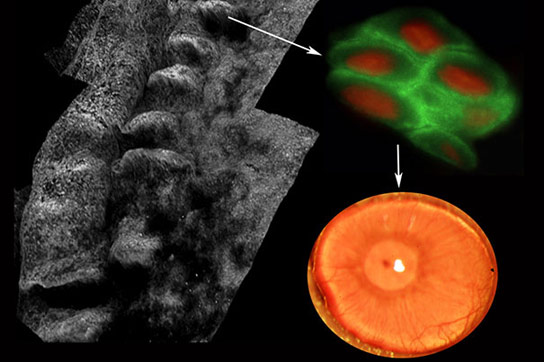
In this study, researchers were able to use antibodies detecting the marker molecule, known as ABCB5, to zero in on the stem cells in tissue from deceased human donors and use it to regrow anatomically correct, fully functional human corneas in mice.
“Limbal stem cells are very rare, and successful transplants are dependent on these rare cells,” said Bruce Ksander of Mass. Eye and Ear, co-lead author on the study with postdoctoral fellow Paraskevi Kolovou. “This finding will now make it much easier to restore the corneal surface. It’s a very good example of basic research moving quickly to a translational application.”
Researchers in the lab of Markus Frank of Boston Children’s Hospital and Natasha Frank of the VA Boston Healthcare System and Brigham and Women’s Hospital, the co-senior investigators on the study, discovered that ABCB5 was being produced in tissue precursor cells in human skin and intestine. In the new work, using a mouse model developed by the Frank lab, they found that ABCB5 also occurs in limbal stem cells and is required for their maintenance and survival, and for corneal development and repair. Mice lacking a functional ABCB5 gene lost their limbal stem cells, and their corneas healed poorly after injury.
“ABCB5 allows limbal stem cells to survive, protecting them from apoptosis [programmed cell death],” said Markus Frank. “The mouse model allowed us for the first time to understand the role of ABCB5 in normal development, and should be very important to the stem cell field in general,” according to Natasha Frank.
Markus Frank is working with the biopharmaceutical industry to develop a clinical-grade ABCB5 antibody that would meet U.S. regulatory approvals. “A single lab cannot do a study like this,” said Natasha Frank, who is also affiliated with the Harvard Stem Cell Institute. “It integrates genetics, knockout mice, antibodies, transplantation — a lot of technical expertise that we were lucky came together in a very nice way.”
Other researchers involved in the work were Sean P. McGuire, Meredith S. Gregory, William J. B. Vincent, and James D. Zieske of Schepens Eye Research Institute/Massachusetts Eye and Ear and Harvard Medical School; Brian J. Wilson, Karim R. Saab, and Jie Ma of Boston Children’s Hospital; Qin Guo of Boston Children’s Hospital and the VA Boston Healthcare System; Victor L. Perez and Fernando Cruz-Guilloty of Bascom Palmer Eye Institute, University of Miami Miller School of Medicine; Winston W.Y. Kao and Mindy K. Call of University of Cincinnati Medical Center; Budd A. Tucker of the Stephen A Wynn Institute for Vision Research, Carver College of Medicine, University of Iowa; Qian Zhan and George Murphy of Brigham and Women’s Hospital; Kira L. Lathrop of the University of Pittsburgh; and Clemens Alt, Luke J. Mortensen, and Charles P. Lin of Massachusetts General Hospital and Harvard Medical School.
The research was supported by the National Institute of Neurological Disorders and Stroke, the Veterans Administration, the Harvard Stem Cell Institute, the National Cancer Institute, the Department of Defense, the National Institutes of Health and its New Innovator Award, a Corley Research Grant, a Western Pennsylvania Medical Eye Bank Core Grant for Vision Research, the Howard Hughes Medical Institute, and the Life Sciences Research Foundation.
Reference: “ABCB5 is a limbal stem cell gene required for corneal development and repair” by Bruce R. Ksander, Paraskevi E. Kolovou, Brian J. Wilson, Karim R. Saab, Qin Guo, Jie Ma, Sean P. McGuire, Meredith S. Gregory, William J. B. Vincent, Victor L. Perez, Fernando Cruz-Guilloty, Winston W. Y. Kao, Mindy K. Call, Budd A. Tucker, Qian Zhan, George F. Murphy, Kira L. Lathrop, Clemens Alt, Luke J. Mortensen, Charles P. Lin, James D. Zieske, Markus H. Frank and Natasha Y. Frank, 2 July 2014, Nature.
DOI: 10.1038/nature13426
Never miss a breakthrough: Join the SciTechDaily newsletter.
Follow us on Google and Google News.
4 Comments
Limbal cells which transform into the transparent cornea, is an important discovery. Anti-bodies were used to zero in on the marker molecule ABCB5 which are prevalent in skin, and intestine, and which are responsible for the formation of cornea, provided they are blocked from apoptosis (Programmed Cell Death).In this context, I would like to mention, that in many kind of fishes, the outer skin is transparent and glass like and so also in jelly fish and bacteria. ABCB5 molecule should be responsible as a precursor to such transparency, which by evolution and slow adaptation, had undergone apoptosis (Programmed Cell Death), to produce pigmented skin. First the sight was through the whole body, and slowly it got localized in the cornea and phakik lens. Once, these ABCB5 protein is planted in the area of repair of the cornea, we can naturally expect the cornea to regrow to the normal form. After all, eye is the modification of the skin, just like the flower which is the modification of leaves in Botany. A further discovery was that cadaver cornea can be peeled into three parts or lining in them and three corneas can be donated to three people, who can regrow it to full in course of time. At last a light in the end of tunnel is visible and we should be thankful for it. Thank You.
Good job science people! Keep up the great work!
Getting a study for cornea transplant for a detached cornea. Total human eye transplant.
I just like to know if this is true?
Would like to ask you any address or detail to work with in Canada bc
How do I refer place or such address to have treatment for my eyes are losing vision 😭 as I am 70 please help with the right address for Canada bc Surrey