
Researchers identify an “Island of Inversion” in proton-neutron symmetric nuclei for the first time.
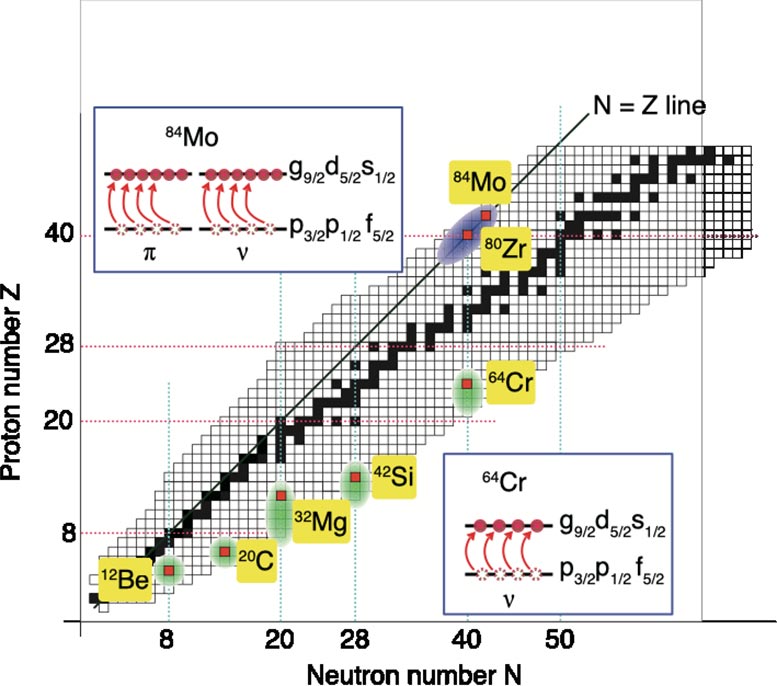
For many years, nuclear physicists thought that “Islands of Inversion” existed mainly in neutron-rich nuclei. These are regions of the nuclear chart where the usual rules of nuclear structure stop working. In these rare cases, familiar magic numbers no longer apply, spherical shapes give way to distorted forms, and nuclei take on unexpectedly strong deformations.
Until now, every known example involved highly exotic systems, including beryllium 12 (N = 8), magnesium 32 (N = 20), and chromium 64 (N = 40), all far removed from the stable nuclei found in nature.
A new study by an international collaboration involving the Center for Exotic Nuclear Studies, the Institute for Basic Science (IBS), the University of Padova, Michigan State University, the University of Strasbourg, and other institutions has now revealed something entirely unexpected. The researchers identified an Island of Inversion in one of the most symmetric regions of the nuclear chart, where the number of protons and neutrons is the same.
Testing symmetry at the N = Z line
The team focused on two isotopes of molybdenum, molybdenum 84 (Z = N = 42) and molybdenum 86 (Z = 42, N = 44). These nuclei sit along the N = Z line, a scientifically important but technically challenging region because such isotopes are difficult to produce in the laboratory. Using rare isotope beams at Michigan State University together with extremely sensitive gamma ray detectors, the researchers measured the lifetimes of excited nuclear states with picosecond level precision.
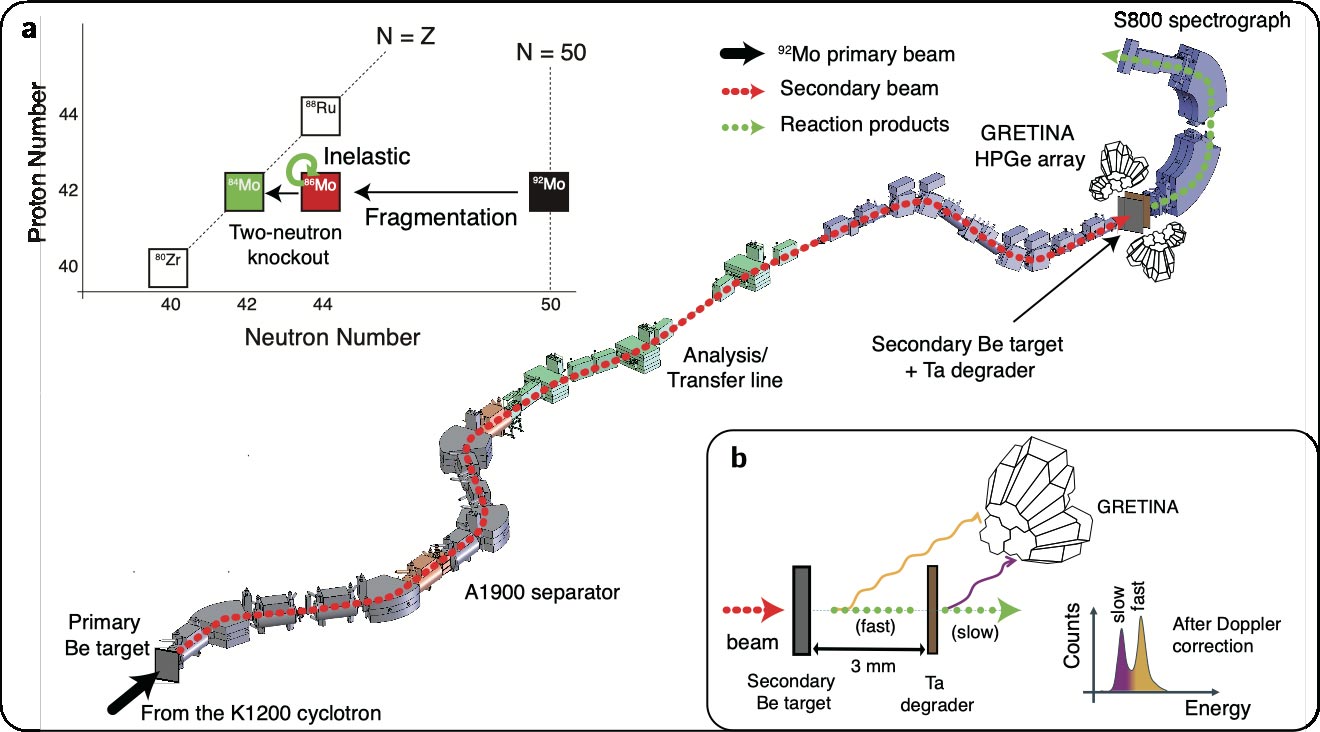
To generate the beams, the scientists created fast-moving Mo 86 nuclei by striking a beryllium target with accelerated Mo 92 ions. An A1900 separator was then used to isolate the desired fragments from the many products created in the collision.
The selected Mo 86 nuclei were directed onto a second target, where some became excited, and others were transformed into Mo 84 by losing two neutrons. As these nuclei relaxed back to their ground states, they emitted gamma rays that carried detailed information about their internal structure.
The emitted gamma rays were recorded using GRETINA, a high resolution germanium detector array capable of tracking individual gamma ray interactions, along with TRIPLEX, an instrument designed to measure extremely short lifetimes on the scale of trillionths of a second. By comparing the experimental data with GEANT4 Monte Carlo simulations, the researchers were able to determine the lifetimes of the first excited states and infer how strongly the nuclei were deformed.
Nearly identical nuclei behave very differently
The measurements revealed that Mo-84 behaves very differently from Mo-86, even though the two isotopes differ by only two neutrons. Mo-84 showed an exceptionally large degree of collective motion — a sign that many protons and neutrons are being promoted together across a major shell gap. Nuclear physicists describe this process as a “particle–hole excitation”: some nucleons jump to higher-energy orbitals (particles), leaving vacancies in the lower-energy orbitals (holes). The more nucleons that participate in these coordinated jumps, the more strongly deformed a nucleus becomes.
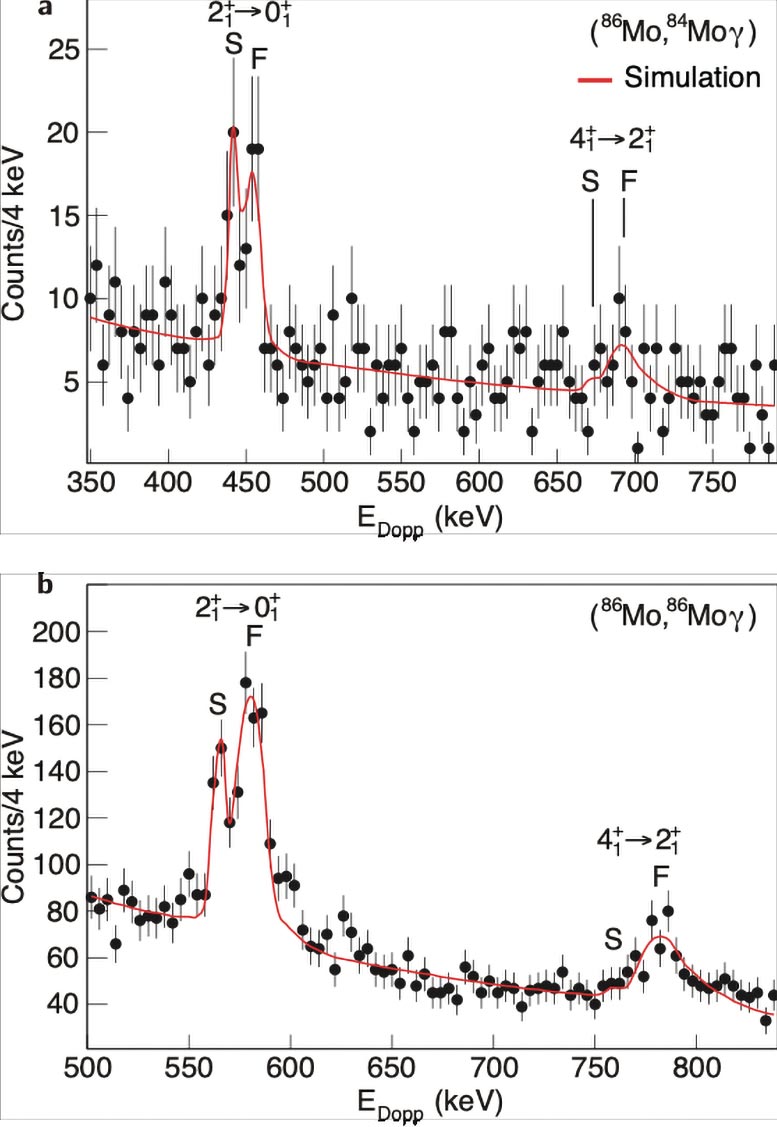
Advanced calculations performed by the team explain this striking contrast. In Mo-84, both protons and neutrons undergo very large simultaneous particle-hole excitations — effectively an 8-particle-8-hole rearrangement — which produces a strongly deformed shape.
This behavior arises from a special interplay between proton–neutron symmetry and the narrowing of the shell gap at N = Z = 40, making such coordinated excitations unusually easy. Importantly, the models show that this deformation cannot be reproduced without including three-nucleon forces, interactions in which three nucleons act together. Models that include only the traditional two-nucleon interaction fail to generate the observed structure.
In contrast, Mo-86 shows modest 4p-4h excitations and therefore remains much less deformed. These combined findings show that Mo-84 resides inside a newly identified “Island of Inversion” while Mo-86 lies outside it.
The new “Isospin-Symmetric Island of Inversion” discovered through this study on the N = Z nuclide Mo-84 is the first case of Island of Inversion that appears in proton-neutron symmetric nuclei. This discovery challenges long-held assumptions about where structural inversions can occur and provides a new window into the fundamental forces that bind matter together.
Reference: “Abrupt structural transition in exotic molybdenum isotopes unveils an isospin-symmetric island of inversion” by J. Ha, F. Recchia, S. M. Lenzi, H. Iwasaki, D. D. Dao, F. Nowacki, A. Revel, P. Aguilera, G. de Angelis, J. Ash, D. Bazin, M. A. Bentley, S. Biswas, S. Carollo, M. L. Cortes, R. Elder, R. Escudeiro, P. Farris, A. Gade, T. Ginter, M. Grinder, J. Li, D. R. Napoli, S. Noji, J. Pereira, S. Pigliapoco, A. Pompermaier, A. Poves, K. Rezynkina, A. Sanchez, R. Wadsworth and D. Weisshaar, 27 November 2025, Nature Communications.
DOI: 10.1038/s41467-025-65621-2
This work was supported by the Institute for Basic Science (IBS-R031-Y3); IRI-I002619N of the FWO Research Foundation—Flanders. A.P. acknowledges support of the grant nos. CEX2020-001007-S funded by MCIN/AEI/10.13039/501100011033 and PID2021-127890NB-I00.
Never miss a breakthrough: Join the SciTechDaily newsletter.
Follow us on Google and Google News.
4 Comments
Scientists have uncovered an unexpected breakdown of nuclear order in a remarkably symmetric atom, challenging long-standing ideas about where such effects can occur.
VERY GOOD.
Scientists, please think deeply:
Is symmetry dominant over natural laws, or asymmetry dominant over natural laws?
Testing symmetry at the N = Z line.
VERY GOOD.
Please ask researchers to think deeply:
1. Can your observation alter symmetry?
2. WHAT ARE THE Science Advances?
Errors or missteps in scientific inquiry are not in themselves cause for alarm. The far more concerning phenomenon is the persistent adherence to flawed premises, the continuous application of incorrect methodologies for superficial corrections, and the simultaneous opposition and resistance to fundamental, substantive improvement.
—— Excerpted from https://zhuanlan.zhihu.com/p/1991830545164959903.
Scientists have uncovered an unexpected breakdown of nuclear order in a remarkably symmetric atom, challenging long-standing ideas about where such effects can occur.
Scientists, please think deeply:
1. Is symmetry dominant over natural laws, or asymmetry dominant over natural laws?
2. Where did your unexpecting come from?
When we pursue the ultimate truth of all things, the space in which our bodies and all things exist may itself be the final and deepest puzzle we need to explore. This is not only the pursuit of physics, but also the most magnificent exploration of the origin of the universe by human reason.
Based on the Topological Vortex Theory (TVT), space is an uniformly incompressible physical entity. Space-time vortices are the products of topological phase transitions of the tipping points in space, are the point defects in spacetime. Point defects do not only impact the thermodynamic properties, but are also central to kinetic processes. They create all things and shape the world through spin and self-organization.
In today’s physics, some so-called peer-reviewed journals—including Physical Review Letters, Nature, Science, and others—stubbornly insist on and promote the following:
1. Even though θ and τ particles exhibit differences in experiments, physics can claim they are the same particle. This is science.
2. Even though topological vortices and antivortices have identical structures and opposite rotational directions, physics can define their structures and directions as entirely different. This is science.
3. Even though two sets of cobalt-60 rotate in opposite directions and experiments reveal asymmetry, physics can still define them as mirror images of each other. This is science.
4. Even though vortex structures are ubiquitous—from cosmic accretion disks to particle spins—physics must insist that vortex structures do not exist and require verification. Only the particles that like God, Demonic, or Angelic are the most fundamental structures of the universe. This is science.
5. Even though everything occupies space and maintains its existence in time, physics must still debate and insist on whether space exists and whether time is a figment of the human mind. This is science.
6. Even though space, with its non-stick, incompressible, and isotropic characteristics, provides a solid foundation for the development of physics, physics must still insist that the ideal fluid properties of space do not exist. This is science.
and go on.
Is this the counterintuitive science they widely promote? Compromising with pseudo academic publications and peer review by pseudo scholars is an insult to science and public intelligence. Some so-called scholars no longer understand what shame is. The study of Topological Vortex Theory (TVT) reminds us that the most profound problems in physics often lie at the intersection of different theories. By exploring these border regions, we can not only resolve contradictions in existing theories but also discover new physical phenomena and application possibilities.
Under the topological vortex architecture, it is highly challenging for even two hydrogen atoms or two quarks to be perfectly symmetrical, let alone counter-rotating two sets of cobalt-60. Contemporary physics and so-called peer-reviewed publications (including Physical Review Letters, Science, Nature, etc.) stubbornly believe that two sets of counter rotating cobalt-60 are two mirror images of each other, constructing a more shocking pseudoscientific theoretical framework in the history of science than the “geocentric model”. This pseudo scientific framework and system have seriously hindered scientific progress and social development.
For nearly a century, physics has been manipulated by this pseudo scientific theoretical system and the interest groups behind it, wasting a lot of manpower, funds, and time. A large amount of pseudo scientific research has been conducted, and countless pseudo scientific papers have been published, causing serious negative impacts on scientific and social progress, as well as humanistic development.
Complexity does not necessarily mean that there is no logical and architectural framework to follow. Mathematics is the language and tool that reveals the motion of spacetime, rather than the motion itself. Although the physical form of spacetime vortices is extremely simple, their interaction patterns are highly complex, and we must develop more and richer mathematical languages to describe and understand them.
The development of the Topological Vortex Theory (TVT) reflects a progression from concrete physical phenomena to abstract mathematical modeling and, ultimately, to interdisciplinary unification. Its core innovation lies in forging the continuous spacetime geometry of general relativity with the discrete interactions of quantum field theory within the same topological dynamical system. The core idea of TVT — space is physical, and matter is its topological excitation—already provides a solid and elegant scientific path for understanding the origin of all things.
——Excerpted from https://scitechdaily.com/microscope-spacecrafts-most-precise-test-of-key-component-of-the-theory-of-general-relativity/#comment-909171 and https://t.pineal.cn/blogs/6255/A-Mathematical-and-Physical-Analysis-On-the-Origin-of-Objects.