

A new study has demonstrated the three-dimensional quantum Hall effect in acoustic waves using a Weyl acoustic crystal, marking the first observation of one-dimensional edge states and opening avenues for advanced acoustic device development.
The quantum Hall effect (QHE) stands as a landmark discovery in condensed matter physics, paving the way for the exploration of topological physics. Advancing QHE into three dimensions presents an exciting yet formidable challenge. The complication stems from the fact that, in three dimensions, Landau levels evolve into bands along the magnetic field direction, which obstructs the formation of bulk gaps.
Recently, a feasible scheme has been proposed in Weyl semimetals, whose Fermi arc states on opposite surfaces are connected through the bulk Weyl points to form a complete Fermi loop, and under the magnetic field, one-dimensional edge states are induced on the boundary of the opposite surface. However, the unique edge states have yet to be experimentally observed.
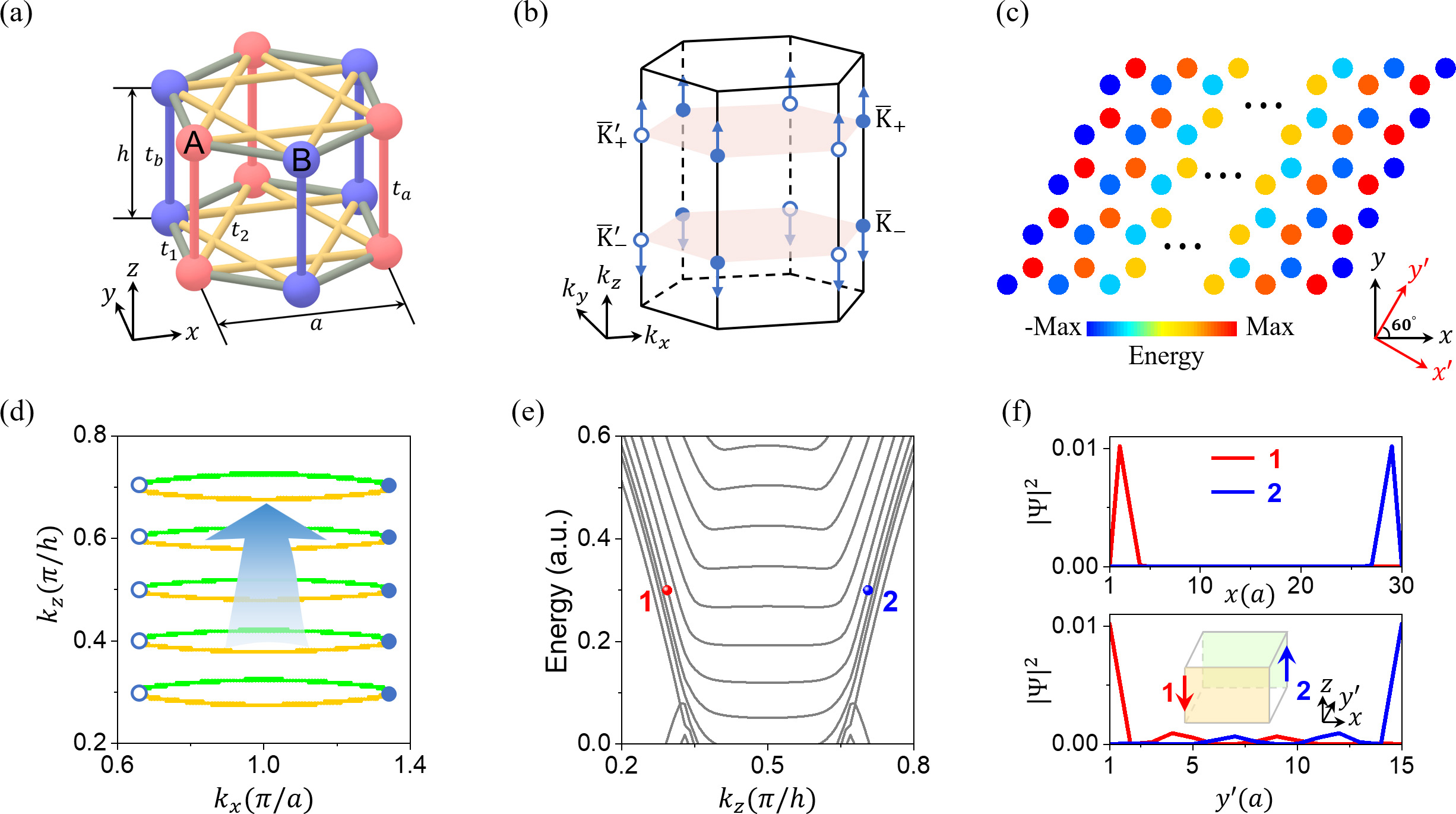
In a new paper published in Science Bulletin, researchers from Shanxi University and Wuhan University of China, theoretically proposed and experimentally demonstrated the three-dimensional QHE for acoustic waves in a Weyl acoustic crystal. In particular, the interesting one-dimensional edge states on the opposite surfaces have been directly observed.
The Quantum Hall Effect
The quantum Hall effect is a quantum phenomenon observed in two-dimensional electron systems subjected to low temperatures and strong magnetic fields. Discovered in 1980 by Klaus von Klitzing, for which he was awarded the Nobel Prize in Physics in 1985, this effect features the quantization of the Hall resistance.
As the magnetic field strength is increased, the Hall resistance, which is the voltage drop across a conductor divided by the current flowing perpendicular to the magnetic field, exhibits distinct plateaus that correspond to integer or fractional values of fundamental constants. These plateaus represent stable states where the resistance is precisely quantized, and the precision of these values has important implications for establishing high standards in resistance measurements.
The quantum Hall effect has not only deepened understanding of quantum mechanics but has also led to further research into topological properties of materials and the development of new quantum technologies.
Pseudomagnetic Field Application
Since the magnetic field has no effect on acoustic waves, a pseudomagnetic field was constructed, whose effect on acoustic waves is similar to that of magnetic fields on electrons. A common strategy for constructing acoustic wave PMFs is to introduce a structural gradient. In this paper, the gradient structure was introduced by varying the acoustic cavities corresponding to the on-site energy. In the process, the Fermi arcs connected the Weyl points simultaneously shifted along the same direction, thereby both the bulk and surface states felt the same pseudomagnetic field. With the pseudomagnetic field, the surface states formed Landau levels, and the one-dimensional edge states were generated and localized near the diagonal hinges.
In the experiment, an acoustic crystal sample was fabricated by using 3D printing technology, and the one-dimensional edge states were directly observed by measuring the acoustic pressure field in the sample.
“This study may open new manners for manipulating acoustic waves, which serves as the basis for acoustic devices with unconventional functions. It provides an ideal and tunable platform to explore the Hall physics, and can extend to other artificial structures, such as the optical and cold atomic systems.” The researchers forecast.
Reference: “Observation of 3D acoustic quantum Hall states” by Xuewei Zhang, Qiang Wei, Mian Peng, Weiyin Deng, Jiuyang Lu, Xueqin Huang, Suotang Jia, Mou Yan, Zhengyou Liu and Gang Chen, 26 April 2024, Science Bulletin.
DOI: 10.1016/j.scib.2024.04.055
The study was funded by the National Key R & D Program of China (Ministry of Science and Technology).
Never miss a breakthrough: Join the SciTechDaily newsletter.
Follow us on Google and Google News.
1 Comment
The quantum Hall effect (QHE) stands as a landmark discovery in condensed matter physics, paving the way for the exploration of topological physics. Advancing QHE into three dimensions presents an exciting yet formidable challenge. The complication stems from the fact that, in three dimensions, Landau levels evolve into bands along the magnetic field direction, which obstructs the formation of bulk gaps.
There has been progress in understanding quantum technology.
Please ask researchers to think deeply:
1. How many dimensions should quantum be to comply with mathematical laws?
2. Does quantum have gravity?
2. What exactly is quantum?
3. Is what you are exploring necessarily quantum?
4. What is the physical reality of quantum?
5. Can low dimensional spacetime matter be the understructure of high-dimensional spacetime matter?
and so on.
Some basic theories of physics today have long been misled by Physical Review Lettersz (PRL). In scientific research, exaggeration and fraud are rampant. Please witness the exemplary collaboration between theoretical physicists and experimentalists (https://zhuanlan.zhihu.com/p/701032654).
The Physical Review Letters firmly believes that two sets of high-dimensional spacetime objects (such as two sets of cobalt-60) can rotate in reverse and form two objects that mirror each other. Is it a reputable scientific journal? Is it still scientific?
Science and pseudoscience are not determined by a publication (such as the journal Nature, Physical Review Letters, et al.), an organization or a person, nor by you or me, but by mathematics the final say. Scientific research guided by correct theories can help humanity avoid detours, failures, and pomposity.