
Electron Microscopes Used to Precisely Dope Graphene
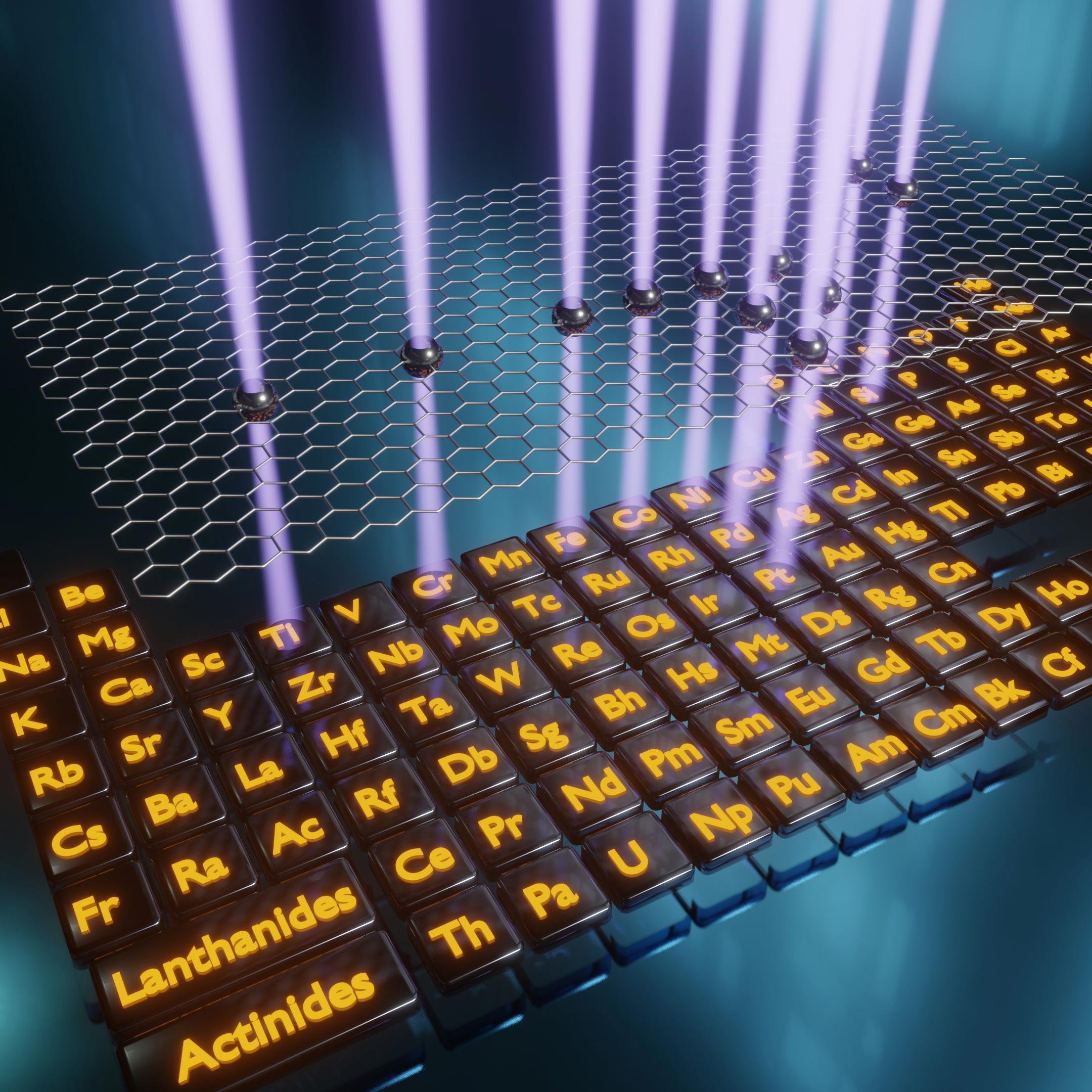
Oak Ridge National Laboratory scientists demonstrated that an electron microscope can be used to selectively remove carbon atoms from graphene’s atomically thin lattice and stitch transition-metal dopant atoms in their place.
This method could open the door to making quantum building blocks that can interact to produce exotic electronic, magnetic and topological properties.
This is the first precision positioning of transition-metal dopants in graphene. The produced graphene-dopant complexes can exhibit atomic-like behavior, inducing desired properties in the graphene.
“What could you build if you could put any atoms exactly where you want? Just about anything,” ORNL’s Ondrej Dyck said. He co-led the study with Stephen Jesse at ORNL’s Center for Nanophase Materials Sciences.
“If a lot of these quantum building blocks get together, they can start to act in a correlated manner, which is when really exciting properties begin to emerge,” Jesse said. The scientists plan to make arrays of interacting quantum building blocks to investigate emergent properties.
Oak Ridge National Laboratory scientists demonstrated that an electron microscope can be used to selectively remove carbon atoms from graphene’s atomically thin lattice and stitch transition-metal dopant atoms in their place.
This method could open the door to making quantum building blocks that can interact to produce exotic electronic, magnetic and topological properties.
First-Time Precision Placement of Transition Metals
This is the first precision positioning of transition-metal dopants in graphene. The produced graphene-dopant complexes can exhibit atomic-like behavior, inducing desired properties in the graphene.
“What could you build if you could put any atoms exactly where you want? Just about anything,” ORNL’s Ondrej Dyck said. He co-led the study with Stephen Jesse at ORNL’s Center for Nanophase Materials Sciences.
“If a lot of these quantum building blocks get together, they can start to act in a correlated manner, which is when really exciting properties begin to emerge,” Jesse said. The scientists plan to make arrays of interacting quantum building blocks to investigate emergent properties.
Oak Ridge National Laboratory scientists demonstrated that an electron microscope can be used to selectively remove carbon atoms from graphene’s atomically thin lattice and stitch transition-metal dopant atoms in their place.
This method could open the door to making quantum building blocks that can interact to produce exotic electronic, magnetic and topological properties.
This is the first precision positioning of transition-metal dopants in graphene. The produced graphene-dopant complexes can exhibit atomic-like behavior, inducing desired properties in the graphene.
“What could you build if you could put any atoms exactly where you want? Just about anything,” ORNL’s Ondrej Dyck said. He co-led the study with Stephen Jesse at ORNL’s Center for Nanophase Materials Sciences.
“If a lot of these quantum building blocks get together, they can start to act in a correlated manner, which is when really exciting properties begin to emerge,” Jesse said. The scientists plan to make arrays of interacting quantum building blocks to investigate emergent properties.
Reference: “Doping transition-metal atoms in graphene for atomic-scale tailoring of electronic, magnetic, and quantum topological properties” by Ondrej Dyck, Lizhi Zhang, Mina Yoon, Jacob L. Swett, Dale Hensley, Cheng Zhang, Philip D. Rack, Jason D. Fowlkes, Andrew R. Lupini and Stephen Jesse, 7 November 2020, Carbon.
DOI: 10.1016/j.carbon.2020.11.015
Never miss a breakthrough: Join the SciTechDaily newsletter.
Follow us on Google and Google News.