
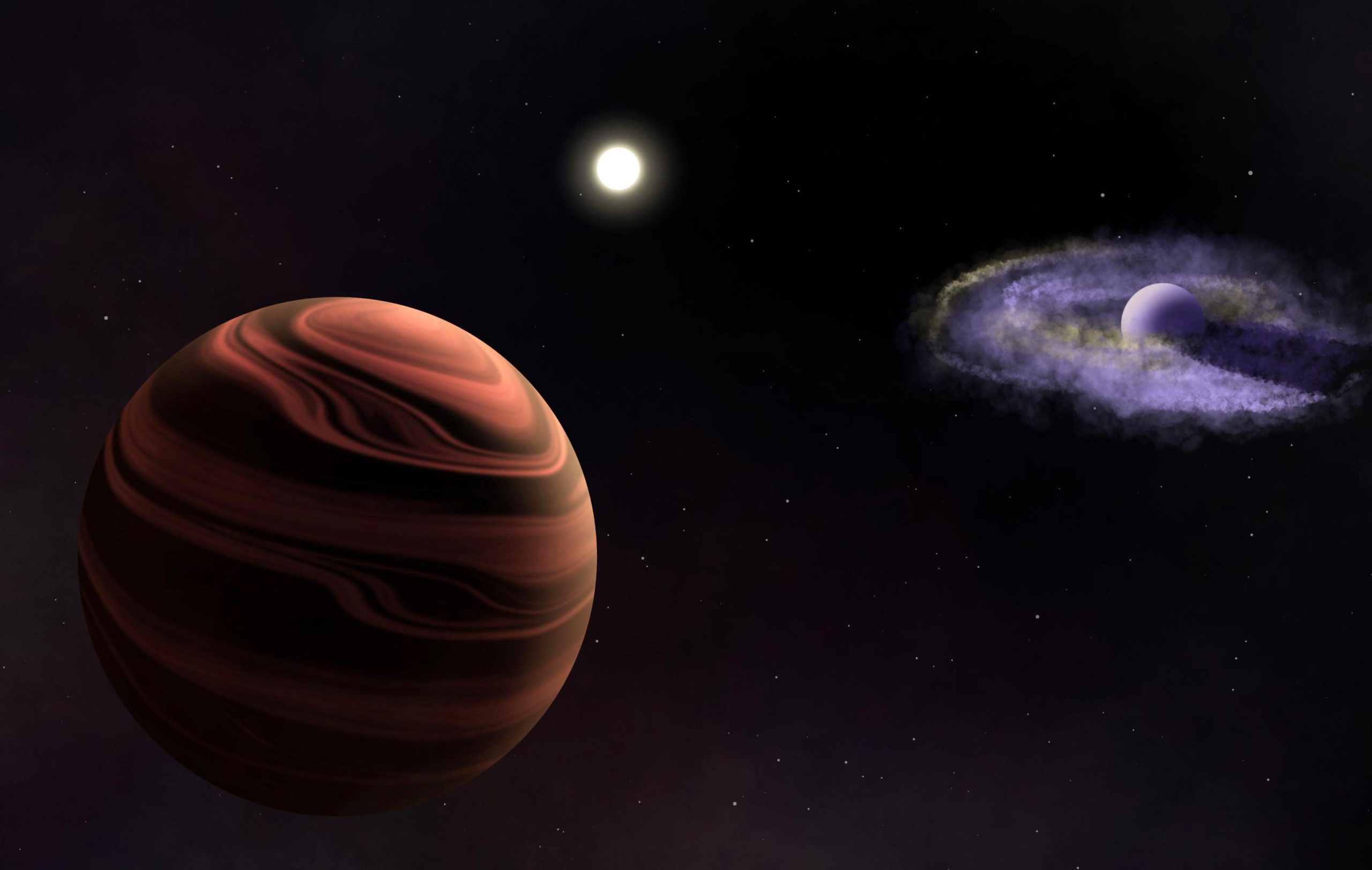
Using the James Webb Space Telescope, scientists have directly imaged two massive, youthful exoplanets in the YSES-1 system—revealing silicate clouds, a moon-forming disk, and some of the most detailed exoplanet atmospheres ever studied.
The findings challenge current planet formation theories and give us a rare glimpse at how gas giants like Jupiter take shape. With features like an unexpectedly long-lived disk and exotic cloud compositions, the YSES-1 system is now a key subject for understanding planetary evolution and our own solar system’s early days.
Webb Telescope Captures Stunning New Exoplanet Detail
Astronomers have just captured one of the most detailed views ever of two young, giant planets orbiting a distant star, thanks to the powerful James Webb Space Telescope. These exoplanets, located in a system called YSES-1, are providing exciting new clues about how planets form and evolve.
One of the planets has clouds made of silicate particles, essentially sand, high in its atmosphere. The other is surrounded by a dusty disk that may be forming moons, much like Jupiter’s moon-making rings. These discoveries offer a rare look at planetary systems still in their infancy.
Real-Time Glimpse Into Planet Formation
This star system, YSES-1, is especially fascinating because it gives us a window into the early stages of planet formation. One of the gas giants in the system is similar to Jupiter, offering a valuable chance to compare how our own solar system may have formed.
“Directly imaged exoplanets—planets outside our own Solar System—are the only exoplanets that we can truly take photos of,” said Dr. Evert Nasedkin, a Postdoctoral Fellow in Trinity College Dublin’s School of Physics, who is a co-author of the research article just published in leading international journal, Nature.“These exoplanets are typically still young enough that they are still hot from their formation, and it is this warmth, seen in the thermal infrared, that we as astronomers observe.”
How JWST Analyzed These Alien Worlds
To study these alien planets, researchers used the spectroscopic instruments aboard the James Webb Space Telescope. Dr. Kielan Hoch, along with a global team of scientists including researchers from Trinity College Dublin, analyzed light from the planets to uncover the makeup of their atmospheres.
The two exoplanets are both several times more massive than Jupiter and orbit a sun-like star far from Earth. By spreading out their light into a spectrum, scientists could detect the unique “fingerprints” left by different molecules and cloud particles. These patterns help identify what the planets are made of and how they might be changing over time.
Identifying Exotic Clouds and Chemical Signatures
Dr. Nasedkin said: “When we looked at the smaller, farther-out companion, known as YSES 1-c, we found the tell-tale signature of silicate clouds in the mid-infrared. Essentially made of sand-like particles, this is the strongest silicate absorption feature observed in an exoplanet yet.”
“We believe this is linked to the relative youth of the planets: younger planets are slightly larger in radius, and this extended atmosphere may allow the cloud to absorb more of the light emitted by the planet. Using detailed modelling, we were able to identify the chemical composition of these clouds, as well as details about the shapes and sizes of the cloud particles.”
A Mysterious, Long-Lived Planetary Disk
The inner planet, YSES-1b, offered up other surprises: while the whole planetary system is young, at 16.7 million years old, it is too old to find signs of the planet-forming disk around the host star. But around YSES-1b the team observed a disk around the planet itself, thought to feed material onto the planet and serve as the birthplace of moons – similar to those seen around Jupiter. Only three other such disks have been identified to date, both around objects significantly younger than YSES-1b, raising new questions as to how this disk could be so long-lived.
Dr. Nasedkin added: “Overall, this work highlights the incredible abilities of JWST to characterise exoplanet atmospheres. With only a handful of exoplanets that can be directly imaged, the YSES-1 system offers unique insights into the atmospheric physics and formation processes of these distant giants.”
Clues to the Origins of Our Solar System
In broad terms, understanding how this super-solar system formed offers further insight into the origins of our own solar system, giving us an opportunity to watch as a planet similar to Jupiter forms in real time. Understanding how long it takes to form planets, and the chemical makeup at the end of formation is important to learn what the building blocks of our own solar system looked like. Scientists can compare these young systems to our own, which provides hints of how our own planets have changed over time.
Dr. Kielan Hoch, Giacconi Fellow at the Space Telescope Science Institute, said, “This program was proposed before the launch of JWST. It was unique, as we hypothesised that the NIRSpec instrument on the future telescope should be able to observe both planets in its field of view in a single exposure, essentially, giving us two for the price of one. Our simulations ended up being correct post-launch, providing the most detailed dataset of a multi-planet system to date.”
“The YSES-1 system planets are also too widely separated to be explained through current formation theories, so the additional discoveries of distinct silicate clouds around YSES-1 c and small hot dusty material around YSES-1 b leads to more mysteries and complexities for determining how planets form and evolve.”
Young Scientists Drive Bold New Discoveries
“This research was also led by a team of early career researchers such as postdocs and graduate students who make up the first five authors of the paper. This work would not have been possible without their creativity and hard work, which is what aided in making these incredible multidisciplinary discoveries.”
Reference: “Silicate clouds and a circumplanetary disk in the YSES-1 exoplanet system” by K. K. W. Hoch, M. Rowland, S. Petrus, E. Nasedkin, C. Ingebretsen, J. Kammerer, M. Perrin, V. D’Orazi, W. O. Balmer, T. Barman, M. Bonnefoy, G. Chauvin, C. Chen, R. J. De Rosa, J. Girard, E. Gonzales, M. Kenworthy, Q. M. Konopacky, B. Macintosh, S. E. Moran, C. V. Morley, P. Palma-Bifani, L. Pueyo, B. Ren, E. Rickman, J.-B. Ruffio, C. A. Theissen, K. Ward-Duong and Y. Zhang, 10 June 2025, Nature.
DOI: 10.1038/s41586-025-09174-w
Never miss a breakthrough: Join the SciTechDaily newsletter.
Follow us on Google and Google News.
3 Comments
If the JWST team directly imaged those exo planets… Why isn’t SciTechDaily using those images? Instead of the artist impression shown in the article….
here is an image
https://en.wikipedia.org/wiki/File:First_ever_image_of_a_multi-planet_system_around_a_Sun-like_star.tif
Iv seen in to the future that our Erath had like 2 moons an some how’s 2 sun’s..I have a gift an I’m shown things it mints sounds crazy put I was showed them..