

Gaia-4b, a giant exoplanet orbiting a small star, is the first planet confirmed using Gaia’s astrometric technique.
Astronomers used NEID and other spectrographs to verify its existence, separating real planets from deceptive binary stars. This breakthrough paves the way for future discoveries in exoplanet science.
Gaia-4b: A Giant Among Exoplanets
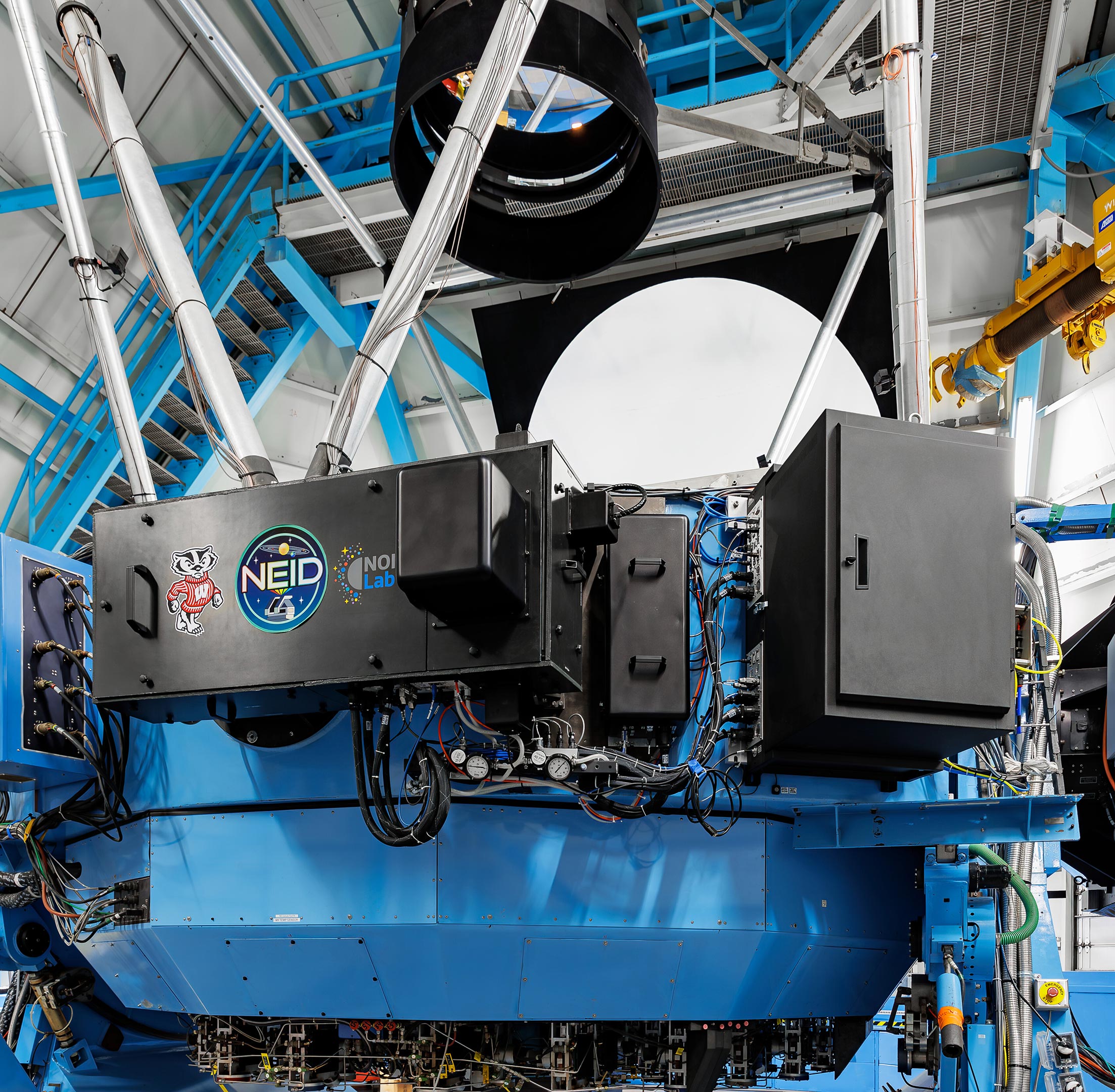
Astronomers have confirmed the existence of exoplanet Gaia-4b, one of the most massive planets known to orbit a low-mass star. This discovery was made in part using the NEID spectrograph, which is mounted on the WIYN 3.5-meter Telescope at the U.S. National Science Foundation’s Kitt Peak National Observatory. Gaia-4b is also the first planet detected by the European Space Agency’s Gaia spacecraft using the astrometric technique.

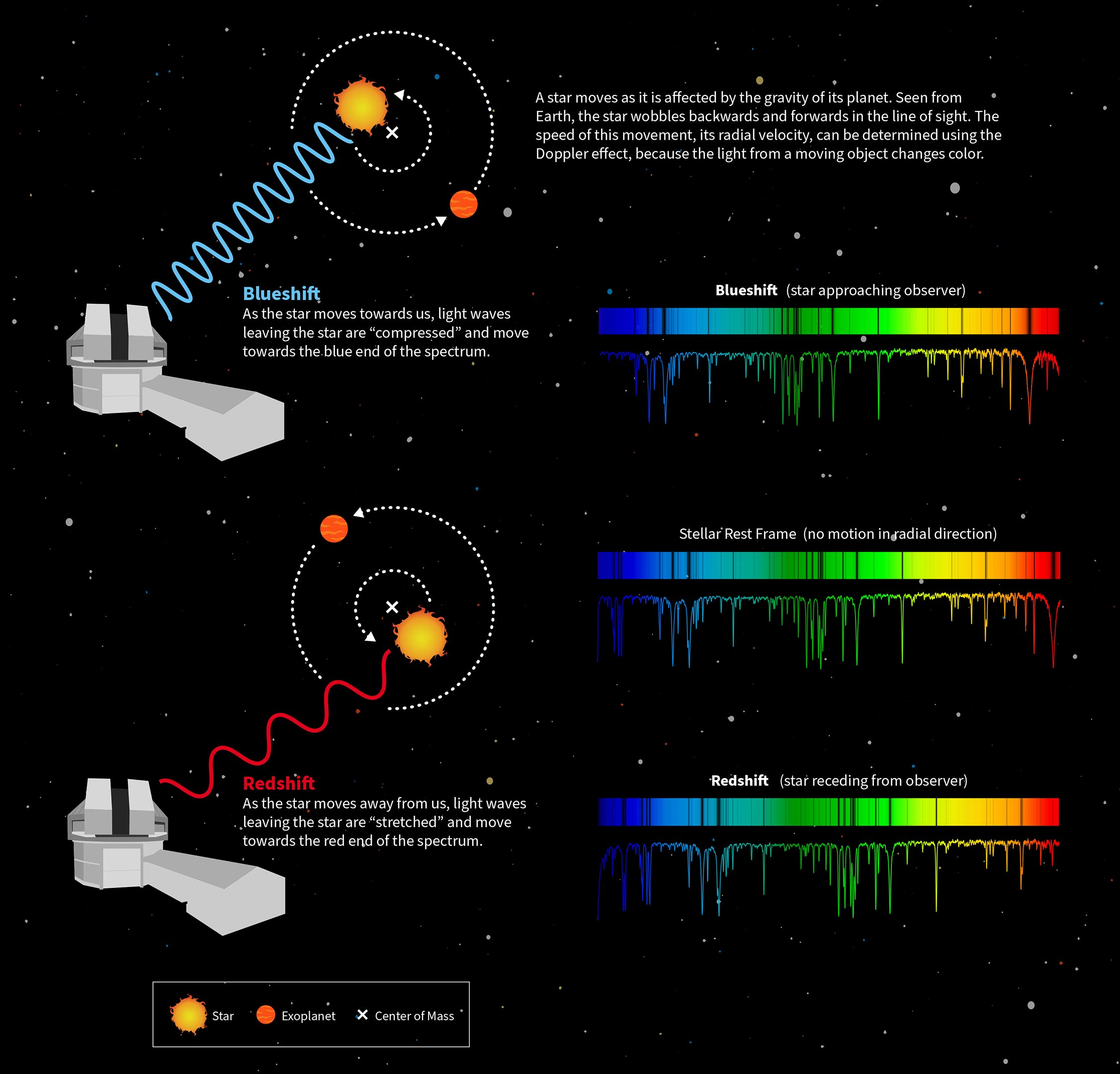
NEID (rhymes with “fluid”) is a high-precision radial-velocity spectrograph designed to measure the tiny wobble of nearby stars caused by the gravitational pull of orbiting planets. This wobble results in slight shifts in the star’s position, a phenomenon known as the radial velocity effect. One of NEID’s primary goals is to confirm exoplanet candidates identified by other missions.
Funded by NASA and NSF’s Exoplanet Exploration Program (NN-EXPLORE), NEID operates on the WIYN 3.5-meter Telescope at Kitt Peak National Observatory, helping astronomers refine their search for distant worlds.
Gaia’s Role in the Search for Exoplanets
One mission that NEID is complementing is the European Space Agency’s (ESA) Gaia spacecraft. Through its precise monitoring of the positions and motions of stars in our galaxy, Gaia is revolutionizing our understanding of many areas of astrophysics. With its exquisite precision, Gaia is expected to be able to detect thousands of exoplanets in orbit around nearby stars.
Unlike the radial velocity method used by NEID, Gaia uses a technique known as astrometry to detect a star’s motion. This technique involves measuring the subtle motion of a star as it is tugged by the gravity of an orbiting planet by looking at how the star moves compared to background or nearby stars.
Sifting Through Gaia’s Planet Candidates
Recently, as part of the latest Gaia data release, a list of stars that appear to be moving as though pulled by an exoplanet — the list of Gaia AStrometric Objects of Interest (Gaia-ASOIs) — was published. “However, the motion of these stars is not necessarily due to a planet,” said Guðmundur Stefánsson, assistant professor at the University of Amsterdam and lead author of the paper appearing in The Astrophysical Journal. “Instead, the ‘star’ might be a pair of stars that are too close together for Gaia to recognize them as separate objects. The tiny shifts in position that appear to be due to a planet might actually result from the nearly perfect cancellation of the larger shifts in position of the two stars.”
To weed out these binary stars and harvest the true planets, it is necessary to conduct follow-up observations with spectroscopy. To do so, the team used observations from NEID and two other spectrographs: the Habitable-zone Planet Finder (HPF) on the 10-meter Hobby Eberly Telescope at McDonald Observatory in Texas, and the FIES Spectrograph on the 2.6-meter Nordic Optical Telescope at La Palma in the Canary Islands.
With these powerful instruments, the team conducted follow-up observations of 28 star systems with planet candidates identified by Gaia. They found that of the 28 candidate systems 21 were false positives and were actually binary star systems — two stars that orbit a common center of mass. They also confirmed that one system is a star hosting a brown dwarf[1] — an object with a mass in between those of planets and stars — but one was a star hosting a giant planet.

Gaia-4b: A Massive World Orbiting a Small Star
The newly discovered exoplanet, named Gaia-4b, has an orbital period of 570 days and a mass of 12 Jupiter masses and orbits a star 64% of the mass of the Sun. Not only is Gaia-4b the first planet ever detected by Gaia using the astrometric technique whose orbital solution is fully and independently confirmed, but it is also one of the most massive planets known to orbit a low-mass star.
“It is an exciting time for both NEID and Gaia,” says Jayadev Rajagopal, scientist at NSF NOIRLab and a co-author of the paper. “Gaia is more than living up to its promise of detecting planetary companions to stars with highly precise astrometry, and NEID is demonstrating that its long-term radial velocity precision is capable of detecting low-mass planets around those stars. With more candidate planets to come as roughly the last year of data is analyzed, this work is a harbinger of the future where Gaia discoveries of planets and brown dwarfs will need to be confirmed, or rejected, by NEID data.”
In addition to the detection of Gaia-4b and Gaia-5b, the authors provide a first glimpse of the ‘false positive rate’ of the Gaia Astrometric Exoplanet catalog, which is in the range 30–80% in their sample. This highlights the importance of ground-based observations like those possible with NEID in confirming planetary candidates in the Gaia-planet-detection era.
Explore Further:
Notes
- The newly discovered brown dwarf, named Gaia-5b, is a 21-Jupiter-mass brown dwarf in a 358-day eccentric orbit around a star with 34% of the mass of the Sun.
Reference: “Gaia-4b and 5b: Radial Velocity Confirmation of Gaia Astrometric Orbital Solutions Reveal a Massive Planet and a Brown Dwarf Orbiting Low-mass Stars” by Gudmundur Stefánsson, Suvrath Mahadevan, Joshua N. Winn, Marcus L. Marcussen, Shubham Kanodia, Simon Albrecht, Evan Fitzmaurice, Onė Mikulskytė, Caleb I. Cañas, Juan I. Espinoza-Retamal, Yiri Zwart, Daniel M. Krolikowski, Andrew Hotnisky, Paul Robertson, Jaime A. Alvarado-Montes, Chad F. Bender, Cullen H. Blake, J. R. Callingham, William D. Cochran, Megan Delamer, Scott A. Diddams, Jiayin Dong, Rachel B. Fernandes, Mark R. Giovinazzi, Samuel Halverson, Jessica Libby-Roberts, Sarah E. Logsdon, Michael W. McElwain, Joe P. Ninan, Jayadev Rajagopal, Varghese Reji, Arpita Roy, Christian Schwab and Jason T. Wright, 4 February 2025, The Astronomical Journal.
DOI: 10.3847/1538-3881/ada9e1
The team is composed of Guðmundur Stefánsson (University of Amsterdam), Suvrath Mahadevan (The Pennsylvania State University), Joshua Winn (Princeton University), Marcus Marcussen (Aarhus University), Shubham Kanodia (Carnegie Institution for Science), Simon Albrecht (Aarhus University), Evan Fitzmaurice (The Pennsylvania State University, Institute for Computational and Data Sciences Scholar), Onė Mikulskitye (University of Amsterdam), Caleb Cañas (NASA Postdoctoral Fellow, NASA Goddard Space Flight Center), Juan Ignacio Espinoza-Retamal (Pontificia Universidad Católica de Chile, Millennium Institute for Astrophysics, University of Amsterdam), Yiri Zwart (University of Amsterdam), Daniel Krolikowski (Steward Observatory, The University of Arizona), Andrew Hotnisky (The Pennsylvania State University), Paul Robertson (The University of California), Jaime A. Alvarado-Montes (Macquarie University), Chad Bender (Steward Observatory, The University of Arizona), Cullen Blake (University of Pennsylvania), Joe Callingham (Leiden University, Netherlands Institute for Radio Astronomy), William Cochran (The University of Texas at Austin), Megan Delamer (The Pennsylvania State University), Scott Diddams (University of Colorado), Jiayin Dong (Flatiron Institute, University of Illinois at Urbana-Champaign), Rachel Fernandes (The Pennsylvania State University), Mark Giovanazzi (Amherst College), Samuel Halverson (California Institute of Technology), Jessica Libby-Roberts (The Pennsylvania State University), Sarah E. Logsdon (NSF NOIRLab), Michael McElwain (NASA Goddard Space Flight Center), Joe Ninan (Tata Institute of Fundamental Research), Jayadev Rajagopal (NSF NOIRLab), Varghese Reji (Tata Institute of Fundamental Research), Arpita Roy (Schmidt Sciences), Christian Schwab (Macquarie University), and Jason Wright (The Pennsylvania State University).
Never miss a breakthrough: Join the SciTechDaily newsletter.
Follow us on Google and Google News.
2 Comments
I find both of these planets orbits crazy. Which of course, any one would! No planet we have seen orbits like this! It looks like its gonna fall, then woop!
I find both of these planets orbits crazy. Which of course, any one would! No planet we have seen orbits like this! It looks like its gonna fall, then woop!