
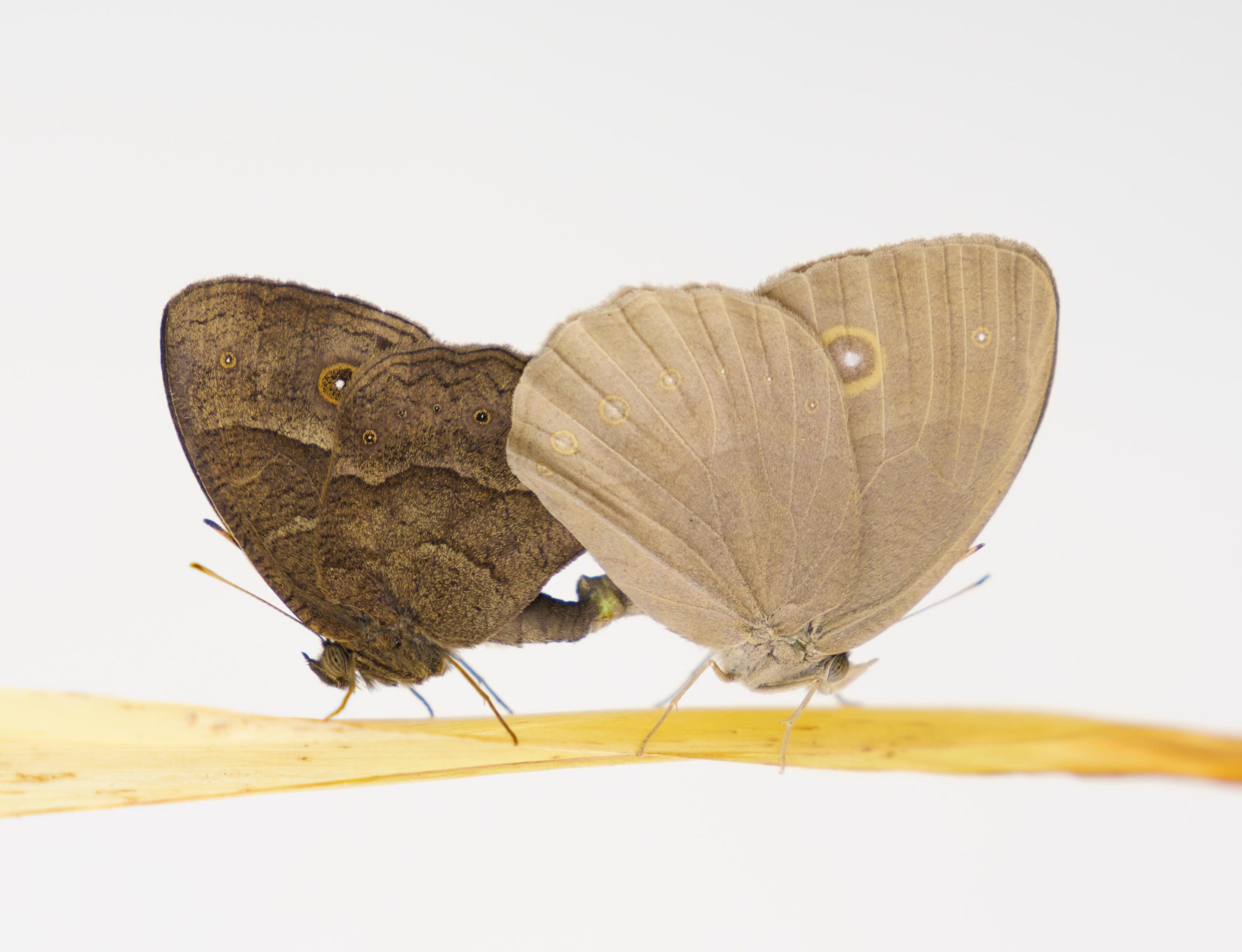
Butterfly and moth wing color variations, long attributed to the cortex gene, are actually controlled by a microRNA, mir-193, which represses pigmentation genes. This discovery, conserved across species, highlights the crucial role of non-coding RNAs in phenotypic diversity.
Butterflies and moths (lepidopterans) display an extraordinary variety of wing color patterns, with many species showcasing black-and-white or dark-and-bright variations due to the presence or absence of melanin. These variations often serve as classic examples of natural selection and evolution. Notable cases include the rapid rise of the melanic form of the British peppered moth (Biston betularia), which adapted to the soot-darkened environment of the late 19th-century United Kingdom during industrialization, and the mimetic diversity of Heliconius butterflies.
While the ecological factors driving the evolution of melanin-based wing patterns are often well understood, the genetic and developmental mechanisms underlying these coloration changes have remained less clear.
How do butterflies and moths paint their wings either black or white?
Over the past two decades, scientists discovered that the majority of melanic wing color variants are controlled by a single genomic region surrounding the protein-coding gene ‘cortex’. It was assumed, then, that cortex was the melanic color switch. A team of international researchers from Singapore, Japan, and the United States of America, led by Professor Antónia MONTEIRO and Dr Shen TIAN from the Department of Biological Sciences at the National University of Singapore (NUS), discovered that cortex does not affect melanic coloration. Instead, a previously ignored microRNA (miRNA), is the actual color switch.
The findings were published in the journal Science on 5 December 2024.
Dr Tian, the lead author of this work said, “Piles of evidence from previous studies cast doubt on whether cortex was really the melanic color switch, which inspired me to test the function of some other genomic features within this genomic region – miRNAs.” He conducted this research work as a PhD/postdoctoral researcher in Professor Monteiro’s laboratory at NUS, and is now a postdoctoral researcher at Duke University, USA.
A video clip showing the research conducted by the team, highlighting their approach and key findings. Credit: NUS
“MiRNAs are small RNA molecules that do not encode proteins like most genes do, yet they play essential roles in gene regulation by repressing the expression of target genes,” added Dr Tian.
In this study, Dr Tian and colleagues found a miRNA located next to cortex, mir-193. The team disrupted mir-193 using a gene editing tool CRISPR-Cas9 in three deeply diverged lineages of butterflies. The complete disruption of mir-193 eliminated black and dark wing colors in the African squinting bush brown butterfly, Bicyclus anynana, the Indian cabbage white butterfly, Pieris canidia, and the common Mormon butterfly, Papilio polytes. In contrast, disrupting cortex and three other protein-coding genes from the same genomic region in B. anynana had no effect on wing colors. This indicated that mir-193, not cortex or any other nearby gene, is the key melanic color regulator across these Lepidoptera.
A Deeper Look at mir-193 and Its Evolutionary Significance
The team further confirmed that mir-193 is processed from a long non-protein-coding RNA, ivory, and it functions by directly repressing multiple pigmentation genes. Since the sequence of mir-193 is deeply conserved not only in Lepidoptera but across the animal kingdom, the team also tested the role of mir-193 in Drosophila flies. Surprisingly, mir-193 was also found to control melanic coloration in these flies, suggesting a deeply conserved role for mir-193 beyond Lepidoptera.
Prof Monteiro said, “While previous studies exclusively focused on the role of cortex in generating melanic color variations, this work brings a twist to this long-standing hypothesis and demonstrates that a small, non-protein coding RNA is the switch that, by being expressed or not expressed, brings about the diverse melanic wing color variations in nature.”
“This study shows that poorly annotated non-protein-coding RNAs, such as miRNAs, should never be ignored in genotype-phenotype association studies, which would otherwise lead to misleading conclusions,” added Prof Monteiro.
Dr Tian said, “The role of non-coding RNAs in phenotypic diversification is largely understudied. This study prompts further investigations on how non-coding RNAs such as miRNAs can contribute to phenotypic diversifications in organisms.”
Reference: “A microRNA is the effector gene of a classic evolutionary hotspot locus” by Shen Tian, Yoshimasa Asano, Tirtha Das Banerjee, Shinya Komata, Jocelyn Liang Qi Wee, Abigail Lamb, Yehan Wang, Suriya Narayanan Murugesan, Haruhiko Fujiwara, Kumiko Ui-Tei, Patricia J. Wittkopp and Antónia Monteiro, 5 December 2024, Science.
DOI: 10.1126/science.adp7899
Never miss a breakthrough: Join the SciTechDaily newsletter.
Follow us on Google and Google News.