
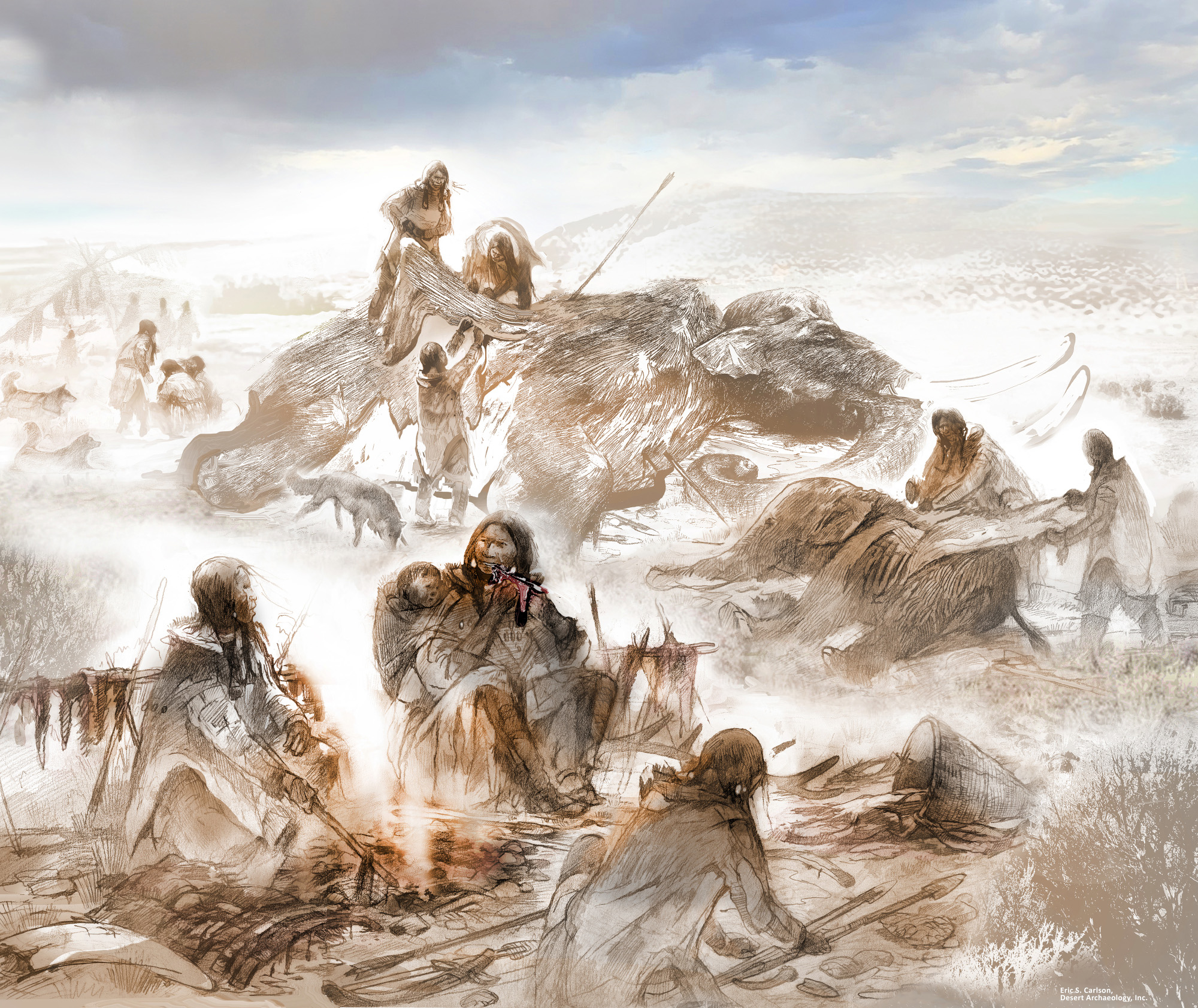
Researchers found direct evidence that Clovis people relied heavily on mammoths for food, using isotopic analysis to confirm 40% of a Clovis mother’s diet came from mammoths. The study highlights how hunting large animals supported the Clovis people’s mobility and rapid spread, while also contributing to the extinction of Ice Age megafauna.
Scientists have discovered the first direct evidence that ancient Americans primarily relied on mammoths and other large animals for food. This research provides new insights into the swift spread of humans across the Americas and the extinction of large Ice Age mammals.
The study, featured on the Dec. 4 cover of the journal Science Advances, employed stable isotope analysis to reconstruct the diet of the mother of an infant found at a 13,000-year-old Clovis burial site in Montana. Previously, researchers inferred prehistoric diets primarily through indirect evidence, such as stone tools or the preserved remains of prey animals.
The findings support the hypothesis that the Clovis people focused on hunting large animals rather than relying primarily on foraging for smaller animals and plants.
The Clovis people inhabited North America around 13,000 years ago. During that time period, animals like mammoths lived across both northern Asia and the Americas. They migrated long distances, which made them a reliable fat- and protein-rich resource for highly mobile humans.
“The focus on mammoths helps explain how Clovis people could spread throughout North America and into South America in just a few hundred years,” said co-lead author James Chatters of McMaster University.
“What’s striking to me is that this confirms a lot of data from other sites. For example, the animal parts left at Clovis sites are dominated by megafauna, and the projectile points are large, affixed to darts, which were efficient distance weapons,” said co-lead author Ben Potter, an archaeology professor at the University of Alaska Fairbanks.
Mobility and Adaptation: Keys to Survival
Hunting mammoths provided a flexible way of life, Potter said. It allowed the Clovis people to move into new areas without having to rely on smaller, localized game, which could vary significantly from one region to the next.
“This mobility aligns with what we see in Clovis technology and settlement patterns,” Potter said. “They were highly mobile. They transported resources like toolstone over hundreds of miles.”
Researchers were able to model the Clovis people’s diet by first analyzing isotopic data published during earlier studies by other researchers of the remains of Anzick-1, an 18-month-old Clovis child. By adjusting for nursing, they were able to estimate values for his mother’s diet.
“Isotopes provide a chemical fingerprint of a consumer’s diet and can be compared with those from potential diet items to estimate the proportional contribution of different diet items,” said Mat Wooller, an author on the study and director of the Alaska Stable Isotope facility at UAF.
The team compared the mother’s stable isotopic fingerprint to those from a wide variety of food sources from the same time period and region. They found that about 40% of her diet came from mammoth, with other large animals like elk and bison making up the rest. Small mammals, sometimes thought to have been an important food source, played a very minor role in her diet.
Insights Into Extinction and Environmental Stress
Finally, the scientists compared the mother’s diet to those of other omnivores and carnivores from the same time period, including American lions, bears, and wolves. The mother’s diet was most similar to that of the scimitar cat, a mammoth specialist.
Findings also suggest that early humans may have contributed to the extinction of large ice age animals, especially as environmental changes reduced their habitats.
“If the climate is changing in a way that reduces the suitable habitat for some of these megafauna, then it makes them potentially more susceptible to human predation. These people were very effective hunters,” said Potter.
“You had the combination of a highly sophisticated hunting culture — with skills honed over 10,000 years in Eurasia — meeting naïve populations of megafauna under environmental stress,” said Chatters.
An important aspect of this research, according to Potter and Chatters, is their outreach to Native Americans in Montana and Wyoming about their concerns and interest in this work.
“It is important and ethical to consult with Indigenous peoples on questions relating to their heritage,” they said.
They worked with Shane Doyle, executive director of Yellowstone Peoples, who reached out to numerous tribal government representatives throughout Montana, Wyoming, and Idaho. “The response has been one of appreciative consideration and inclusion,” said Doyle.
“I congratulate the team for their astounding discovery about the lifeways of Clovis-era Native people and thank them for being tribally inclusive and respectful throughout their research,” he said. “This study reshapes our understanding of how Indigenous people across America thrived by hunting one of the most dangerous and dominant animals of the day, the mammoth.”
Reference: “Mammoth featured heavily in Western Clovis diet” by James C. Chatters, Ben A. Potter, Stuart J. Fiedel, Juliet E. Morrow, Christopher N. Jass and Matthew J. Wooller, 4 December 2024, Science Advances.
DOI: 10.1126/sciadv.adr3814
Never miss a breakthrough: Join the SciTechDaily newsletter.
Follow us on Google and Google News.
4 Comments
“ Scientists Uncover Ancient Ice Age Americans’ Secret to Survival: Mammoths”
Umm yeah, obviously. Nobody uncovered anything in this story. This title is sensationalized and the story is full of fluff; it could’ve been a single sentence. Literally everybody past the age of 5 knows mammoths were an essential part of ice-age people’s survival. Getting the dietary percentage mammoths made up is like a small update to what we already knew, not a novel discovery.
They weren’t “Americans”! 🤣
No, they were British, and still owe us 25000 years of back-rent, with interest……………and taxes.
I am glad to see that indigenous humans living in harmony with Mother Nature and with their perfect indigenous understanding of Mother Nature whilst managing their perfect balance in their environment ate the mammoths to death.
It reminds me of my natural human heritage.