
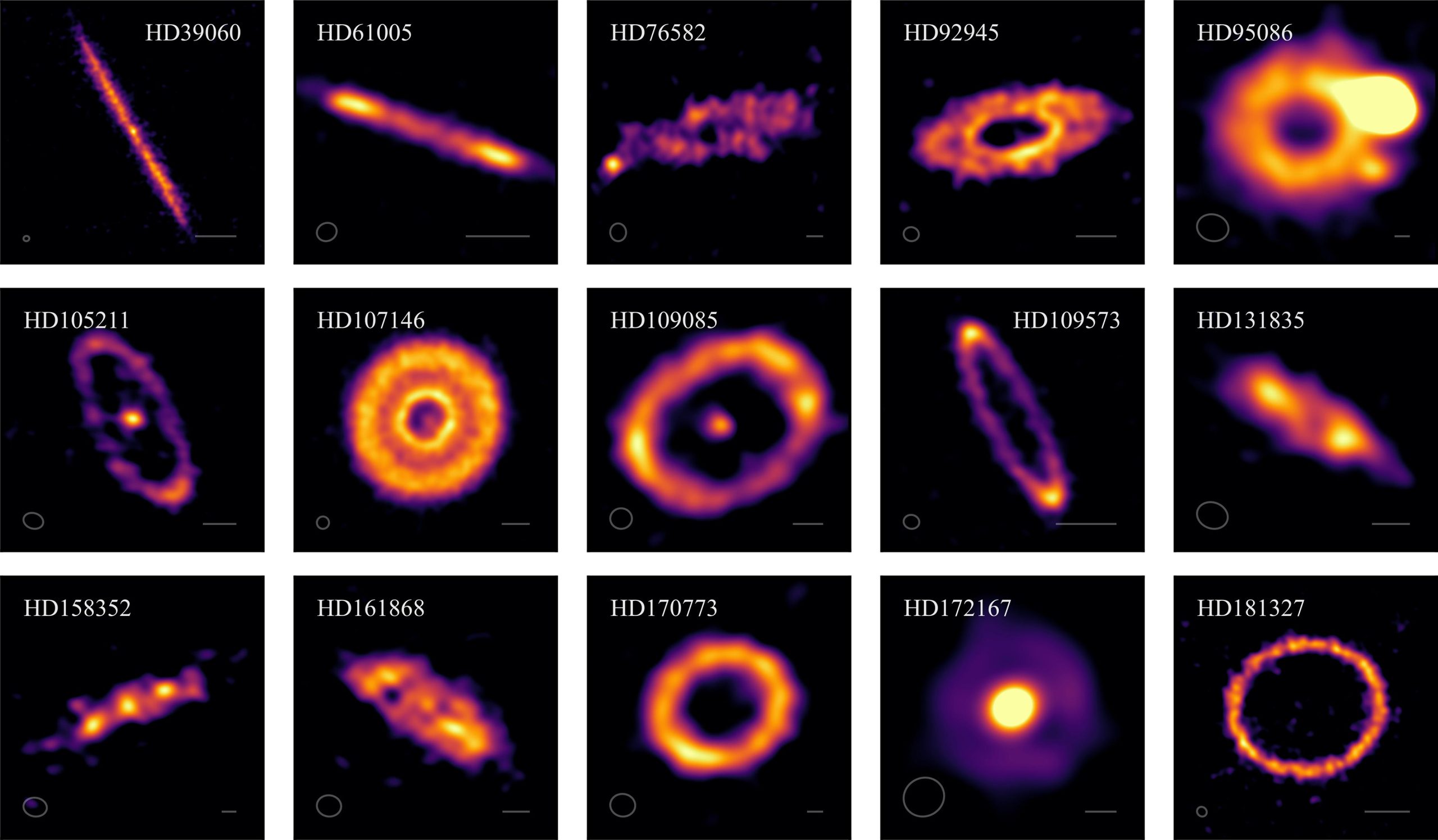
Astrophysicists have achieved a major breakthrough by capturing images of exocomet belts around 74 nearby stars.
Using the ALMA and SMA telescopes, they identified millimeter-sized pebbles in these belts, offering unprecedented insights into their structure and evolution. The findings suggest that exocomets and their belts play a crucial role in the formation of planetary systems and provide clues about hidden planets.
First-Ever Imaging of Exocomet Belts
Astrophysicists from Trinity College Dublin have, for the first time, captured images of a large number of exocomet belts around nearby stars, along with the tiny pebbles within them. These high-resolution images reveal light emitted by millimeter-sized pebbles orbiting 74 nearby stars. The stars in the study represent a broad range of ages, from young systems still forming to more mature ones similar to our Solar System.
The study, known as REASONS (REsolved ALMA and SMA Observations of Nearby Stars), is a major breakthrough in understanding exocomet belts. The detailed images and analysis provide crucial insights into the location of these pebbles — and the exocomets they form — revealing that they typically orbit their host stars at distances ranging from tens to hundreds of astronomical units (AU), where one AU is the distance between Earth and the Sun.

Ice Reservoirs and Their Role in Planetary Systems
In these regions, it is so cold (-250 to -150 degrees Celsius) that most compounds including water are frozen as ice on these exocomets. What the astrophysicists are therefore observing is where the ice reservoirs of planetary systems are located. REASONS is the first program to unveil the structure of these belts for a large sample of 74 exoplanetary systems.
The Atacama Large Millimeter/submillimeter Array (ALMA) is an array of 66 radio telescopes in the Atacama Desert of northern Chile, while the Submillimeter Array (SMA) is a similar eight-element array in Hawaii. Both observe electromagnetic radiation at millimeter and submillimetre wavelengths. This study used both to produce the images that have provided more information on populations of exocomets than ever before.

How Exocomets Shape Their Surrounding Belts
“Exocomets are boulders of rock and ice, at least 1 km in size, which smash together within these belts to produce the pebbles that we observe here with the ALMA and SMA arrays of telescopes. Exocometary belts are found in at least 20% of planetary systems, including our own Solar System,” said Luca Matrà, Associate Professor in Trinity’s School of Physics, and senior author of the research article that has just been published in leading international journal Astronomy and Astrophysics.
Dr. Sebastián Marino, Royal Society University Research Fellow at the University of Exeter, and coauthor in this study, added: “The images reveal a remarkable diversity in the structure of belts. Some are narrow rings, as in the canonical picture of a ‘belt’ like our Solar System’s Edgeworth-Kuiper belt. But a larger number of them are wide, and probably better described as ‘disks’ rather than rings.”
Some systems have multiple rings/disks, some of which are eccentric, which provides evidence that yet undetectable planets are present and their gravity affects the distribution of pebbles in these systems.
Population-Wide Trends in Exocomet Belts
“The power of a large study like REASONS is in revealing population-wide properties and trends,” explained Prof. Matrà.
“For example, it confirmed that the number of pebbles decreases for older planetary systems as belts run out of larger exocomets smashing together, but showed for the first time that this decrease in pebbles is faster if the belt is closer to the central star. It also indirectly showed – through the belts’ vertical thickness – that unobservable objects as large as 140 km to Moon-size are likely present in these belts.
Future Research and the Legacy of REASONS
Dr. David Wilner, Senior Astrophysicist at the Center for Astrophysics | Harvard & Smithsonian, underlined: “Arrays like the ALMA and SMA used in this work are extraordinary tools that are continuing to give us incredible new insights into the universe and its workings. The REASONS survey required a large community effort and has an incredible legacy value, with multiple potential pathways for future investigation.
“For example, the REASONS dataset of belt and planetary system properties will enable studies of the birth and evolution of these belts, as well as follow-up observations across the wavelength range, from JWST to the next generation of Extremely Large Telescopes and ALMA’s upcoming ARKS Large Program to zoom even further onto the details of these belts.”
Reference: “REsolved ALMA and SMA Observations of Nearby Stars (REASONS) – A population of 74 resolved planetesimal belts at millimetre wavelengths” by L. Matrà, S. Marino, D. J. Wilner, G. M. Kennedy, M. Booth, A. V. Krivov, J. P. Williams, A. M. Hughes, C. del Burgo, J. Carpenter, C. L. Davies, S. Ertel, Q. Kral, J.-F. Lestrade, J. P. Marshall, J. Milli, K. I. Öberg, N. Pawellek, A. G. Sepulveda, M. C. Wyatt, B. C. Matthews and M. MacGregor, 17 January 2025, Astronomy & Astrophysics.
DOI: 10.1051/0004-6361/202451397
Never miss a breakthrough: Join the SciTechDaily newsletter.
Follow us on Google and Google News.
1 Comment
Exquisite pictures are very beautiful!
According to the the Topological Vortex Theory (TVT), topological spins create everything and shape the world.