
Close Menu
    Facebook X (Twitter) Instagram
    SciTechDaily
    • Biology
    • Chemistry
    • Earth
    • Health
    • Physics
    • Science
    • Space
    • Technology
    Facebook X (Twitter) Pinterest YouTube RSS
    SciTechDaily
    Home»Health»Self-Moisturising Smart Contact Lenses – Electroosmotic Flow Used to Keep Eyes Moist
    Health

    Self-Moisturising Smart Contact Lenses – Electroosmotic Flow Used to Keep Eyes Moist

    By Tohoku UniversityJanuary 22, 20201 Comment3 Mins Read
    Facebook Twitter Pinterest Telegram LinkedIn WhatsApp Email Reddit
    Share
    Facebook Twitter LinkedIn Pinterest Telegram Email Reddit
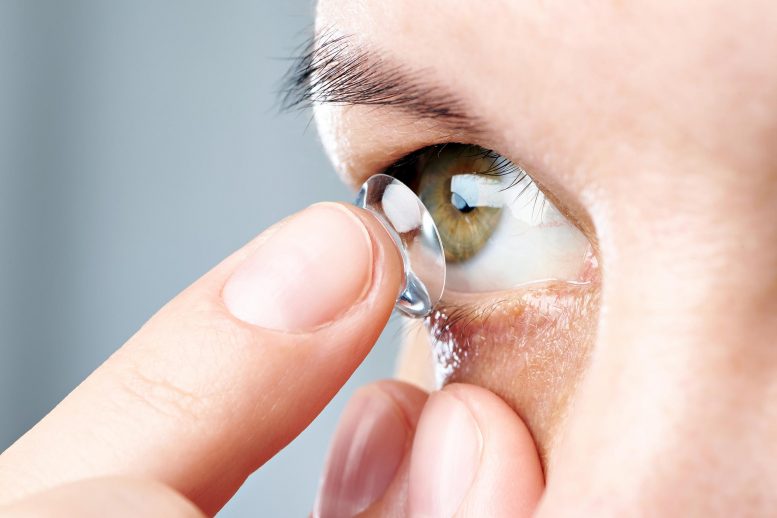
    Putting On Contact Lens
    One of the biggest problems with contact lenses is they can cause “dry eye syndrome” due to reduced blinking and increased moisture evaporation. Researchers at Tohoku University have developed a new type of smart contact lenses that can prevent dry eyes.

    Researchers at Tohoku University have developed a new type of smart contact lenses that can prevent dry eyes. The self-moisturizing system, which is described in the journal Advanced Materials Technologies, maintains a layer of fluid between the contact lens and the eye using a novel mechanism.

    Smart contact lenses are wearable devices that could accelerate vision beyond natural human capabilities. They are being developed for a wide range of applications from non-invasive monitoring to vision correction to augmented reality display.

    “Although there have been many recent advancements in new functions for smart contact lenses, there has been little progress in solving the drawbacks associated with wearing contact lenses day to day,” says Professor Matsuhiko Nishizawa, an engineer at Tohoku University.

    One of the biggest problems with contact lenses is they can cause “dry eye syndrome” due to reduced blinking and increased moisture evaporation. Dry eye syndrome can lead to corneal wounds and inflammation as well as a feeling of discomfort.
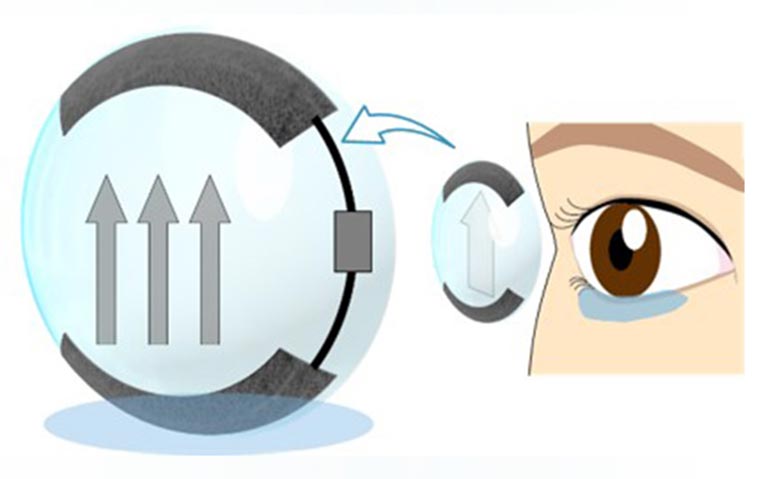
    Self Moisturising Smart Contact Lenses
    Illustration of a self-moisturizing soft contact lens that supplies tears via electroosmotic flow from the temporary tear reservoir behind the lower eyelid. Credit: Tohoku University

    In order to tackle this important problem, the researchers developed a new mechanism that keeps the lens moist. The system uses electroosmotic flow (EOF), which causes liquid to flow when a voltage is applied across a charged surface. In this case, a current applied to a hydrogel causes fluid to flow upwards from the patient’s temporary tear reservoir behind the lower eyelid to the surface of the eye.

    “This is the first demonstration that EOF in a soft contact lens can keep the lens moist,” says Nishizawa.

    The researchers also explored the possibility of using a wireless power supply for the contact lenses. They tested two types of battery, a magnesium-oxygen battery and an enzymatic fructose-oxygen fuel cell, both of which are known to be safe and non-toxic for living cells. They showed that the system can be successfully powered by these biobatteries, which can be mounted directly on the charged contact lens.

    Further research is needed to develop improved self-moisturizing contact lenses that are tougher and capable of operating at smaller currents.

    “In the future, there is scope to expand this technology for other applications, such as drug delivery,” says Nishizawa.

    Reference: “Self‐Moisturizing Smart Contact Lens Employing Electroosmosis” by Shinya Kusama, Kaito Sato, Shotaro Yoshida and Matsuhiko Nishizawa, 28 November 2019, Advanced Materials Technologies.
    DOI: 10.1002/admt.201900889

    Never miss a breakthrough: Join the SciTechDaily newsletter.
    Follow us on Google and Google News.

    Biotechnology Contact Lenses Tohoku University
    Share. Facebook Twitter Pinterest LinkedIn Email Reddit

    Related Articles

    Bioengineers Develop Hybrid Hydrogel System to Help Heal Bones

    Radiation Study Using Human Gut-on-a-Chip Provides Hope for the Future

    Organ-On-Chip Tech Reaches Next Stage, Experts Test Interaction With Pathogens

    New Discovery Helps Identify Children at Risk for Type 1 Diabetes

    New Drug Capsule Delivers a Week’s Worth of HIV Drugs in a Single Dose

    Micro-Needle Patch Turns Energy-Storing Fats Into Energy-Burning Fats

    Injectable, Spontaneously Assembling Vaccines Could Fight Cancer

    Yale Researchers Develop Method to Attack Cancer at Its Source

    Engineered Liposomes: A Possible Alternative to Antibiotics

    1 Comment

    1. Varun Sharma on May 12, 2020 10:23 pm

      I really liked the idea of a self moisturizing contact lense as the problem of dryness is present in contact lenses. This will really help to improve the vision and eliminate the problem of dryness caused by contact lenses. I found your post really interesting to read. Thank you for sharing this post.

      Reply
    Leave A Reply Cancel Reply

    • Facebook
    • Twitter
    • Pinterest
    • YouTube

    Don't Miss a Discovery

    Subscribe for the Latest in Science & Tech!

    Trending News

    JWST Finds a “Star” 100 Billion Times Brighter Than Any Star Should Be

    Scientists Find a Hidden Biological Link Across Different Forms of Autism

    Astronomers Discover a Ghostly River of Stars That Could Reveal Dark Matter

    Why Is Colorectal Cancer Rising in People Under 50? New Clues Point to the Environment

    Quantum Fluctuations Break a Crystal’s Symmetry Rules

    Why Does an Irregular Heartbeat Strike 40 Years Early in Some People?

    Scientists Reveal How ADHD Could Fuel Creative Thinking

    Scientists Find Just 3 Minutes of Sprinting Can Transform Blood Chemistry

    Follow SciTechDaily
    • Facebook
    • Twitter
    • YouTube
    • Pinterest
    • Newsletter
    • RSS
    SciTech News
    • Biology News
    • Chemistry News
    • Earth News
    • Health News
    • Physics News
    • Science News
    • Space News
    • Technology News
    Recent Posts
    • Cleaner Cars May Be Hiding a New Pollution Problem
    • Common Plant Chemical Linked to Widespread Organ Damage in Aquatic Animals
    • Scientists Discover a Hidden Baobab Species in Madagascar
    • Dogs and Humans May Share a Surprising Biological Secret to Longevity
    • A 150-Million-Year-Old Dinosaur Flight Mystery May Finally Have an Answer
    Copyright © 1998 - 2026 SciTechDaily. All Rights Reserved.
    • Science News
    • About
    • Contact
    • Editorial Board
    • Privacy Policy
    • Terms of Use

    Type above and press Enter to search. Press Esc to cancel.