
Close Menu
    Facebook X (Twitter) Instagram
    SciTechDaily
    • Biology
    • Chemistry
    • Earth
    • Health
    • Physics
    • Science
    • Space
    • Technology
    Facebook X (Twitter) Pinterest YouTube RSS
    SciTechDaily
    Home»Technology»Smart LED Contact Lenses for Treating and Preventing Eye Disease
    Technology

    Smart LED Contact Lenses for Treating and Preventing Eye Disease

    By Pohang University of Science & Technology (POSTECH)May 19, 2022No Comments3 Mins Read
    Facebook Twitter Pinterest Telegram LinkedIn WhatsApp Email Reddit
    Share
    Facebook Twitter LinkedIn Pinterest Telegram Email Reddit
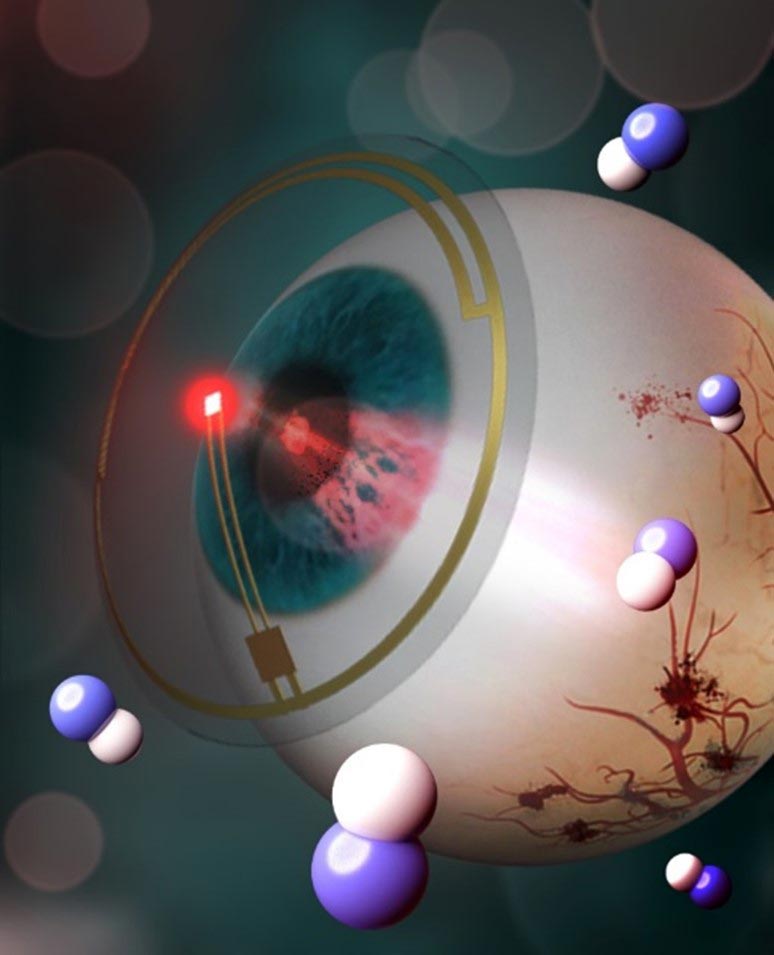
    Smart LED Contact Lenses for Treating Diabetic Retinopathy
    Schematic diagram of the prevention and early treatment system for diabetic retinopathy using wirelessly driven smart contact lenses equipped with LEDs. Credit: POSTECH

    Smart LED contact lenses developed for treating diabetic retinopathy.

    Diabetes is a long-term chronic disease with many complications and requires lifelong care. The longer a patient suffers from diabetes, the higher the risk of developing retinopathy (disease of the retina) which can progressively lead to a decline in vision and even to blindness.

    A POSTECH research team led by Professor Sei Kwang Hahn and Ph.D. candidate Geon-Hui Lee (Department of Materials Science and Engineering) in collaboration with Dr. Sangbaie Shin of PHI BIOMED Co. has recently developed a smart contact lens-type wearable device to prevent diabetic retinopathy and treat it in its early stages by irradiating 120 µW far red/LED light to the retina. This technology for smart LED contact lenses has attracted a great deal of attention for various ophthalmologic diseases.

    Diabetic retinopathy is currently treated by highly invasive repeated therapeutic injections to the eyeball or thousands of small burns made with a laser to destroy capillaries near the edges of the retina under anesthesia. Both procedures are considered highly painful for the patient.

    Through the study with diabetic animal models, the researchers confirmed that the diabetic retinopathy did not appear in animals that wore the smart contact lenses for 15 minutes 3 times a week for a total of 8 weeks. In contrast, the animals that did not wear the lenses showed retinopathic conditions. The safety and effectiveness of the lenses were also confirmed by the histological analysis of the cornea and retina.

    “This study has demonstrated the feasibility of a lens-type wearable device for the applications not only to monitoring oxygen saturation, heart beating rate, and ophthalmologic diseases, but also to treating depression, insomnia, neuronal diseases, and more,” remarked Professor Sei Kwang Han who led the study.

    Reference: “Smart Wireless Near-Infrared Light Emitting Contact Lens for the Treatment of Diabetic Retinopathy” by Geon-Hui Lee, Cheonhoo Jeon, Jee Won Mok, Sangbaie Shin, Su-Kyoung Kim, Hye Hyeon Han, Seong-Jong Kim, Sang Hoon Hong, Hwanhee Kim, Choun-Ki Joo, Jae-Yoon Sim and Sei Kwang Hahn, 29 January 2022, Advanced Science.
    DOI: 10.1002/advs.202103254

    Published in the international academic journal Advanced Science, this study was conducted with support from the Nano · Material Technology Development Program, Disease Oriented Translational Research, Mid-career Researcher Program, Brain Korea 21 Fostering Outstanding Universities (FOUR) project, and the Korea Medical Device Development Fund of the National Research Foundation of Korea, and by the World Class 300 Project of the Ministry of SMEs and Startups of Korea.

    Never miss a breakthrough: Join the SciTechDaily newsletter.
    Follow us on Google and Google News.

    Biomedical Engineering Diabetes Eyes Ophthalmology Pohang University of Science & Technology Retina Vision
    Share. Facebook Twitter Pinterest LinkedIn Email Reddit

    Related Articles

    Could a Tiny Eye Implant Reverse Macular Degeneration?

    Stunning Results: Revolutionary Retinal Chip Lets Patients With Severe Vision Loss Read Again

    Groundbreaking New Treatment Is the First to Halt This Common Eye Disease

    New Research Reveals How Our Eyes “Dance” for Clearer Vision

    Incredible Potential: A New Way To Prevent Common Causes of Vision Loss

    Advanced Computer Model Enables Improvements to “Bionic Eye” Technology

    New Retinal Implant Technology Expected to Help Restore Sight

    Scientists Restore Basic Elements of Vision in Live Mice

    Gene Therapy Improves Eye Function in Patients

    Leave A Reply Cancel Reply

    • Facebook
    • Twitter
    • Pinterest
    • YouTube

    Don't Miss a Discovery

    Subscribe for the Latest in Science & Tech!

    Trending News

    Popular Supplement Ingredient Linked to Shorter Lifespan in Men

    Scientists May Have Found a Way To Repair Nerve Damage in Multiple Sclerosis

    “Totally Unexpected” – Scientists Discover Pancreatic Cancer’s Fatal Addiction

    A Strange Quantum Effect May Explain One of Biology’s Greatest Mysteries

    James Webb Telescope Reveals the Universe’s Hidden Cosmic Web in Stunning Detail

    Scientists Identify Simple Supplement That Greatly Reduces Alzheimer’s Damage

    You May Have a Dangerous Type of Cholesterol Even if Your Tests Look Normal

    Your Blood Pressure Reading Could Be Wrong Because of One Simple Mistake

    Follow SciTechDaily
    • Facebook
    • Twitter
    • YouTube
    • Pinterest
    • Newsletter
    • RSS
    SciTech News
    • Biology News
    • Chemistry News
    • Earth News
    • Health News
    • Physics News
    • Science News
    • Space News
    • Technology News
    Recent Posts
    • Scientists Say a 40-Year-Old Childhood Obesity Warning May Be Completely Wrong
    • Marijuana Use May Raise Lung Cancer Risk, Researchers Warn
    • This Common Type of Food May Be Raising Your Risk of Heart Disease
    • Fur Seals’ Hearts Suddenly Spike Hours After Returning to Land
    • Scientists Say Cognitive Decline Isn’t Inevitable — Your Brain Can Improve at Any Age
    Copyright © 1998 - 2026 SciTechDaily. All Rights Reserved.
    • Science News
    • About
    • Contact
    • Editorial Board
    • Privacy Policy
    • Terms of Use

    Type above and press Enter to search. Press Esc to cancel.