
Close Menu
    Facebook X (Twitter) Instagram
    SciTechDaily
    • Biology
    • Chemistry
    • Earth
    • Health
    • Physics
    • Science
    • Space
    • Technology
    Facebook X (Twitter) Pinterest YouTube RSS
    SciTechDaily
    Home»Space»Solar Orbiter Captures the Sun’s Fluffy Corona in Stunning Detail [Video]
    Space

    Solar Orbiter Captures the Sun’s Fluffy Corona in Stunning Detail [Video]

    By European Space Agency (ESA)May 5, 2024No Comments3 Mins Read
    Facebook Twitter Pinterest Telegram LinkedIn WhatsApp Email Reddit
    Share
    Facebook Twitter LinkedIn Pinterest Telegram Email Reddit
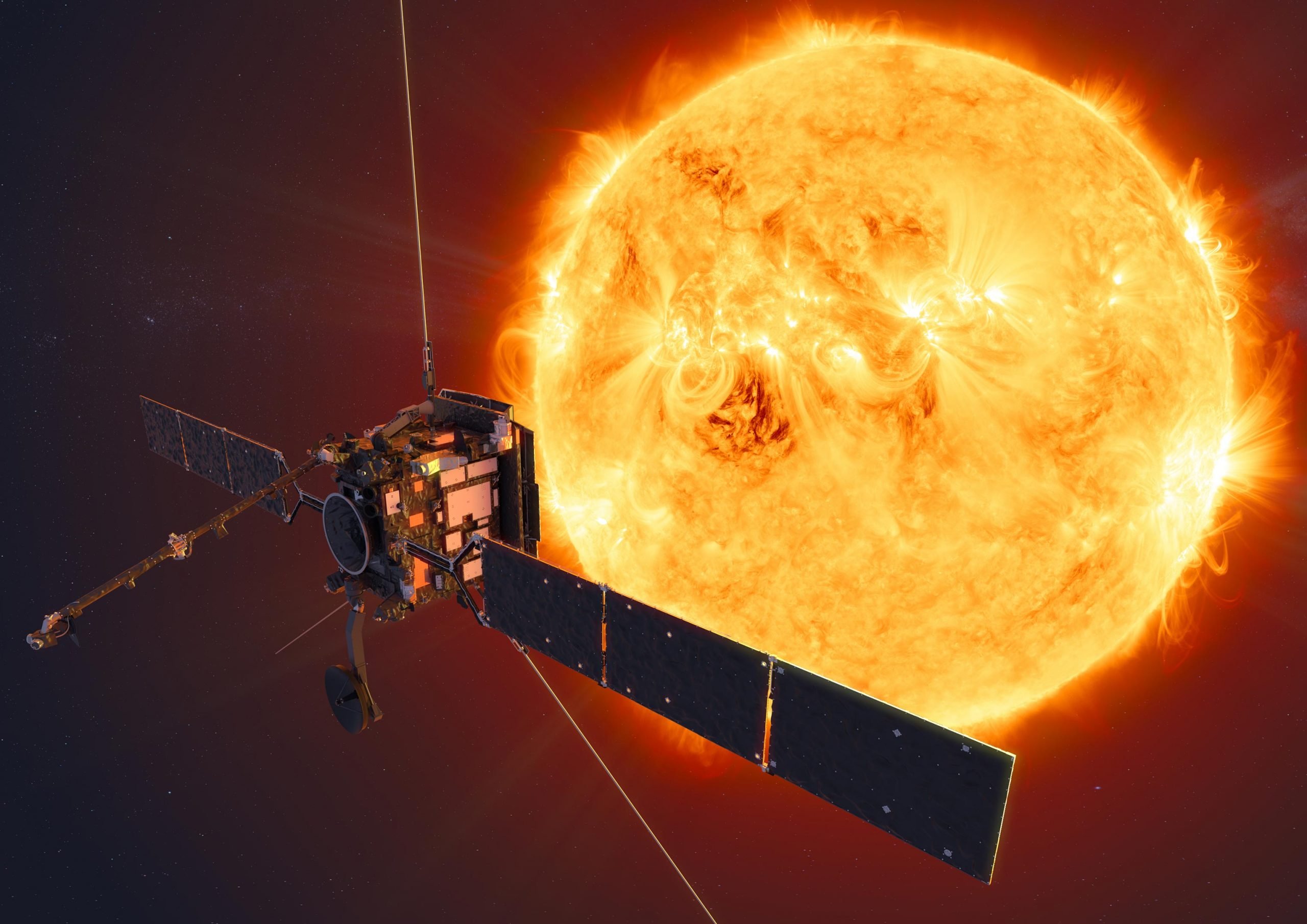
    ESA Solar Orbiter
    Solar Orbiter’s mission is to study the Sun up close and from high latitudes, providing the first images of the Sun’s poles and investigating the heliosphere. Credit: ESA/ATG medialab

    Stunning close-up views of the Sun reveal its dynamic magnetic structures and extreme temperatures, captured by ESA’s Solar Orbiter in collaboration with NASA’s Parker Solar Probe.

    This otherworldly, ever-changing landscape (see video below) is what the Sun looks like up close. the European Space Agency’s Solar Orbiter filmed the transition from the Sun’s lower atmosphere to the much hotter outer corona. The hair-like structures are made of charged gas (plasma), following magnetic field lines emerging from the Sun’s interior.

    The brightest regions are around one million degrees Celsius, while cooler material looks dark as it absorbs radiation.

    This video was recorded on September 27, 2023, by the Extreme Ultraviolet Imager (EUI) instrument on Solar Orbiter. At the time, the spacecraft was at roughly a third of the Earth’s distance from the Sun, heading for a closest approach of 27 million miles (43 million km) on October 7, 2023.

    On the same day that this video was recorded, NASA’s Parker Solar Probe skimmed just 4.51 million miles (7.26 million kilometers) from the solar surface. Rather than directly imaging the Sun, Parker measures particles and the magnetic field in the Sun’s corona and in the solar wind. This was a perfect opportunity for the two missions to team up, with ESA-led Solar Orbiter’s remote-sensing instruments observing the source region of the solar wind that would subsequently flow past Parker Solar Probe.

    Spot the Moss, Spicules, Eruption, and Rain

    Lower left corner: An intriguing feature visible throughout this movie is the bright gas that makes delicate, lace-like patterns across the Sun. This is called coronal ‘moss’. It usually appears around the base of large coronal loops that are too hot or too tenuous to be seen with the chosen instrument settings.

    On the solar horizon: Spires of gas, known as spicules, reach up from the Sun’s chromosphere. These can reach up to a height of 10,000 km (6,200 miles).

    Center around 0:22: A small eruption in the center of the field of view, with cooler material being lifted upwards before mostly falling back down. Don’t be fooled by the use of ‘small’ here: this eruption is bigger than Earth!

    Center-left around 0:30: ‘Cool’ coronal rain (probably less than 10,000 °C / 18,000 °F) looks dark against the bright background of large coronal loops (around one million degrees Celsius). The rain is made of higher-density clumps of plasma that fall back towards the Sun under the influence of gravity.


    This is the same video as above but without the annotations. Credit: ESA & NASA/Solar Orbiter/EUI Team

    Never miss a breakthrough: Join the SciTechDaily newsletter.
    Follow us on Google and Google News.

    Astronomy Astrophysics European Space Agency Popular Solar Orbiter Sun
    Share. Facebook Twitter Pinterest LinkedIn Email Reddit

    Related Articles

    Solar Orbiter Spacecraft Discovers Tiny Jets That Could Power the Solar Wind

    See a Solar Snake Slither Across the Sun’s Surface – At 380,000 Miles per Hour

    Incredible New Views of the Sun – As You’ve Never Seen It Before

    Solar Orbiter Spacecraft Captures the Full Sun in Unprecedented Detail

    Massive Solar Eruption Captured by Solar Orbiter Spacecraft

    Solar Orbiter Has Already Made a Wealth of Science Discoveries

    “Campfires” on the Sun Offer Clue to Solar Heating Mystery

    Solar Orbiter Snaps Closest Pictures Ever of the Sun – Reveals New “Campfires” Phenomena

    Solar Orbiter Made First Close Approach to the Sun Today [Video]

    Leave A Reply Cancel Reply

    • Facebook
    • Twitter
    • Pinterest
    • YouTube

    Don't Miss a Discovery

    Subscribe for the Latest in Science & Tech!

    Trending News

    289-Million-Year-Old Reptile Mummy Reveals Origin of Human Breathing System

    New Brain Discovery Challenges Long-Held Theory of Teenage Brain Development

    Scientists Discover Plants “Scream” – We Just Couldn’t Hear Them Until Now

    Scientists Discover a Surprising Reason Intermittent Fasting Extends Life

    This Simple Fruit Wash Could Make Produce Safer and Last Days Longer

    Scientists Say Adding This Unusual Seafood to Your Diet Could Reverse Signs of Aging

    Scientists Say a Hidden Structure May Exist Inside Earth’s Core

    Doctors Surprised by the Power of a Simple Drug Against Colon Cancer

    Follow SciTechDaily
    • Facebook
    • Twitter
    • YouTube
    • Pinterest
    • Newsletter
    • RSS
    SciTech News
    • Biology News
    • Chemistry News
    • Earth News
    • Health News
    • Physics News
    • Science News
    • Space News
    • Technology News
    Recent Posts
    • Scientists Propose Radical New Way To Detect Alien Life – Without Traditional Biosignatures
    • Scientists Just Discovered Light Can Actually Slow Plant Growth
    • Scientists Finally Solved One of Water’s Biggest Mysteries
    • 7,000-Year-Old DNA Rewrites the Story of the “Neolithic Revolution”
    • Missing Medieval Relic of Legendary English King Found After Being Missing for 40 Years
    Copyright © 1998 - 2026 SciTechDaily. All Rights Reserved.
    • Science News
    • About
    • Contact
    • Editorial Board
    • Privacy Policy
    • Terms of Use

    Type above and press Enter to search. Press Esc to cancel.