
Close Menu
    Facebook X (Twitter) Instagram
    SciTechDaily
    • Biology
    • Chemistry
    • Earth
    • Health
    • Physics
    • Science
    • Space
    • Technology
    Facebook X (Twitter) Pinterest YouTube RSS
    SciTechDaily
    Home»Space»This “Ordinary” Spiral Galaxy Explodes With Star Birth and Black Hole Power
    Space

    This “Ordinary” Spiral Galaxy Explodes With Star Birth and Black Hole Power

    By ESA/HubbleSeptember 17, 2025No Comments2 Mins Read
    Facebook Twitter Pinterest Telegram LinkedIn WhatsApp Email Reddit
    Share
    Facebook Twitter LinkedIn Pinterest Telegram Email Reddit
    Spiral Galaxy NGC 7456
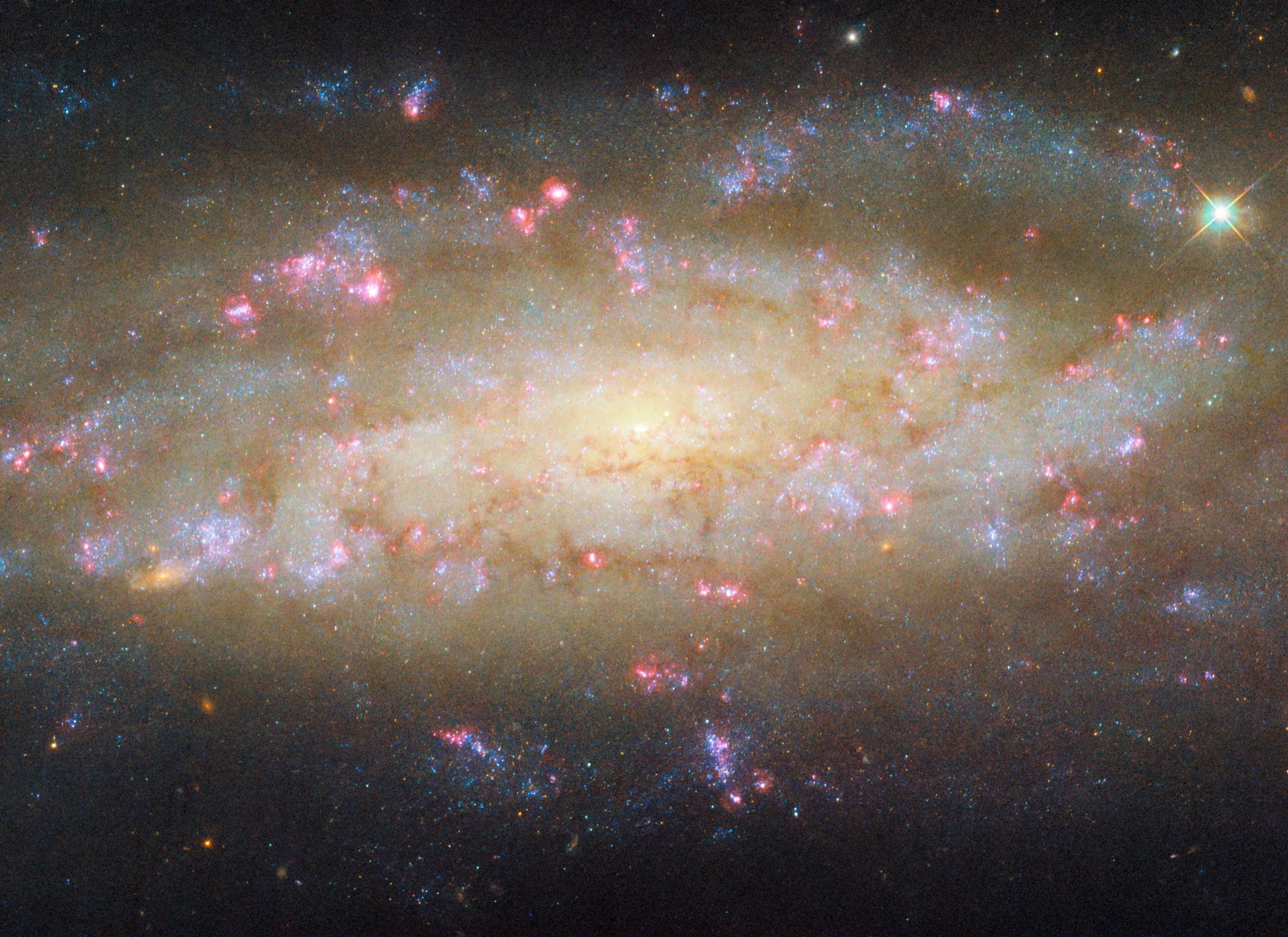
    NGC 7456 reveals stunning details: dust lanes, glowing star nurseries, and ultraluminous X-ray sources. Its brilliant, active core cements its status as a galaxy worth watching. Credit: ESA/Hubble & NASA, D. Thilker

    NGC 7456 may look like just another spiral galaxy, but it’s full of surprises.

    From vibrant star-forming regions glowing pink to mysterious ultraluminous X-ray sources, it’s a cosmic laboratory for astronomers.

    A Hidden Galaxy With a Story to Tell

    At first glance, this galaxy might look ordinary, one spiral among countless others scattered across the Universe. But the subject of the ESA/Hubble Picture of the Week, known as NGC 7456, holds far more than meets the eye. It lies more than 51 million light-years away in the constellation Grus (the Crane).

    The image highlights the uneven spiral arms of NGC 7456, laced with pockets of dark dust that block starlight. Scattered across the galaxy are brilliant pink regions, glowing clouds of gas where new stars are taking shape. Their intense light excites the surrounding material, producing the distinctive red glow that signals stellar birth. The Hubble program gathered this data as part of its effort to study galactic evolution, tracking the formation of stars, clouds of hydrogen, and star clusters over time.

    Extreme X-Ray Powerhouses

    Hubble, with its ability to capture visible, ultraviolet and some infrared light, is not the only observatory focused on NGC 7456. ESA’s XMM-Newton satellite has imaged X-rays from the galaxy on multiple occasions, discovering a number of so-called ultraluminous X-ray sources. These small, compact objects emit terrifically powerful X-rays, much more than would be expected for their size. Astronomers are still trying to pin down what powers these extreme objects, and NGC 7456 contributes a few more examples.

    On top of that, the region around the galaxy’s supermassive black hole is spectacularly bright and energetic, making NGC 7456 an active galaxy. Whether looking at its core or its outskirts, at visible light or X-rays, this galaxy has something interesting to show!

    Never miss a breakthrough: Join the SciTechDaily newsletter.
    Follow us on Google and Google News.

    Astronomy European Space Agency Hubble Space Telescope
    Share. Facebook Twitter Pinterest LinkedIn Email Reddit

    Related Articles

    A Diamond Necklace of Cosmic Proportions

    Hubble Snaps a Stunning Close-Up of a Magnificent Spiral Galaxy

    Extraordinary Hubble Image: Light Bends From the Beyond

    Hubble Space Telescope Sees Volcanic Activity Reforming the Atmosphere on a Rocky Exoplanet

    Hubble Spies a Luminous Heart With Dark Tendrils

    Spectacular Return to the Veil Nebula

    Hubble Spots a Peculiar Sight: Unusual Spiral Galaxy With a Heavy Arm

    A Flash of Life: Hubble Spies an Unusual Planetary Nebula

    Through the Cosmic Clouds: Hubble Spots a Beautiful Stellar Nursery

    Leave A Reply Cancel Reply

    • Facebook
    • Twitter
    • Pinterest
    • YouTube

    Don't Miss a Discovery

    Subscribe for the Latest in Science & Tech!

    Trending News

    New Molecule Restores the Brain’s Natural Defenses Against Alzheimer’s

    Could Creatine Boost More Than Muscles? It May Also Help Depression

    Scientists Discover a Natural Molecule That Could Help Prevent Vision Loss

    Scientists Thought Royal Jelly Made Queen Bees. They Were Wrong

    One Tiny Change May Explain How Viruses Jump From Bats to Humans

    The Secret to Healthy Aging May Be More Protein and More Exercise

    These 567-Million-Year-Old Fossils Are Rewriting the Story of Life on Earth

    The Spider-Like Creatures Helping Scientists Decode the Origins of Fatherhood

    Follow SciTechDaily
    • Facebook
    • Twitter
    • YouTube
    • Pinterest
    • Newsletter
    • RSS
    SciTech News
    • Biology News
    • Chemistry News
    • Earth News
    • Health News
    • Physics News
    • Science News
    • Space News
    • Technology News
    Recent Posts
    • Rethinking Movement Disorders: Scientists Uncover a Surprising Disconnect Deep Inside the Brain
    • Groundbreaking Study Challenges 40 Years of Beliefs About Mad Cow Disease
    • One Sugar Tells Your Brain You’re Full. Another Barely Does
    • One of Arizona’s Largest Reservoirs Is Less Than 1% Full After Snowpack Collapse
    • Scientists Detect Hundreds of Iceberg Earthquakes at Antarctica’s Crumbling Doomsday Glacier
    Copyright © 1998 - 2026 SciTechDaily. All Rights Reserved.
    • Science News
    • About
    • Contact
    • Editorial Board
    • Privacy Policy
    • Terms of Use

    Type above and press Enter to search. Press Esc to cancel.