
Close Menu
    Facebook X (Twitter) Instagram
    SciTechDaily
    • Biology
    • Chemistry
    • Earth
    • Health
    • Physics
    • Science
    • Space
    • Technology
    Facebook X (Twitter) Pinterest YouTube RSS
    SciTechDaily
    Home»Space»This Week @NASA: Celebrating the Worm, Record-Breaking Black Hole, First Euclid Images
    Space

    This Week @NASA: Celebrating the Worm, Record-Breaking Black Hole, First Euclid Images

    By NASANovember 12, 2023No Comments4 Mins Read
    Facebook Twitter Pinterest Telegram LinkedIn WhatsApp Email Reddit
    Share
    Facebook Twitter LinkedIn Pinterest Telegram Email Reddit
    Euclid Mission
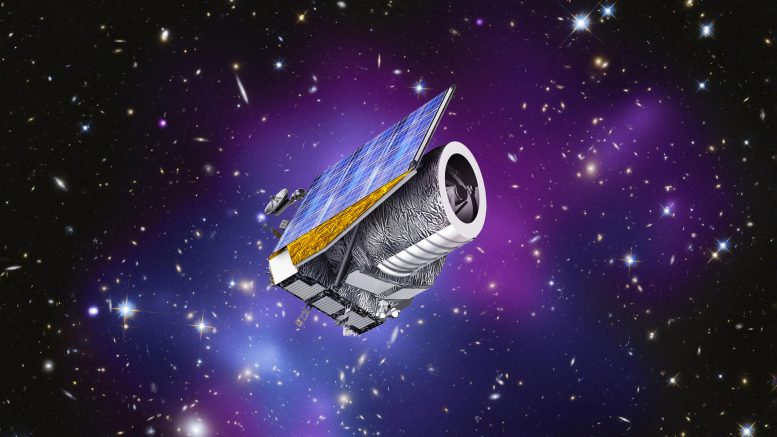
    Launched on July 1, the Euclid mission is designed to study dark matter and dark energy to answer big questions about why our universe is expanding faster and faster. On November 7, the Euclid mission released its first science images.

    Celebrating the NASA worm…

    NASA telescopes spot a record-breaking black hole…

    And the first science images from a new space observatory…

    A few of the stories to tell you about – This Week at NASA!

    NASA Celebrates Worm Logo With Original Designer

    On November 6 at NASA headquarters, we hosted a panel discussion about the design and cultural significance of the NASA worm logotype with Richard Danne, the designer of the worm. In 1992, the worm was retired but it has been brought back for limited use to complement the agency’s official insignia, known as the meatball.

    “I can’t even, in words, express how rewarding it’s been for this to come back. It’ll always be a special place in my heart for NASA.”

    Learn more about the “worm” on the July 24, 2020 episode of “Houston We Have a Podcast,” the official podcast of NASA’s Johnson Space Center.
    Black Hole UHZ1 Annotated
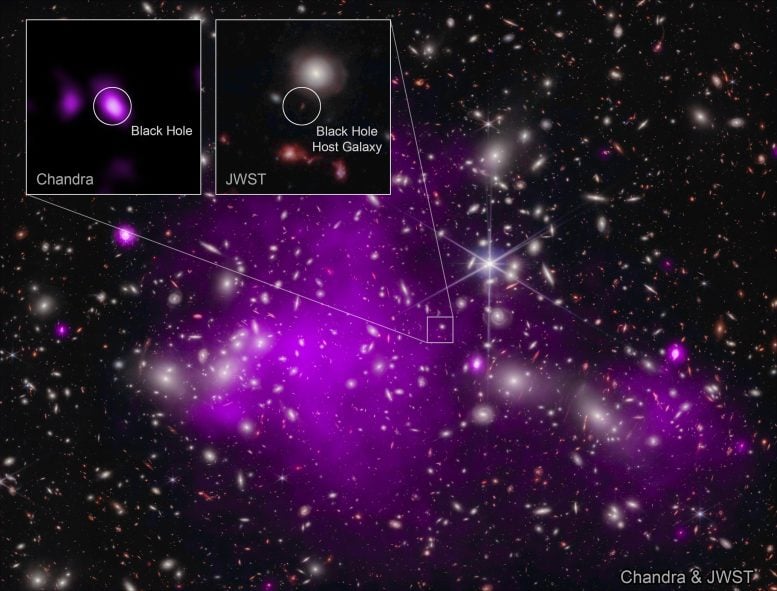
    Astronomers found the most distant black hole ever detected in X-rays (in a galaxy dubbed UHZ1) using the Chandra and Webb space telescopes. X-ray emission is a telltale signature of a growing supermassive black hole. This result may explain how some of the first supermassive black holes in the universe formed. These images show the galaxy cluster Abell 2744 that UHZ1 is located behind, in X-rays from Chandra and infrared data from Webb, as well as close-ups of the black hole host galaxy UHZ1. Credit: X-ray: NASA/CXC/SAO/Ákos Bogdán; Infrared: NASA/ESA/CSA/STScI; Image Processing: NASA/CXC/SAO/L. Frattare & K. Arcand

    NASA Telescopes Discover Record-Breaking Black Hole

    Astronomers using NASA’s Chandra X-ray Observatory and James Webb Space Telescope have discovered the most distant black hole yet seen in X-rays.

    The black hole is at an early stage of growth that had never been witnessed before, where its mass is similar to that of its host galaxy.

    This result may explain how some of the first supermassive black holes in the universe formed.
    Euclid's First Images
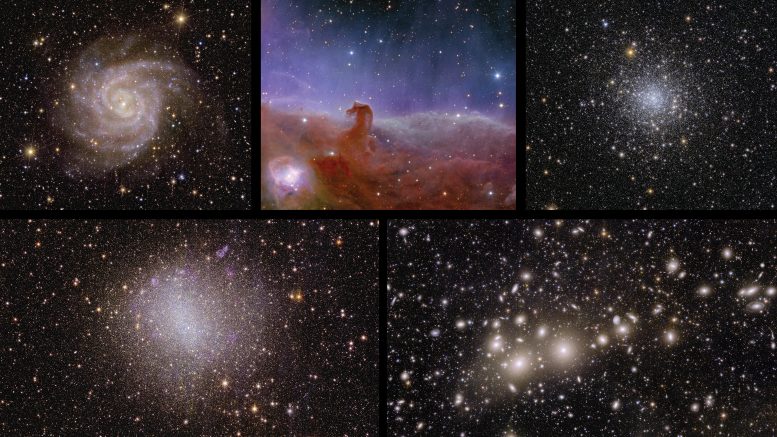
    ESA’s Euclid space mission revealed its first full-color images of the cosmos. Never before has a telescope been able to create such razor-sharp astronomical images across such a large patch of the sky, and looking so far into the distant Universe. These five images illustrate Euclid’s full potential; they show that the telescope is ready to create the most extensive 3D map of the Universe yet, to uncover some of its hidden secrets. Credit: ESA/Euclid/Euclid Consortium/NASA, image processing by J.-C. Cuillandre (CEA Paris-Saclay), G. Anselmi, CC BY-SA 3.0 IGO

    First Science Images Released From Euclid Mission

    On November 7, the Euclid mission released its first science images, including this image of the Perseus cluster, a group of thousands of galaxies about 240 million light-years from Earth. Euclid is led by the European Space Agency (ESA) with NASA contributions.

    It will begin its regular science operations to study dark matter and dark energy in early 2024.
    NASA Plus
    NASA+ is the agency’s no-cost, ad-free streaming service featuring live coverage and original video series. No subscription required. Credit: NASA

    New NASA+ On-Demand Streaming Service Is Here

    NASA’s new on-demand streaming service, NASA+ and upgraded app are now available. These new digital platforms offer original video series, live launch coverage, kids’ content, and the latest news.

    NASA+ is available for download via the NASA App on iOS and Android devices, as well as streaming media players Roku and Apple TV.

    That’s what’s up this week @NASA.

    Never miss a breakthrough: Join the SciTechDaily newsletter.
    Follow us on Google and Google News.

    NASA
    Share. Facebook Twitter Pinterest LinkedIn Email Reddit

    Related Articles

    The Cosmic “Hand of God” Just Got Even Stranger

    NASA’s Parker Solar Probe Just Solved a 70-Year Solar Mystery

    NASA’s Perseverance Mars Rover Spots Bizarre Helmet-Shaped Rock and Mysterious Megaripples

    Hubble Reveals a Rare Interstellar Comet Racing at 130,000 MPH Through Our Solar System

    Stunning New NASA Perseverance Rover Images Show Mars Clearer Than Ever Before

    NASA Unveils Possible Building Blocks of Life on Saturn’s Moon Titan

    NASA’s Curiosity Mars Rover Just Got a Big Brain Upgrade

    NASA’s Webb May Have Found a Planet Next Door. Then It Vanished

    NASA’s Lunar Trailblazer Moon Mission Lost Just a Day After Launch

    Leave A Reply Cancel Reply

    • Facebook
    • Twitter
    • Pinterest
    • YouTube

    Don't Miss a Discovery

    Subscribe for the Latest in Science & Tech!

    Trending News

    Walking for Just 20 Minutes Caused an Immediate Change in the Gut

    Scientists Have Uncovered Previously Hidden Microbial Activity on Human Skin

    Stacked Mummies Reveal 700 Years of Changing Burial Rituals in Ancient Egypt

    Scientists Discover a Butterfly That Barely Seems To Age

    Astronomers Detect a Faint Hydrogen Signal From Billions of Light-Years Away

    Fighting Fire With Fire Could Save Giant Sequoias

    Scientists Just Found a Hidden Factor That Could Trigger an Atlantic Ocean Collapse

    Scientists Find a Berry Compound That Helps Muscle Cells Burn Fat

    Follow SciTechDaily
    • Facebook
    • Twitter
    • YouTube
    • Pinterest
    • Newsletter
    • RSS
    SciTech News
    • Biology News
    • Chemistry News
    • Earth News
    • Health News
    • Physics News
    • Science News
    • Space News
    • Technology News
    Recent Posts
    • A Pompeii-Like Volcanic Disaster Preserved a 22-Million-Year-Old Landscape
    • One of Earth’s Oldest Animal Fossils Found in a Norwegian Sheep Field
    • Ancient DNA Rewrites the Story of the “American Cheetah”
    • Biggest Supernova Dataset Yet Challenges Dark Energy Theory
    • 1,000x Speedup: Scientists Just Broke Through a Major Quantum Computing Bottleneck
    Copyright © 1998 - 2026 SciTechDaily. All Rights Reserved.
    • Science News
    • About
    • Contact
    • Editorial Board
    • Privacy Policy
    • Terms of Use

    Type above and press Enter to search. Press Esc to cancel.