
More than 2,500 alien plant species could find suitable conditions in the Arctic, especially in northern Norway and Svalbard. Researchers used massive biodiversity datasets to map risk areas and improve early detection efforts.
When species are introduced outside their natural range, they can outcompete and displace native plants. The Intergovernmental Panel on Nature (IPBES) ranks invasive species among the most serious threats to global biodiversity.
To better understand the danger facing Arctic ecosystems, scientists compiled a comprehensive list of alien plant species that could establish themselves in the region. Their findings raise concern, especially at a time when expanding travel and human presence make it easier than ever for species to move across continents.
“We found a total of 2554 species that would find a suitable climatic niche in today’s Arctic,” says Kristine Bakke Westergaard, an associate professor at the Department of Natural History at the NTNU University Museum (at the Norwegian University of Science and Technology).
In practical terms, this means these species could survive if they reach the Arctic. One of the most likely ways they could arrive is by traveling unintentionally with people, for example, attached to clothing, equipment, or transported goods.

Human Activity Accelerates Arctic Species Spread
“Our results show that alien species from virtually all over the world can find a niche in the Arctic. And with all the human activity in the Arctic now, there are lots of opportunities to get there,” Westergaard said.
Westergaard and her collaborators from the Department of Natural History and the University of Liverpool carried out what is known as a “horizon scan” to anticipate future biological invasions.
“We looked at roughly 14,000 known alien plant species that can spread to places where they do not originally belong,” Westergaard said.
Massive Biodiversity Dataset Reveals Arctic Hotspots
The team drew on more than 51 million documented observations of these species. The records were sourced from the GBIF—the Global Biodiversity Information Facility—as well as other large databases and scientific publications.
First author Tor Henrik Ulsted completed the research while he was a master’s student at the NTNU University Museum until 2024. He received the Faculty of Natural Science’s award for the best master’s thesis that contributes to sustainable development and has since worked to publish the findings.
Using the combined dataset, the researchers produced a map highlighting the Arctic regions most exposed to potential plant invasions.
Norway and Svalbard Among Highest-Risk Arctic Regions
“Our map shows hotspot areas in the Arctic where many alien species can tolerate the climate. The highest number of species are found in the north of Norway,” Ulsted said.
Although Norway stands out as a high-risk area, almost no part of the Arctic can be considered fully protected, including Svalbard.
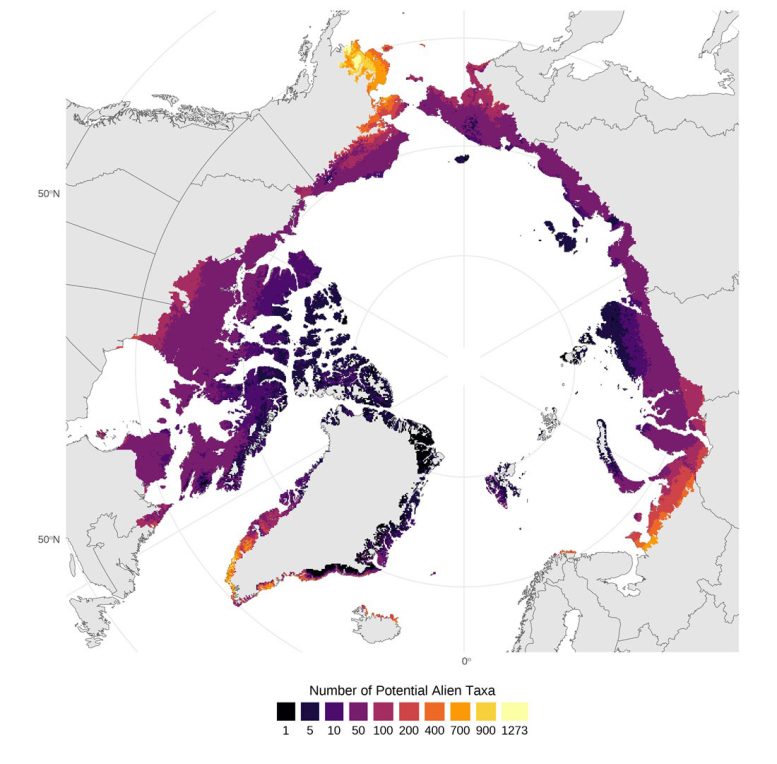
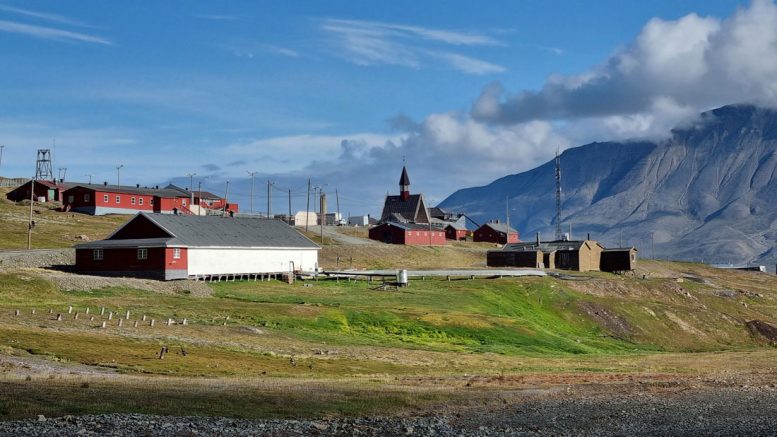
“Even in Svalbard, 86 alien species can find a climatic niche,” says Westergaard, who has found and studied alien species there herself.
Rapid environmental change is compounding the threat. Rising temperatures across the Arctic lately have created conditions that allow an increasing number of foreign plant species to survive and potentially spread.
Early Detection Tools to Prevent Arctic Invasions
In Norway and Svalbard, the Norwegian Biodiversity Information Centre‘s expert committees evaluate the risks posed by alien species in different regions.
“These committees have long found it to be very laborious, almost impossible, to make a list of relevant species that should be assessed as possible new alien species,” says Westergaard.
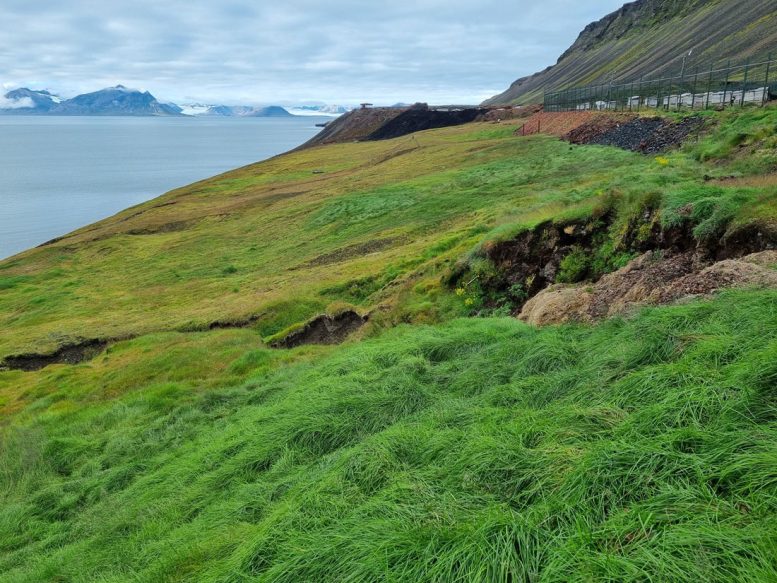
The newly developed approach provides experts with clearer species lists and a more systematic way to evaluate ecological risk in specific areas.
Supporting Global Biodiversity Goals by 2030
“Our long-term goal is to help identify alien species before they become invasive and problematic,” Ulsted said.
Detecting and managing invasive species early is far more effective than trying to control them once they are firmly established.
According to Westergaard, this strategy also advances the objectives of the Kunming-Montreal Global Biodiversity Framework, which calls for reducing the threat from alien species, including cutting their introduction and establishment by half by 2030.
The work also supports several measures outlined in the Norwegian authorities’ action plan against alien organisms.
Reference: “Horizon scanning of potential new alien vascular plant species and their climatic niche space across the Arctic” by Tor Henrik Ulsted, Kristine Bakke Westergaard, Wayne Dawson and James D. M. Speed, 7 November 2025, NeoBiota.
DOI: 10.3897/neobiota.104.165054
Never miss a breakthrough: Join the SciTechDaily newsletter.
Follow us on Google and Google News.
2 Comments
“We looked at roughly 14,000 known alien plant species that can spread to places where they do not originally BELONG”
One might argue that a species ‘belongs’ anywhere it is adapted to survive. It is humans, who have the power to alter the composition of an ecological niche, who make the subjective judgement about ‘belonging.’ We decide that if an introduction, either by intent or accident and was facilitated by humans or not, is somehow ‘unnatural’ and we should expend time and resources to eliminate, what are in many instances organisms better adapted than those currently there. I’m certain that throughout geologic time, when humans weren’t around to get involved, there were numerous introductions of unmonitored species that resulted in changes in biodiversity and probably impacted the evolution of other species that had previously been relieved of the pressures of competition.
One of the unique characteristics of Life is that it has the capacity to evolve to fill new ecological niches as mountain building changes the elevation and hence temperature and precipitation of the rising land. Even relatively static landforms like Australia experience climate changes over very long times. Life forms almost seem to have a ‘Prime Directive’ to invade any ecological niche that has a vacancy or is under-filled. Biodiversity seems to be greatest in the tropics, particularly lowlands without topographic barriers.
What seems to be hidden in the discussion are questions that are philosophical in nature. Should humans actively be playing a role in evolution because we can? Is it wise to attempt to prevent the spread of different life forms, thus impeding evolution? We are doing it (as with Burmese pythons in Florida) by rationalizing that there is currently a reduction in diversity of mammals, for which humans are demonstrably responsible, over the last few decades. However, that is for the perspective of a few ten’s of thousands of years on a planet that has had life for over 500 million years. It seems to be a conscious effort to rationalize preventing, or at least slowing, evolution, which is the sine qua non of all Life.
Personally, I wouldn’t be unhappy if mosquitoes were exterminated and I could live without pythons. However, for that matter, I could live without alligators. The point I’m trying to make is that by using the pejorative word “belongs,” to rationalize maintaining the status quo, it may actually be an unwise course of action. I try to live my life by the dictum of, “Imagine what the world would be like if everyone were to act as I’m about to act.” I think that all too frequently people react to changes by either not thinking at all, or rationalizing behavior that is ultra conservative — i.e. all change is bad.
The alternative is to decide that organisms that are pathogens, predators that are a direct threat to humans, or that the introduction of plants like cheat grass, yellow star thistle, and kudzu were mistakes with undesirable results, and we should unapologetically try to exterminate them — without claiming that they don’t “belong.”
If any readers found my remarks above to be heretical, you might want to read the following:
https://aeon.co/essays/ecologys-war-on-invasive-species-isnt-science