

A solar jet captured by the Solar Orbiter unleashed a mind-blowing 200,000-fold increase in a rare helium isotope, 3He – far surpassing anything ever recorded.
Scientists traced it to a quiet region of the Sun with unexpectedly weak magnetic fields, upending previous assumptions about solar particle acceleration. Even stranger, the event didn’t show the usual heavy element enrichment, leaving researchers with more questions than answers. The find underscores the crucial role of missions near the Sun in solving the mysteries of solar energetic particles.
Solar Orbiter Detects Record 3He Levels
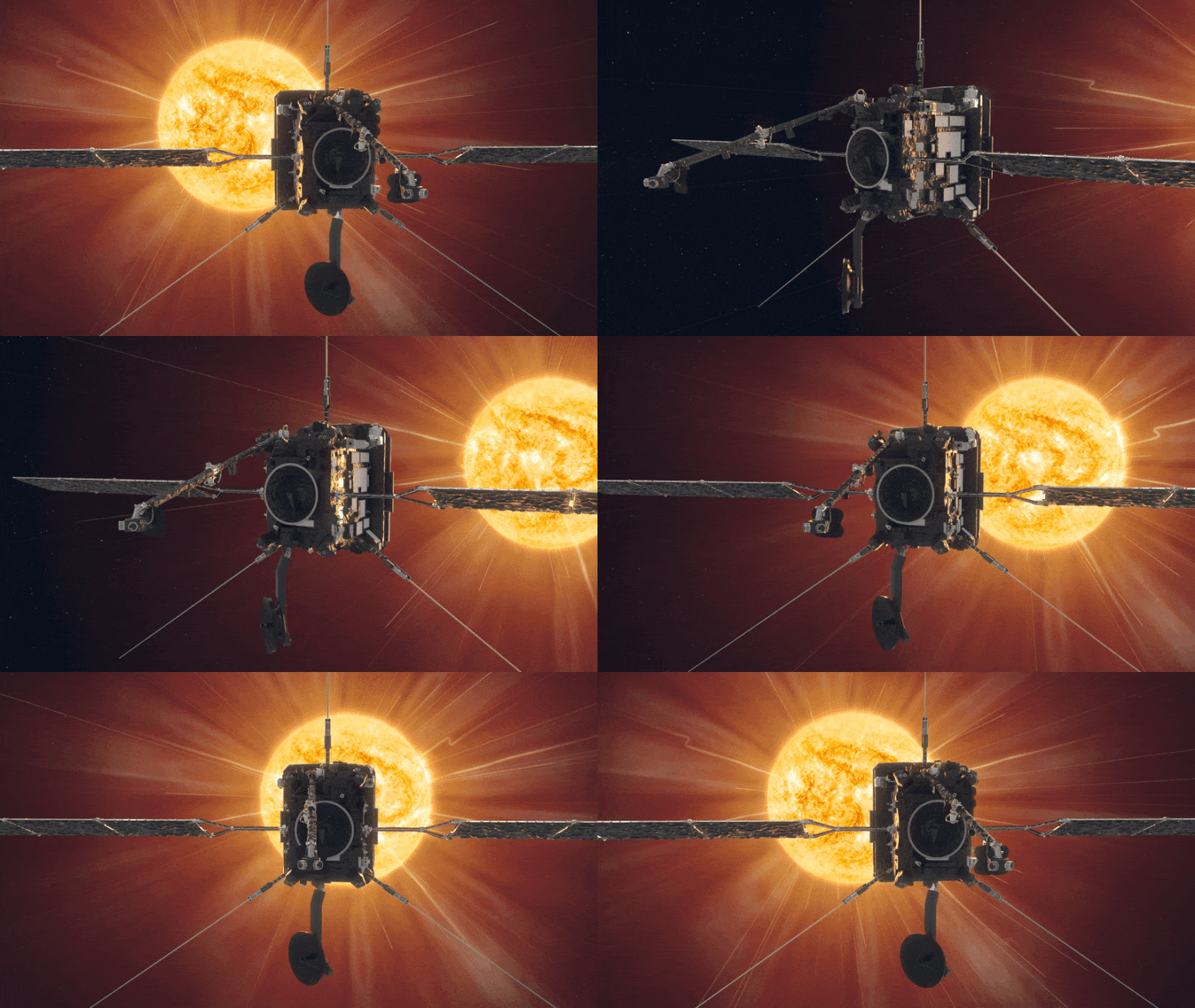
The NASA/ESA Solar Orbiter recently detected the highest concentration ever recorded of a rare helium isotope known as helium-3 (3He), emitted from the Sun. To uncover the source of this unusual event, a team of scientists led by the Southwest Research Institute (SwRI) investigated how these particles are accelerated and released into space.
These particles, known as solar energetic particles (SEPs), include high-energy protons, electrons, and heavier ions. They’re typically produced during solar flares and coronal mass ejections and travel throughout the solar system.
“This rare isotope, which is lighter than the more common 4He by just one neutron, is scarce in our solar system — found at a ratio of about one 3He ion per 2,500 4He ions,” said SwRI’s Dr. Radoslav Bucik, lead author of a paper describing this phenomenon. “However, solar jets appear to preferentially accelerate 3He to high speeds or energies, likely due to its unique charge-to-mass ratio.”
Unprecedented Enrichment and Acceleration
Bucik said the mechanism behind this acceleration remains unknown, but it can typically boost 3He abundance by up to 10,000 times its usual concentration in the Sun’s atmosphere — an effect unparalleled in any other known astrophysical setting. Incredibly, in this case, Solar Orbiter recorded a 200,000-fold enhancement of 3He. In addition to its great abundance, the 3He was accelerated to significantly higher speeds than heavier elements.
Tracing the Source to a Tiny Solar Jet
The SwRI team pinpointed the origin of the 3He emissions. NASA’s Solar Dynamics Observatory (SDO) provided high-resolution images of a small solar jet at the edge of a coronal hole — a region where magnetic field lines open into interplanetary space. Despite its tiny size, the jet was clearly linked to the SEP event, Bucik said.
“Surprisingly, the magnetic field strength in this region was weak, more typical of quiet solar areas rather than active regions,” he added. “This finding supports earlier theories suggesting that 3He enrichment is more likely in weakly magnetized plasma, where turbulence is minimal.”
A Rare Pattern of Ion Abundance
Additionally, this event stands out as one of the rare cases where ion enhancements do not follow the usual pattern. Typically, events like these exhibit greater abundance of heavy ions such as iron. But in this case, iron was not increased. Instead, carbon, nitrogen, silicon, and sulfur were significantly more abundant than expected. Scientists have observed only 19 similar events in the past 25 years, highlighting the rarity and puzzling nature of this phenomenon.
Why Close-Orbit Missions Matter
While the Parker Solar Probe was in a favorable location, it was too far away to detect the event, Bucik notes. This highlights the importance of spacecraft operating closer to the Sun, to detect more of these small, intriguing events and offering valuable insights into the acceleration mechanisms of this least understood energetic particle population in our solar system.
Reference: “Origin of the Unusual Composition of 3He-rich Solar Energetic Particles” by Radoslav Bučík, Glenn M. Mason, Sargam M. Mulay, George C. Ho, Robert F. Wimmer-Schweingruber and Javier Rodríguez-Pacheco, 7 March 2025, The Astrophysical Journal.
DOI: 10.3847/1538-4357/adb48d
Launched in February 2020, Solar Orbiter is a collaborative ESA/NASA mission aimed at exploring the Sun’s polar regions, magnetic field dynamics, and the origins of the solar wind. Equipped with both in-situ and remote-sensing instruments, it operates in a highly elliptical orbit that allows close solar flybys and unprecedented views of the Sun’s poles. The mission plays a key role in understanding how solar activity drives space weather.
Never miss a breakthrough: Join the SciTechDaily newsletter.
Follow us on Google and Google News.