
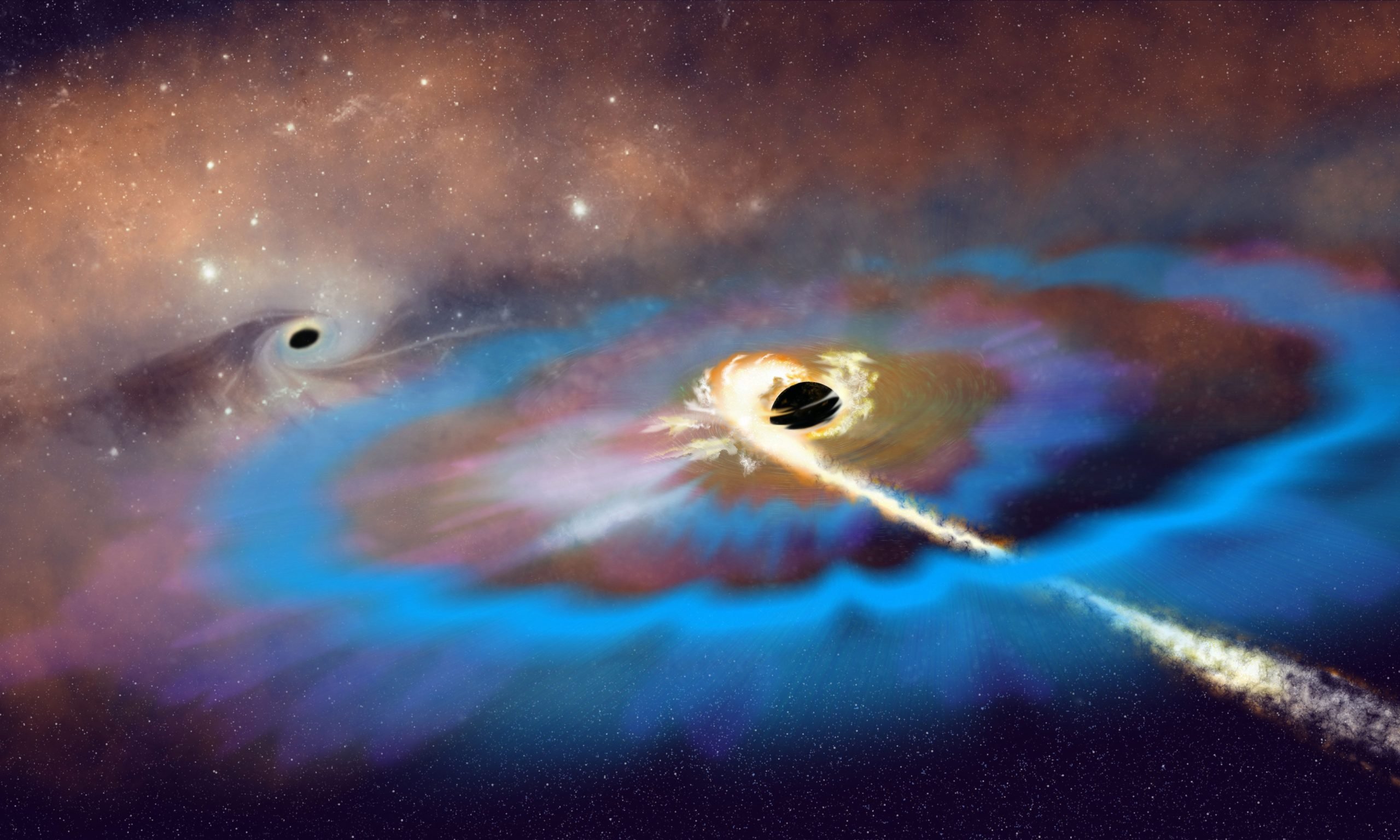
A black hole far from its galactic center has unleashed the fastest, brightest radio flares ever seen from a star’s destruction.
For the first time, astronomers have detected a tidal disruption event (TDE), when a black hole destroys a passing star, taking place far from a galaxy’s center. This unusual cosmic encounter produced remarkably strong and fast-changing radio waves, revealing that supermassive black holes can exist and stay active well beyond galactic cores, overturning long-held assumptions about their behavior and location.
The delayed and powerful radio signals hint at new, previously unrecognized processes that control how black holes expel matter over time.
The discovery was made by an international research team led by Dr. Itai Sfaradi and Prof. Raffaella Margutti of the University of California, Berkeley, with contributions from scientists worldwide, including Prof. Assaf Horesh of the Racah Institute of Physics at the Hebrew University of Jerusalem.
Known as AT 2024tvd, the event displayed the most rapidly changing radio signals ever detected from a star being destroyed by a black hole.
“This is truly extraordinary,” said Dr. Itai Sfaradi, lead author of the study. “Never before have we seen such bright radio emission from a black hole tearing apart a star, away from a galaxy’s center, and evolving this fast. It changes how we think about black holes and their behavior.”
Dr. Sfaradi, who led the research, is a former graduate student of Prof. Assaf Horesh. “This is one of the fascinating discoveries I’ve been part of,” said Prof. Horesh. “The fact that it was led by my former student, Itai, makes it even more meaningful. It’s another scientific achievement that places Israel at the forefront of international astrophysics.”
A black hole far from home
Tidal disruption events occur when a star ventures too close to a massive black hole and is torn apart by its immense gravity.
In this exceptional case, however, the black hole was located about 2,600 light-years (0.8 kiloparsecs) from its host galaxy’s core, evidence that supermassive black holes can lurk in unexpected places.
The key role of radio observations
The discovery was made possible through high-quality observations from several of the world’s premier radio telescopes, including the Very Large Array (VLA), ALMA, ATA, SMA, and the Arcminute Microkelvin Imager Large Array (AMI-LA) in the UK.
The AMI observations, led by the Hebrew University team, were crucial in revealing the unusually rapid evolution of the radio emission — a hallmark of this event and a major clue to understanding its physical nature.
The data showed two distinct radio flares evolving faster than any TDE observed before. These results indicate that powerful outflows of material were launched from the vicinity of the black hole, not immediately after the stellar destruction, but months later, suggesting delayed and complex processes in the aftermath of the disruption.
Detailed modeling points to at least two separate ejection events, months apart — clear evidence that black holes can episodically “reawaken” after periods of apparent inactivity.
Reference: “The First Radio-bright Off-nuclear Tidal Disruption Event AT 2024tvd Reveals the Fastest-evolving Double-peaked Radio Emission” by Itai Sfaradi, Raffaella Margutti, Ryan Chornock, Kate D. Alexander, Brian D. Metzger, Paz Beniamini, Rodolfo Barniol Duran, Yuhan Yao, Assaf Horesh, Wael Farah, Edo Berger, Nayana A. J., Yvette Cendes, Tarraneh Eftekhari, Rob Fender, Noah Franz, Dave A. Green, Erica Hammerstein, Wenbin Lu, Eli Wiston, Yirmi Bernstein, Joe Bright, Collin T. Christy, Luigi F. Cruz, David R. DeBoer, Walter W. Golay, Adelle J. Goodwin, Mark Gurwell, Garrett K. Keating, Tanmoy Laskar, James C. A. Miller-Jones, Alexander W. Pollak, Ramprasad Rao, Andrew Siemion, Sofia Z. Sheikh, Nadav Shoval and Sjoert van Velzen, 13 October 2025, The Astrophysical Journal Letters.
DOI: 10.3847/2041-8213/ae0a26
Never miss a breakthrough: Join the SciTechDaily newsletter.
Follow us on Google and Google News.
4 Comments
Inc Bao telling us that what we THINK is a tidal disruption event is actually just a TOPOLOGICAL VORTEX omg mind blown how can he know so much
CB memo 2510_181814,190424_Source1.Reinterpretation Summary【
Source 1.
https://scitechdaily.com/truly-extraordinary-supermassive-black-hole-found-in-the-last-place-scientists-expected/
1.
_Truly surprising” – Scientists discover supermassive black hole at last place expected
_Artist’s interpretation of two massive black holes (MBHs) in the galaxy. Tidal collapse occurs around the MBH far from the center of the galaxy, and material from a collapsed star swirls into a bright accretion disk, generating high-energy eruptions and producing two bright radio flares.
1-1.
A black hole far from the center of the galaxy emitted the fastest and brightest radio flares ever observed due to the destruction of the stars.
It is a grand principle that the black hole vixer should be in the central zz’line of the galaxy.
>>>>> Assuming a large number of complex merging galaxies, some of the absorbed galaxies are not in the center of the overlapping merging
>>>> There can be a number of cases where nova, pulsar or black hole, baryon, lepton appear only with the field of energy. Uh-huh.
>>>>>>>>lattice.ems appears in qpms.in .energy_field.rhomb? The phenomenon of explosion or occurrence itself is the concept of qpeoms. Uh-huh. Great discovery!! Good good!!
>>>> In these lat.qpems, it appears as a quasi-quantum unit positional arhomb.qpeo, whether black hole or supernova. Uh-huh.
】
_Astronomers first detected tidal collapse (TDE), in which a black hole destroys a passing star at a distance from the center of the galaxy.
1-2.
_This unusual cosmic encounter produced surprisingly powerful and fast-changing radio waves. This shows that supermassive black holes can exist and operate well beyond the center of the galaxy, reversing long-standing assumptions about their behavior and location.
_Delayed and powerful radio signals suggest a previously unrecognized new process that controls the way black holes emit matter over time.
2.
_The discovery was made by an international team of researchers led by Dr. Itai Sparadi and Prof. Raphaela Marguti at the University of California, Berkeley, with contributions from scientists around the world, including Professor Asaf Horesh at the Raka Physics Laboratory at the Hebrew University of Jerusalem.
_The event, known as AT204tvd, showed the fastest-changing radio signals detected in stars destroyed by black holes.
_”It’s such an amazing thing,” said Dr. Itai Sparadi, the study’s lead author.
2-1.
_”I have never seen such a bright radio emission in a black hole that is evolving at such a high speed, tearing apart a star far from the center of the galaxy. This has changed our thinking about black holes and their behavior.”
Dr. Sparadi, who led the study, was a graduate student at Professor Asaf Horresh. “This is one of the most exciting discoveries I’ve ever been a part of,” Professor Horresh said
_All the more significant is that my former student Yatai led the study. This is another scientific achievement that has put Israel at the forefront of international astrophysics.”
2-2. Black hole far from home
_Tidal destruction occurs when a star gets too close to a huge black hole and is torn apart by enormous gravity.
[In order to understand this case, if the shape of msbase.qpeoms is a square indicating the mass distribution, it must now be changed to a rhombus in which energy creates mass.
>>>>The strong dark energy qpms surprisingly creates rhombus energy field qpbasems(*) with lattice.pointing.
>>>> Whether it is a black hole or a supernova, [appears through the point of occurrence of the energy field qplbase.rhomb] is a discovery of a groundbreaking conceptual idea.
[_In this exceptional case, the black hole was located about 2,600 light-years (0.8 kph) away from the center of the collection, evidence that supermassive black holes may be hiding in unexpected places]
>>>>> The exceptional case was caused by rhombic qpems (qperhomes) in the energy field. Uh-huh.
】
thanks
thanks thank you for the last information