
Close Menu
    Facebook X (Twitter) Instagram
    SciTechDaily
    • Biology
    • Chemistry
    • Earth
    • Health
    • Physics
    • Science
    • Space
    • Technology
    Facebook X (Twitter) Pinterest YouTube RSS
    SciTechDaily
    Home»Space»Webb’s Infrared Eyes Expose Black Hole Mysteries in Vivid Detail
    Space

    Webb’s Infrared Eyes Expose Black Hole Mysteries in Vivid Detail

    By European Space Agency (ESA)July 9, 2024No Comments3 Mins Read
    Facebook Twitter Pinterest Telegram LinkedIn WhatsApp Email Reddit
    Share
    Facebook Twitter LinkedIn Pinterest Telegram Email Reddit
    Bejeweled Ring
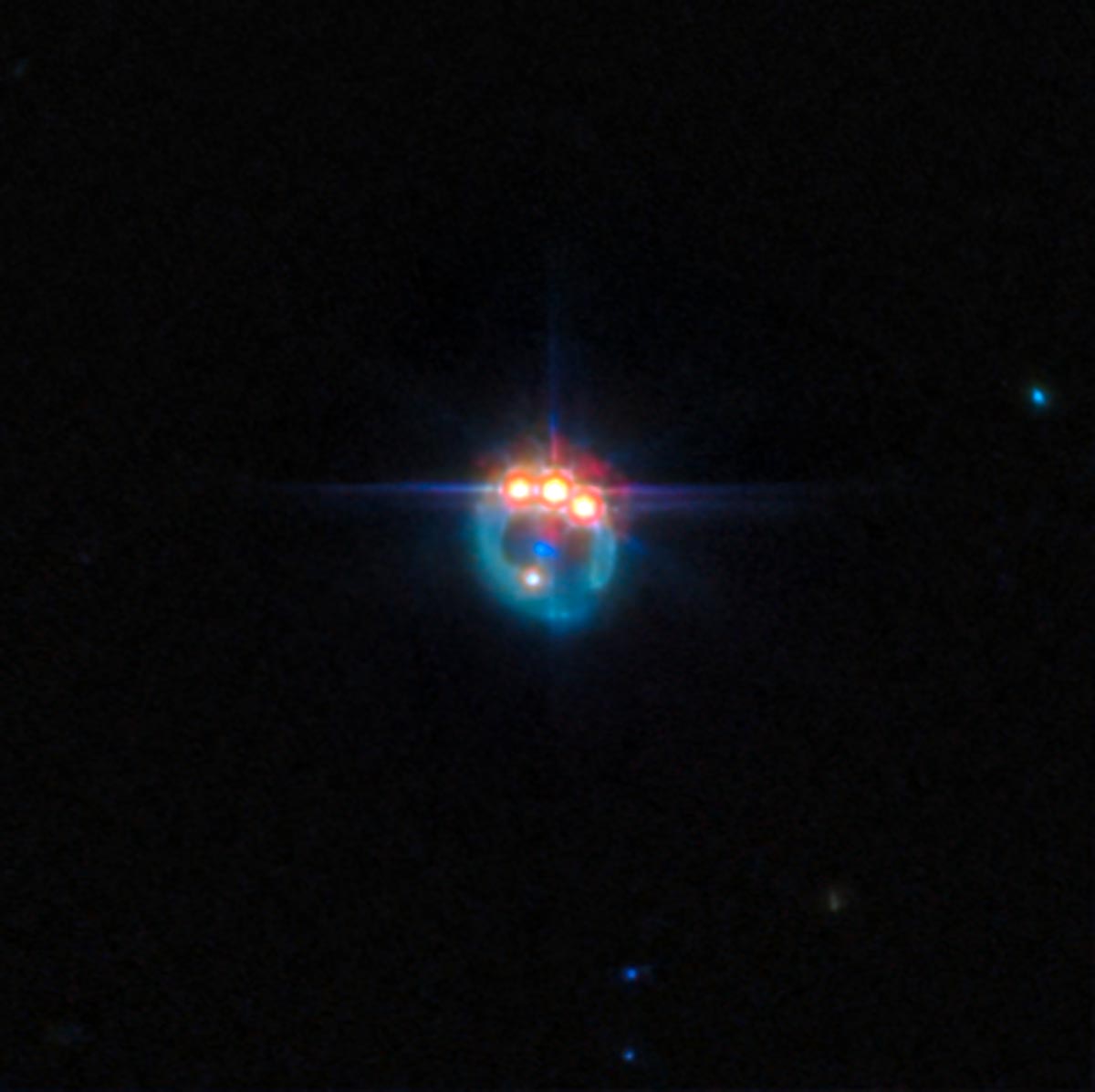
    This James Webb Space Telescope image of quasar RX J1131-1231 highlights gravitational lensing, magnifying the quasar to allow detailed study of its properties and the surrounding dark matter. X-ray emissions suggest the black hole is rapidly spinning, likely due to galaxy mergers. Credit: ESA/Webb, NASA & CSA, A. Nierenberg

    Webb’s image of RX J1131-1231 uses gravitational lensing to explore the quasar’s black hole and dark matter, revealing details about its growth and the universe’s mass composition.

    This new James Webb Space Telescope image features the gravitational lensing of the quasar known as RX J1131-1231, located roughly six billion light-years from Earth in the constellation Crater. It is considered one of the best-lensed quasars discovered to date, as the foreground galaxy smears the image of the background quasar into a bright arc and creates four images of the object.

    Gravitational lensing, first predicted by Einstein, offers a rare opportunity to study regions close to the black hole in distant quasars, by acting as a natural telescope and magnifying the light from these sources. All matter in the Universe warps the space around itself, with larger masses producing a stronger effect. Around very massive objects, such as galaxies, light that passes close by follows this warped space, appearing to bend away from its original path by a clearly visible amount. One of the consequences of gravitational lensing is that it can magnify distant astronomical objects, letting astronomers study objects that would otherwise be too faint or far away.
    Quasar RX J1131-1231
    The James Webb Space Telescope has captured an image of the quasar RX J1131-1231, which is located six billion light-years away and demonstrates the effects of gravitational lensing, magnifying the distant quasar into a bright arc and multiple images. Credit: ESA/Webb, NASA & CSA, A. Nierenberg

    Measurements of the X-ray emission from quasars can provide an indication of how fast the central black hole is spinning and this gives researchers important clues about how black holes grow over time. For example, if a black hole grows primarily from collisions and mergers between galaxies, it should accumulate material in a stable disc, and the steady supply of new material from the disc should lead to a rapidly spinning black hole. On the other hand, if the black hole grew through many small accretion episodes, it would accumulate material from random directions. Observations have indicated that the black hole in this particular quasar is spinning at over half the speed of light, which suggests that this black hole has grown via mergers, rather than pulling material in from different directions.

    This image was captured with Webb’s MIRI (Mid-Infrared Instrument) as part of an observation program to study dark matter. Dark matter is an invisible form of matter that accounts for most of the Universe’s mass. Webb’s observations of quasars are allowing astronomers to probe the nature of dark matter at smaller scales than ever before.

    Never miss a breakthrough: Join the SciTechDaily newsletter.
    Follow us on Google and Google News.

    Astronomy European Space Agency James Webb Space Telescope Popular
    Share. Facebook Twitter Pinterest LinkedIn Email Reddit

    Related Articles

    Webb Reveals What Happens When a Sun Like Ours Dies

    Webb Space Telescope’s Infrared Universe: A New Window to the Cosmos

    Got it! Gaia Observatory Snaps Photo of James Webb Space Telescope at L2

    Webb Space Telescope: Uncovering Hidden Parts of Our Solar System

    Webb Space Telescope Placed on Top of Ariane 5 Rocket in Preparation for Launch

    $10 Billion Webb Space Telescope Arrives at Europe’s Spaceport

    NASA’s $10 Billion New Observatory: James Webb Space Telescope Gets a Launch Date

    First James Webb Space Telescope General Observer Scientific Programs Selected

    Comparing the Hubble and James Webb Space Telescopes: From Ultraviolet to Infrared

    Leave A Reply Cancel Reply

    • Facebook
    • Twitter
    • Pinterest
    • YouTube

    Don't Miss a Discovery

    Subscribe for the Latest in Science & Tech!

    Trending News

    JWST Finds a “Star” 100 Billion Times Brighter Than Any Star Should Be

    Scientists Find a Hidden Biological Link Across Different Forms of Autism

    Astronomers Discover a Ghostly River of Stars That Could Reveal Dark Matter

    Why Is Colorectal Cancer Rising in People Under 50? New Clues Point to the Environment

    Quantum Fluctuations Break a Crystal’s Symmetry Rules

    Why Does an Irregular Heartbeat Strike 40 Years Early in Some People?

    Scientists Reveal How ADHD Could Fuel Creative Thinking

    Scientists Find Just 3 Minutes of Sprinting Can Transform Blood Chemistry

    Follow SciTechDaily
    • Facebook
    • Twitter
    • YouTube
    • Pinterest
    • Newsletter
    • RSS
    SciTech News
    • Biology News
    • Chemistry News
    • Earth News
    • Health News
    • Physics News
    • Science News
    • Space News
    • Technology News
    Recent Posts
    • AI Decodes a Hidden DNA Signal Linked to Disease-Causing Mutations
    • Billions of Invasive Fish Have Taken Over the Great Lakes. Scientists Say We Can Still Stop Their Next Invasion
    • Scientists Turn Red Strawberries White With a Single Gene Edit
    • NASA’s Artemis II Crew Flew Farther Than Any Humans Ever. Now They’re Being Honored
    • The Sun’s Corona Usually Looks White. In Spain, It Turned Gold
    Copyright © 1998 - 2026 SciTechDaily. All Rights Reserved.
    • Science News
    • About
    • Contact
    • Editorial Board
    • Privacy Policy
    • Terms of Use

    Type above and press Enter to search. Press Esc to cancel.